Nanosoccer debuts at RoboCup 2007
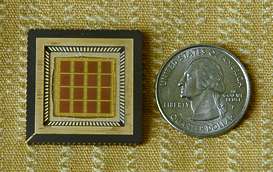
Imagine a mechanical Pelé or David Beckham six times smaller than an amoeba playing with a “soccer ball” no wider than a human hair on a field that can fit on a grain of rice. Purely science fiction? Not anymore.
The U.S. Department of Commerce’s National Institute of Standards and Technology (NIST) organizes the first nanoscale soccer games at the 2007 RoboCup in Atlanta, Ga., on July 7-8, 2007.
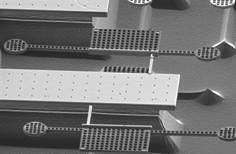
RoboCup is an annual international competition designed to foster innovations and advances in artificial intelligence and intelligent robotics by using the game of soccer as a testing ground. NIST hopes that a competition between the smallest robots in RoboCup history will show the feasibility and accessibility of technologies for fabricating MicroElectroMechanical Systems (MEMS), tiny mechanical devices that are built onto semiconductor chips and are measured in micrometers (millionth of a meter).
The 2007 RoboCup features six competition leagues: Four-Legged, Humanoid, Middle Size, Small Size, Simulation and Rescue Robot. RoboCup and NIST are jointly organizing this year’s nanosoccer competition as a demonstration event with plans for it to become the Nanogram League in 2008. Five teams are entered in the Nanogram Demonstration Competition: two from Carnegie Mellon University (Pittsburgh, Pa.), and one each from the U.S. Naval Academy (Annapolis, Md.), the Swiss Federal Institute of Technology (Zurich, Switzerland) and Simon Fraser University (Burnaby, British Columbia, Canada).
The soccer nanobots (nanoscale robots) operate under an optical microscope, are controlled by remote electronics using visual feedback and are viewed on a monitor. While they are a few tens of micrometers to a few hundred micrometers long, the robots are considered “nanoscale” because their masses range from a few nanograms to a few hundred nanograms.
To win the competition, a nanobot must be fast, agile and capable of manipulating objects. These abilities will be tested in three events: a two-millimeter dash in which each nanobot seeks the best time for a goal-to-goal sprint across the playing field; a slalom drill where the path between goals is blocked by "defenders" (polymer posts) and a ball handling drill that requires robots to “dribble” as many “nanoballs” (microdisks with the diameter of a human hair) as possible into the goal within a 3-minute period.
Video: Click here for video of Swiss nanosoccer robot scoring goals with nanoball (microdisk) (AVI file).
Source: NIST


