Sounds of Star Death Near Middle C
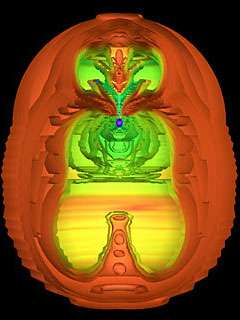
Scientists have made the astonishing discovery that sound might drive supernovae explosions. Their computer simulations say that dying stars pulse at audible frequencies -- for instance, at about the F-note above middle C -- for a split second before they blow up.
Researchers in the 1960s began using computer models to test ideas about what, exactly, causes stars to explode. But mathematical simulations have so far failed to satisfactorily explain the inner workings of nature's most spectacular blasts.
Neutrinos -- subatomic particles widely thought to power supernovae explosions -- don't seem to be energetic enough to do the job, especially for more massive stars. More sophisticated models that include convective motion work a bit better, but not well enough.
Adam Burrows of The University of Arizona and colleagues at UA's Steward Observatory, Hebrew University, and Germany's Max Planck Institute (Potsdam) have developed computer models that simulate the full second or more of star death, from the dynamics of core collapse through supernova explosion. Their two-dimensional computer models allow for the fact that supernovae outbursts are not spherical, symmetrical events.
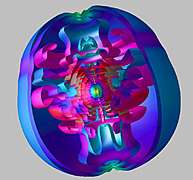
A supernova is a massive star that has burned for 10 million to 20 million years and developed a hot, dense 'white dwarf' star about the size of Earth at its core. When the white dwarf reaches a critical mass (about 1.5 times the mass of the sun), it collapses and creates a spherical shock wave, all within less than half a second before the star would explode as a supernova.
However, in all the best recent simulations, the shock wave stalls. So theorists have focused their work on what might revive the shock wave into becoming a supernova explosion.
According to Burrow's new results, part of the problem is that other computer models don't run long enough. His team's detailed models involve a million steps, or about five times as many as typical models that calculate only the first few hundred milliseconds of supernovae events. Burrows team's simulations also characterize the natural motion of a supernova core, something that other detailed models do not.
"Our simulations show that the inner core starts to execute pulsations," Burrows said. "And they allow us to follow the development to explosion for a longer time than other models do. They show that after about 500 milliseconds, the inner core begins to vibrate wildly. And after 600, 700 or 800 milliseconds, this oscillation becomes so vigorous that it sends out sound waves. In these computer runs, it's these sound waves that actually cause the star to explode, not the neutrinos."
He added, "We were quite sure when we started seeing this phenomenon that we were seeing sound waves, but it was so unexpected that we kept rechecking and retesting our results."
The team has used their models to make billions of calculations on computer clusters in the UA astronomy department, at Berkeley's supercomputer center and elsewhere, checking their analysis for the past year. They are publishing the research in the Astrophysical Journal. Their research is funded by the National Science Foundation, the Department of Energy, and the Joint Institute for Nuclear Astrophysics.
The team got a clear picture of what likely happens by making movies from their simulations. Burrows has posted the movies on his Website at zenith.as.arizona.edu/~burrows/briley
Collapsing material falls lopsidedly onto the inner core and soon excites oscillations at specific frequencies in the simulations. Within hundreds of milliseconds, the inner core vibrations become so intense that they actually generate sound waves. Typical sound frequencies are about 200 to 400 hertz, in the audible range bracketing middle C.
"Sound also generates pressure, which pushes the exciting streams of infalling matter to the opposite side of the core, further driving the core oscillations in a runaway process," Burrows said. "The sound waves reinforce the shock wave (created by the collapsed star) until it finally explodes aspherically."
Burrows said that others who study supernova explosions in computer experiments will be skeptical of his team's results -- and should be.
"This is such a break from 40 years of traditional thinking that one should be cautious trumpeting it," he said. "Nevertheless, this is provocative and interesting. It would open up many new possibilities and perhaps solve a long-standing problem of what triggers supernovae explosions."
Source: University of Arizona


