A Webb in a golden cage
Mar 06, 2013 by Rob Gutro
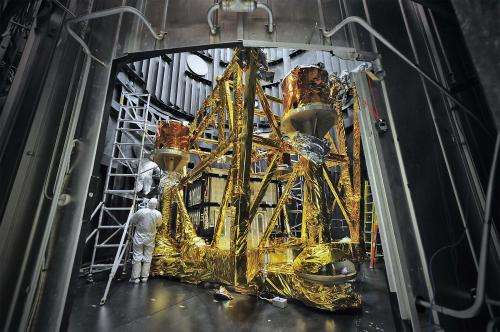
Credit: NASA/Chris Gunn

(Phys.org) —This photograph shows support structures wrapped in gold thermal blankets that look like a golden cage. The structure is housed within the vacuum chamber called the Space Environment Simulator, or SES. The SES is located at NASA's Goddard Space Flight Center in Greenbelt, Md., where components of the James Webb Space Telescope are being tested to withstand the extreme temperatures of space.

The entire structure is a system of supports and thermal control devices for the series of thermal tests. Visible in the photo is the lower GESHA (Ground Environmental SES Hardware Assembly).The box in the center photo is a group of four LN2 (liquid nitrogen) panels that are designed to keep it at around 100 kelvins. The panels surround the primary mirror of the OTE ( Element) Simulator or OSIM.

When NASA's Webb telescope launches in 2018, it will fly a million miles from Earth and enable scientists on Earth to see the most detailed pictures of the universe.

Explore further: 'Giant erector set' supports Webb Telescope test component

More information: For more information about NASA's James Webb Space Telescope, visit: www.jwst.nasa.gov

add to favorites email to friend print save as pdf

Related Stories

The Webb Telescope's 'Golden Spider'

Aug 24, 2012

What looks like a giant golden spider weaving a web of cables and cords, is actually ground support equipment, including the Optical Telescope Simulator (OSIM), for the James Webb Space Telescope. OSIM's ...

NASA's Webb Telescope components meet 'Big Red'

Feb 27, 2013

(Phys.org)—"Big Red" isn't a golden retriever or a NASA engineer, it's the nickname for a small chamber that helps ensure equipment can withstand very cold temperatures that would be experienced in space.

Scanning Webb's surrogate eye

Jul 06, 2012

(Phys.org) -- Engineer Erin Wilson adds aluminum tape to electrical cables to protect them from the cold during environmental testing of special optical equipment. These tests will verify the alignment of ...

Webb Telescope's 'wormholes' in the clean room

Oct 05, 2012

(Phys.org)—This photo gives a "worms eye" view of a robot arm holding a surrogate or simulated mirror segment (black hexagonal shape) for NASA's James Webb Space Telescope. The arm is placing the surrogate ...

Recommended for you

NASA head views progress on asteroid lasso mission

2 hours ago

Surrounded by engineers, NASA chief Charles Bolden inspected a prototype spacecraft engine that could power an audacious mission to lasso an asteroid and tow it closer to Earth for astronauts to explore.

Ecuador satellite collides with Russian space junk

2 hours ago

A small Ecuadoran satellite collided in orbit with the remains of a Russian rocket, but it is too soon to know how much damage it might have sustained, Quito's space agency said Thursday.

Forecast for Titan: Wild weather could be ahead

May 22, 2013

(Phys.org) —Saturn's moon Titan might be in for some wild weather as it heads into its spring and summer, if two new models are correct. Scientists think that as the seasons change in Titan's northern hemisphere, ...

SDO observes mid-level solar flare

May 22, 2013

UPDATE 16:30 p.m. EDT: The M7-class flare was also associated with a coronal mass ejection or CME, another solar phenomenon that can send billions of tons of particles into space. While this CME was not Ea ...

User comments : 0

More news stories

Hubble reveals the ring nebula's true shape

(Phys.org) —The Ring Nebula's distinctive shape makes it a popular illustration for astronomy books. But new observations by NASA's Hubble Space Telescope of the glowing gas shroud around an old, dying, ...

NASA head views progress on asteroid lasso mission

Surrounded by engineers, NASA chief Charles Bolden inspected a prototype spacecraft engine that could power an audacious mission to lasso an asteroid and tow it closer to Earth for astronauts to explore.

A hidden population of exotic neutron stars

(Phys.org) —Magnetars – the dense remains of dead stars that erupt sporadically with bursts of high-energy radiation - are some of the most extreme objects known in the Universe. A major campaign using ...

Future doctors unaware of their obesity bias

Two out of five medical students have an unconscious bias against obese people, according to a new study by researchers at Wake Forest Baptist Medical Center. The study is published online ahead of print in the Journal of ...

WHO: Scientific red tape mars efforts vs. virus

International efforts to combat a new pneumonia-like virus that has now killed 22 people are being slowed by unclear rules and competition for the potentially profitable rights to disease samples, the head ...