Warmer climate boosts northern crops but the bad soon outweighs the good

Mar 14, 2013 by Sunanda Creagh, The Conversation
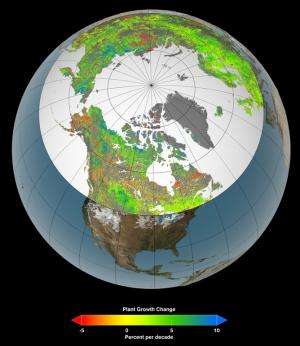
The study showed increased plant growth over a 30 year period in northern areas of the Earth. Credit: NASA's Goddard Space Flight Center Scientific Visualization Studio

Climate change is creating warmer growing conditions in parts of the Earth's northern regions, a new study has found, but experts warn that drought and heat wil soon cancel out the agricultural benefits.

The international study, published in the journal Nature Climate Change, analysed NASA satellite data and 30 years of records for 26 million square kilometres between the Arctic Ocean and 45 degrees north latitude.

"Higher northern latitudes are getting warmer, and the duration of snow cover are diminishing, the growing season is getting longer and plants are growing more," Ranga Myneni of Boston University's Department of Earth and Environment, said in a media release on the NASA website.

"In the north's Arctic and boreal areas, the characteristics of the seasons are changing, leading to great disruptions for plants and related ecosystems."

Of the area studied, up to 41% had experienced increased plant growth since 1982.

While warming climate may boost crop conditions in some regions, it also increases the risk of drought, and pest outbreaks, the study found.

Dr Daniel Rodriguez, Senior Research Fellow at the University of Queensland's Centre for Plant Science said the results of the study accord with what climate change scientists have been saying for some time.

"The good news is that this study provides clear evidence on modelled results present in previous reports," he said adding that the warmer conditions had boosted Denmark's commercial and doubled grain yields in Finland.

"The bad news is that this confirms that climate change is happening very quickly, as expected, and that even though some regions are going to have increases in productivity (though nothing is said here about changes in variability), in other places we expect these changes to be highly detrimental to food production," said Dr Rodriguez.

"In the same issue of Nature Climate Change other authors indicate that for North America's maize production, strong negative yield responses to the accumulation of temperatures over 30 degrees Celsius could also be expected as a consequence of increased air dryness."

Dr Andrew Ash, Director of the CSIRO's Climate Adaptation Flagship, said the early stages of climate change could also lead to increased crop productivity in some parts of Australia.

"But then a combination of declining rainfall projected for the mid-latitudes of Australia and increasing temperatures will negatively impact crop growth. You can initially get some good news but ultimately it's a negative," he said.

Within a couple of decades, the benefits of warmer growing conditions and increased carbon dioxide concentrations would be quickly outweighed by declining rainfall and heat stress on grain quality, he said.

"The big unknown in all of this is other factors like pests, disease and fire. There are still a great many uncertainties around the effects of but very few of the likely scenarios are positive for agriculture," he said.

Explore further: Climate change to lengthen growing season

add to favorites email to friend print save as pdf

Related Stories

Climate change to lengthen growing season

Oct 10, 2012

Across much of Norway, the agricultural growing season could become up to two months longer due to climate change. A research project has been studying the potential and challenges inherent in such a scenario.

New Ice Age maps point to climate change patterns

Jan 19, 2009

(PhysOrg.com) -- New climate maps of the Earth’s surface during the height of the last Ice Age support predictions that northern Australia will become wetter and southern Australia drier due to climate change.

Amplified greenhouse effect shaping North into South

Mar 10, 2013

An international team of 21 authors from 17 institutions in seven countries has just published a study in the journal Nature Climate Change showing that, as the cover of snow and ice in the northern latitu ...

Recommended for you

Indonesia to use rain-making technology to stop fires

27 minutes ago

Indonesia plans to use weather changing technology to try to unleash torrents of rain and extinguish raging fires on Sumatra island that have cloaked neighbouring Singapore in thick haze, an official said ...

The contribution of particulate matter to forest decline

1 hour ago

Air pollution is related to forest decline and also appears to attack the protecting wax on tree leaves and needles. Bonn University scientists have now discovered a responsible mechanism: particulate matter ...

World Bank warns global warming woes closing in

4 hours ago

The World Bank on Wednesday warned that severe hardships from global warming could be felt within a generation, with a new study detailing devastating impacts in Africa and Asia.

User comments : 12

Adjust slider to filter visible comments by rank

Display comments: newest first

jamesbraginton
1.5 / 5 (8) Mar 14, 2013
Give it up.
ubavontuba
1.7 / 5 (12) Mar 16, 2013
Warmer climate boosts northern crops but the bad soon outweighs the good
So they're saying the observed phenomena is that global warming has been good for the ecosystem, yet insist it's bad news anyway? Really?

What is wrong with these people?

deepsand
3 / 5 (14) Mar 16, 2013
Warmer climate boosts northern crops but the bad soon outweighs the good
So they're saying the observed phenomena is that global warming has been good for the ecosystem, yet insist it's bad news anyway? Really?

What is wrong with these people?

A question that you should be asking of yourself.
ubavontuba
1.8 / 5 (10) Mar 16, 2013
A question that you should be asking of yourself.
What's wrong with you?

Why is an improved ecosystem a bad thing?

deepsand
2.5 / 5 (11) Mar 16, 2013
What's wrong with you?

A question that you should be asking of yourself.
runrig
3.1 / 5 (7) Mar 16, 2013
What's wrong with you?

Why is an improved ecosystem a bad thing?


Selective reading/interpretation.
From the article
"Within a couple of decades, the benefits of warmer growing conditions and increased carbon dioxide concentrations would be quickly outweighed by declining rainfall and heat stress on grain quality"
ubavontuba
1.9 / 5 (9) Mar 16, 2013
What's wrong with you?

Why is an improved ecosystem a bad thing?


Selective reading/interpretation.
From the article
"Within a couple of decades, the benefits of warmer growing conditions and increased carbon dioxide concentrations would be quickly outweighed by declining rainfall and heat stress on grain quality"
There's nothing selective about it. The observed fact is, what warming we've had, has been beneficial. The part you refer to is nothing more than Chicken Little whining.

deepsand
2.2 / 5 (10) Mar 17, 2013
What's wrong with you?

Why is an improved ecosystem a bad thing?


Selective reading/interpretation.
From the article
"Within a couple of decades, the benefits of warmer growing conditions and increased carbon dioxide concentrations would be quickly outweighed by declining rainfall and heat stress on grain quality"
There's nothing selective about it. The observed fact is, what warming we've had, has been beneficial. The part you refer to is nothing more than Chicken Little whining.

This from a chicken shit whiner.
antigoracle
1 / 5 (5) Mar 18, 2013
What's wrong with you?

Why is an improved ecosystem a bad thing?


Selective reading/interpretation.
From the article
"Within a couple of decades, the benefits of warmer growing conditions and increased carbon dioxide concentrations would be quickly outweighed by declining rainfall and heat stress on grain quality"
There's nothing selective about it. The observed fact is, what warming we've had, has been beneficial. The part you refer to is nothing more than Chicken Little whining.

This from a chicken shit whiner.
-- deepsandTurd

I now anoint thee ReTurd.
deepsand
2 / 5 (8) Mar 18, 2013
What's wrong with you?

Why is an improved ecosystem a bad thing?


Selective reading/interpretation.
From the article
"Within a couple of decades, the benefits of warmer growing conditions and increased carbon dioxide concentrations would be quickly outweighed by declining rainfall and heat stress on grain quality"
There's nothing selective about it. The observed fact is, what warming we've had, has been beneficial. The part you refer to is nothing more than Chicken Little whining.

This from a chicken shit whiner.
-- deepsandTurd

I now anoint thee ReTurd.

As AnalOrifice, you no doubt know a great deal about fecal matter.
antigoracle
1 / 5 (5) Mar 19, 2013
What's wrong with you?

Why is an improved ecosystem a bad thing?


Selective reading/interpretation.
From the article
"Within a couple of decades, the benefits of warmer growing conditions and increased carbon dioxide concentrations would be quickly outweighed by declining rainfall and heat stress on grain quality"
There's nothing selective about it. The observed fact is, what warming we've had, has been beneficial. The part you refer to is nothing more than Chicken Little whining.

This from a chicken shit whiner.
-- deepsandTurd

I now anoint thee ReTurd.

As AnalOrifice, you no doubt know a great deal about fecal matter.
-- deepsandReTurd

I hereby anoint thee FecalMatter
deepsand
2.1 / 5 (7) Mar 20, 2013
What's wrong with you?

Why is an improved ecosystem a bad thing?


Selective reading/interpretation.
From the article
"Within a couple of decades, the benefits of warmer growing conditions and increased carbon dioxide concentrations would be quickly outweighed by declining rainfall and heat stress on grain quality"
There's nothing selective about it. The observed fact is, what warming we've had, has been beneficial. The part you refer to is nothing more than Chicken Little whining.

This from a chicken shit whiner.
-- deepsandTurd

I now anoint thee ReTurd.

As AnalOrifice, you no doubt know a great deal about fecal matter.
-- deepsandReTurd

I hereby anoint thee FecalMatter

Another steaming heap from AnalOrifice.

More news stories

Siberian caves warn of permafrost meltdown

Climate records captured in Siberian caves suggest 1.5 degrees of warming is enough to trigger thawing of permafrost, according to a paper to be given at the Geological Society of London on 27 June.

Multiview 3-D photography made simple

Computational photography is the use of clever light-gathering tricks and sophisticated algorithms to extract more information from the visual environment than traditional cameras can.