New river-routing model improves simulations of water movement within the Earth's system
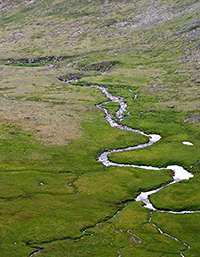
A new river-routing model improves computer simulations of the magnitude and timing of water flow through the landscape and into the ocean, thanks to the work of a research team led by Dr. Ruby Leung at Pacific Northwest National Laboratory. Designed to work in tandem with land and Earth systems models, this new tool is better at simulating water flow at different scales than some widely used large-scale routing models. The model also can simulate river dynamics, including variations in depth and the velocity of river flow.
Water is essential for households, power generation and agriculture. Resource managers need tools to understand how water flows through the landscape, especially as water availability is affected by climate change. Scientists tackled a new way to model how water travels through and on the landscape and joined their simulations with established land and Earth system models to better understand a wide range of water-land interactions. The model serves as a cornerstone for integrating and understanding impacts of human activities, such as irrigation and reservoir operation, on the water cycle at a regional or global scale.
In this study, PNNL researchers developed the MOdel for Scale Adaptive River Transport (MOSART), a new large-scale river routing model. MOSART improves the magnitude and timing of river flow simulations and provides a framework for studying the influence of dams and reservoirs for water management decision-making. The research developed and tested a new physically-based river routing model that improves simulations of river flow over the Pacific Northwest region, thus supporting better water management decision-making.
The team applied MOSART across local, regional and global scales with explicit treatment of sub-grid and in-channel water flow and dynamics. Designed to work within each spatial model grid unit, they tracked surface water runoff, first routed across ground surfaces, and then discharged along with subsurface runoff into a "tributary sub-network" before entering the main river channel. The spatial units are thus linked via routing through the main channel network, which is constructed in a consistent way across different spatial resolutions. All model parameters are physically based, and only a small subset requires calibration.
The team tested MOSART on a large river basin at different spatial resolutions and evaluated their model output using observed streamflow measurements from stream gauge stations. MOSART was compared to two other routing models used with land surface models. Their results compared well with consistent performance at multiple resolutions.
Additional model evaluations used channel velocities from field measurements or a hydraulic model at various locations. These results showed MOSART could produce seasonal variation and channel velocity magnitudes at different resolutions.
PNNL researchers are conducting further studies based on MOSART. The team has incorporated MOSART into the Community Land Model and is testing it at the global scale. In addition, they developed and are testing a reservoir operation model to build on MOSART.
More information: Li, H. et al. 2013. A Physically Based Runoff Routing Model for Land Surface and Earth System Models. Journal of Hydrometeorology. DOI:10.1175/JHM-D-12-015.1
Provided by Pacific Northwest National Laboratory


