Milestone for European navigation system
Mar 12, 2013
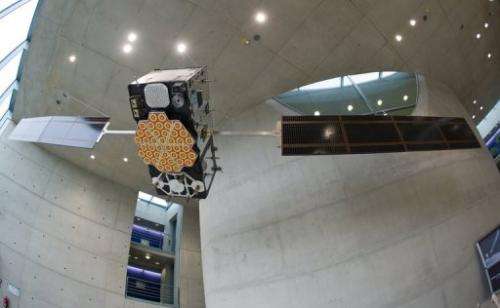
A model of the Galileo satellite hangs at the German Aerospace Center in Oberpfaffenhofen, near Wessling, Bavaria, on October 20, 2011. Galileo, Europe's rival to the US Global Positioning System (GPS), passed a milestone Tuesday when it pinpointed its first-ever ground location, the European Space Agency said.

Galileo, Europe's rival to the US Global Positioning System (GPS), passed a milestone Tuesday when it pinpointed its first-ever ground location, the European Space Agency said.

The spot—ESA's research and technology centre in Noordwijk in the Netherlands—was determined with an accuracy of between 10 and 15 metres (32 to 49 feet), using four satellites already in orbit.

"This is the first time ever that Europe has been able to determine a position on the ground using only its own independent navigation system," Galileo project manager Javier Benedicto said.

"This fundamental step confirms the works as planned," added an ESA statement.

A minimum of four satellites are required to fix a position in three dimensions—longitude, latitude and altitude.

The first two Galileo satellites were launched in October 2011, and two more last year.

The system's accuracy will improve as more infrastructure is added, said the agency.

ESA is set to launch four more Galileo satellites this year, contributing to an ultimate constellation of 27 orbiters and three spares.

Early should be available from the end of next year.

Explore further: Key flight for Europe's GPS is cleared for launch

add to favorites email to friend print save as pdf

Related Stories

Soyuz rocket launches two Galileo satellites

Oct 13, 2012

A Soyuz rocket launched two Galileo satellites into orbit on Friday, marking a crucial step for Europe's planned navigation system, operator Arianespace announced.

Two years in space for Galileo satellite

Dec 19, 2007

On 28 December, it will be two years since GIOVE-A - the first Galileo satellite - was launched by a Soyuz rocket from Baikonur, in Kazakhstan. This satellite demonstrates the progress Europe has made in setting ...

Recommended for you

Dish won't submit revised bid for Sprint

10 hours ago

Satellite TV operator Dish Network Corp. said Tuesday it would not submit a revised bid for Sprint, leaving the path open for the wireless carrier to accept what it already considers a superior offer from Japan's Softbank.

Google launches Internet-beaming balloons

Jun 15, 2013

Wrinkled and skinny at first, the translucent, jellyfish-shaped balloons that Google released this week from a frozen field in the heart of New Zealand's South Island hardened into shiny pumpkins as they ...

Obama acts to free up spectrum to ease crunch

Jun 14, 2013

US President Barack Obama moved Friday to free up more broadcast spectrum used by federal agencies to help meet the surging demand from smartphones and other mobile devices.

User comments : 1

Adjust slider to filter visible comments by rank

Display comments: newest first

baudrunner
not rated yet Mar 12, 2013
They should make for interesting competition. Who can provide the greatest accuracy, the American system, or the European system, once all of its satellites are in place and their clocks properly calibrated? This should be fun.

More news stories

Tech companies eye security that goes beyond passwords

In late February, a thief or thieves cracked into Evernote's digital vault filled with log-ins, passwords and email addresses belonging to 50 million users. It was a shocking cyberattack considering the Redwood City, Calif., ...

Multiview 3-D photography made simple

Computational photography is the use of clever light-gathering tricks and sophisticated algorithms to extract more information from the visual environment than traditional cameras can.

Metamorphosis of moon's water ice explained

Using data gathered by NASA's Lunar Reconnaissance Orbiter (LRO) mission, scientists believe they have solved a mystery from one of the solar system's coldest regions—a permanently shadowed crater on the ...