Boys are right-handed, girls are left...
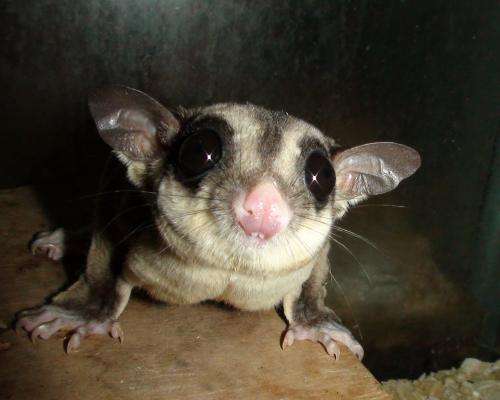
Well at least this is true for sugar gliders (Petaurus breviceps) and grey short-tailed opossums (Monodelphis domestica), finds an article in BioMed Central's open access journal BMC Evolutionary Biology, and shows that handedness in marsupials is dependent on gender. This preference of one hand over another has developed despite the absence of a corpus collosum, the part of the brain which in placental mammals allows one half of the brain to communicate with the other.
Many animals show a distinct preference for using one hand/paw/hoof over another. This is often related to posture – an animal is more likely to show manual laterality if it is upright, related to the difficulty of the task, more complex tasks show a handed preference, or even with age. As an example of all three: crawling human babies show less hand preference than toddlers.
Some species also show a distinct sex effect in handedness but among non-marsupial mammals this tendency is for left-handed males and right-handed females. In contrast researchers from St Petersburg State University show that male quadruped marsupials, such as who walk on all fours, tend to be right-handed while the females are left-handed, especially as tasks became more difficult.
Dr Yegor Malashichev from Saint Petersburg State University who led this study explained why they think this has evolved, "Marsupials do not have a corpus callosum – which connects the two halves of the mammalian brain together. Reversed sex related handedness is an indication of how the marsupial brain has developed different ways of the two halves of the brain communicating in the absence of the corpus callosum."
More information: Forelimb preferences in quadrupedal marsupials and there implications for laterality evolution in mammals, Andrey Giljov, Karina Karenina and Yegor Malashichev, BMC Evolutionary Biology (in press)
Journal information: BMC Evolutionary Biology
Provided by BioMed Central


