Computer scientists prevent data theft on smartphones and tablet computers
Feb 27, 2013
Some mobile applications on web-enabled mobile phones and tablet computers spy on personal data. Computer scientists from Saarbrücken prevent this through a new approach. The freely available app attacks the program code of the digital spies. Credit: Bellhäuser - das bilderwerk

Some mobile applications on web-enabled mobile phones and tablet computers spy on personal data. Computer scientists from Saarbrücken prevent this through a new approach. Its chief attraction: For the protection to work, it is not necessary to identify the suspicious programs in advance, nor must the operating system be changed. Instead, the freely available app attacks the program code of the digital spies. The researchers present the app at Cebit 2013 in Hanover.

"Malicious Android apps are becoming a mass plague" is the headline of a study published by a German software company for anti-virus programs in recent days. That this is not just a is confirmed by the analysis of the governmental supported "Stiftung Warentest" . In May last year, it categorized 37 popular apps as "critical" for the user's privacy.

"I am not surprised. My smartphone knows everything about me, starting with my name, my phone number, my e-mail address, my interests, up to my current location," explains computer science professor Michael Backes, who manages the Center for IT-Security, Privacy and Accountability at Saarland University.

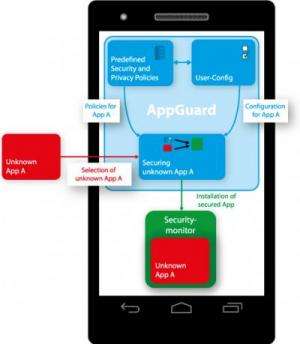
To prevent smartphones and tablets turning into digital spies the researchers have developed a new method which works for the Android operating system. "Similar to a screening line, the method scans every selected app installed on the smartphone and indicates its real behavior: Accessing your private contacts, establishing a connection to the internet and checking your position", Backes explains. The user can now revoke or grant privileges to the respective app at any time. A company founded by Backes used the published method to develop an app named "SRT Appguard". It runs problem-free on Android 2.0 and higher. It is also now guaranteed that the guarded apps receive updates from the Play Store.

For their approach, the Saarbrücken researchers use the fact that the Android apps, written in the programming language Java, run in a so-called virtual machine. Compared to other smartphone operating systems, a running app can access the storage of Android's virtual machine. That's when SRT Appguard comes into play. Before the suspicious app starts, Appguard scans the storage of the virtual machine to detect security-critical functions – identified by the IT-security experts from Saarbrücken. It does not manipulate the bytecode anymore. Instead, it directs the function call within the virtual machine to the security monitor, which observes the suspicious method calls and can even block them.

Explore further: New approach uncovers data abuse on mobile end devices

More information: Michael Backes, Sebastian Gerling, Christian Hammer, Matteo Maffei and Philipp von Styp-Rekowsky: The Android Monitor – Real-time policy enforcement for third-party applications
www.infsec.cs.uni-saarland.de/projects/android-monitor/android-monitor.pdf

Download of SRT Appguard from the software register Heise.de
www.heise.de/download/srt-appguard-1187469.html

add to favorites email to friend print save as pdf

Related Stories

Yahoo! helps find smartphone 'apps'

Jun 16, 2011

Yahoo! has begun helping people navigate the sea of applications available for Apple iPhones or mobile gadgets powered by Google-backed Android software.

Android users get malware with their apps

Mar 02, 2011

(PhysOrg.com) -- As new platforms make their way into the market there will always someone who is looking to exploit them for illegal or unethical ends. More proof of that fact has come today when Google was ...

Recommended for you

Mobile app to help fight against racism in France

12 hours ago

A French anti-racism association is launching a mobile application it hopes will help eradicate racist graffiti by enabling users to take photos of offensive tags, geo-locate them and get them removed.

Google Drive sports new view and scan enhancements

May 23, 2013

(Phys.org) —Google Drive has a new look and functions. The makeover in Google Drive features scanning and interface enhancements that put the user into "card" mode. The enhancements make it easy for the ...

Model will unlock mysteries of the voice

May 22, 2013

Swedish researchers are leading the development of the world's first comprehensive model of the human voice, which could contribute to better voice care, voice prosthetics, talking robots and teaching opportunities.

Patented system better secures digitally stored data

May 21, 2013

(Phys.org) —Arizona State University computer scientist Gail-Joon Ahn has been granted a U.S. patent for a novel identity management system that helps protect personal identity information stored on digital devices.

UC Davis startup changes listening experience

May 20, 2013

Fifteen years of research at the University of California, Davis, is being turned into commercial products by Dysonics, a startup company based in San Francisco. Since becoming the first "graduate" from the Engineering Translational ...

User comments : 0

More news stories

Google eyes emerging markets networks

Google has become deeply involved in a series of projects to build and operate wireless networks in emerging markets including sub-Saharan Africa and Southeast Asia, a report said Friday.

Facial-recognition technology proves its mettle

(Phys.org) —In a study that evaluated some of the latest in automatic facial recognition technology, researchers at Michigan State University were able to quickly identify one of the Boston Marathon bombing ...

Drones may violate international law

(Phys.org) —As President Obama gives a speech on national security—including defending U.S. use of drones to combat terrorism—Leila Sadat, JD, international law expert and professor of law at Washington University in ...

The long road to the 2000-watt society

The vision of a society in which each inhabitant of the earth manages to consume only 2000 watts has already been around for 15 years. During this time, there has been a steady increase in environmental awareness ...

Galaxies fed by funnels of fuel

(Phys.org) —Computer simulations of galaxies growing over billions of years have revealed a likely scenario for how they feed: a cosmic version of swirly straws.