Offspring for first captive-bred Philippine eagle
Feb 14, 2013
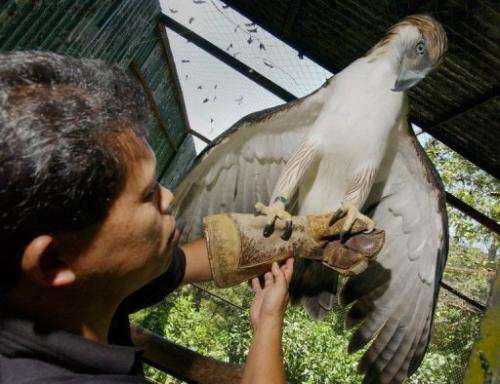
Pag-asa, the first Philippine eagle bred in captivity, is pictured on April 23, 2004 at the Philippine Eagle Foundation in the southern island of Mindanao. She has sired her first offspring, in what conservationists said Thursday was a small victory in efforts to save one of the world's rarest raptors.

The first Philippine eagle bred in captivity has sired her first offspring, in what conservationists said Thursday was a small victory in efforts to save one of the world's rarest raptors.

The bird was hatched after a dramatic wait on February 9 at the Philippine Foundation in the southern island of Mindanao, the group's executive director Dennis Salvador told AFP.

"This is a triumph for the Philippine Eagle, but there is still a long way to go to for these majestic creatures to grow in number in the wild," Salvador said.

"It (the bird) is in very good condition, although we had a very problematic hatch—we waited with baited breath for it to finally come out of the shell," he said.

The chick's mother is an eagle named Pag-asa (Hope) that was the first bred in captivity at the centre in 1992, Salvador said.

The Philippine eagle, or Pithecophaga jefferyi, found only in the country's vanishing forests, is the world's largest eagle and is considered "critically endangered".

With a distinctive shaggy and cream-coloured crest, the raptor grows to up to 3.35 feet (one metre) in length with a wing span of up to seven feet.

According to the foundation and the International Union for the Conservation of Nature, there are only about between 180 to 500 pairs in the wild, mostly in the lush jungles of Mindanao, the country's main southern island.

The new hatchling is only the 25th bred in captivity at the centre, which has a total 37 of the eagles.

It took about 48 hours for the chick to emerge from the shell from the time it began breaking its way out, Salvador said.

"This underscores the fact that breeding these birds in captivity remains difficult," he said. "We are certainly a long way off in coping with losses in the wild."

Conservationists said decreasing and hunting by humans either for sport or food were to blame for the decreasing numbers.

In 2012, a court fined a 26-year-old man some 2,300 dollars for shooting and then eating an eagle that had previously been cared for by the foundation, triggering an uproar.

Explore further: Front-row seats to climate change

add to favorites email to friend print save as pdf

Related Stories

Near-extinct Philippine eagle shot dead

Oct 07, 2011

An endangered Philippine eagle, one of only a few hundred left in the world, has been shot dead, a conservation group that had previously rescued the bird said Friday.

Trapping threatens near-extinct Philippine eagle

Apr 28, 2011

Conservationists raised alarm Thursday over the future of the near-extinct Philippine eagle after several maimed or diseased birds were retrieved from captivity over recent months.

New eagle crowding nesting eagle pair

Feb 18, 2008

A pair of bald eagles nesting in Virginia's Norfolk Botanical Garden are used to being visited by people, but now must deal with an interloping female eagle.

Endangered crocodiles released to fight extinction

Jan 27, 2011

Nineteen of the world's most critically endangered crocodiles were released Thursday into the wild in the Philippines as part of efforts to save the species from extinction, conservationists said.

Recommended for you

Front-row seats to climate change

15 hours ago

By day, insects provide the white noise of the South, but the night belongs to the amphibians. In a typical year, the Southern air hangs heavy from the humidity and the sounds of wildlife.

Captured in silken netting and sticky hairs

May 16, 2013

The great ecological success of spiders is often substantiated by the evolution of silk and webs. Biologists of the Kiel University and the University of Bern now found an alternative adaptation to hunting ...

User comments : 1

Adjust slider to filter visible comments by rank

Display comments: newest first

jyasmin_calub
not rated yet Feb 18, 2013
Correction: Pagasa (the father/sire) is male. The eaglet's mother is named Kalinawan.

More news stories

Front-row seats to climate change

By day, insects provide the white noise of the South, but the night belongs to the amphibians. In a typical year, the Southern air hangs heavy from the humidity and the sounds of wildlife.

Climate change may have little impact on tropical lizards

A new Dartmouth College study finds human-caused climate change may have little impact on many species of tropical lizards, contradicting a host of recent studies that predict their widespread extinction in a rapidly warming ...

US seizes Bitcoin operator accounts

US authorities seized the accounts of a Bitcoin digital currency exchange operator, claiming it was functioning as an "unlicensed money service business," court documents showed Friday.

Alaska volcano shoots ash 15,000 feet into the air

(AP)—One of Alaska's most restless volcanoes has shot an ash cloud 15,000 feet into the air in an ongoing eruption that has drawn attention from a nearby community but isn't expected to threaten air traffic.

Chinese, Indian airlines face EU pollution fines

Eight Chinese and two Indian airlines face fines of up to several million euros for not paying for their greenhouse gas emissions during flights within the bloc, the European Commission said on Friday.