20 NASA balloons studying the radiation belts
Feb 04, 2013
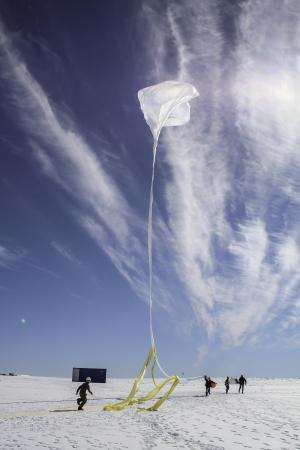
Scientists race through the Antarctic snow to launch one of 20 balloons as part of NASA's BARREL (Balloon Array for Radiation belt Relativistic Electron Losses) mission. Each balloon is equipped with instruments to help track how electrons from giant radiation belts surrounding Earth travel down magnetic field lines toward the poles. Credit: NASA/S. Spain

In the bright, constant sun of the Antarctic summer, a NASA-funded team is launching balloons. There are twenty of these big, white balloons, each of which sets off on a different day for a leisurely float around the South Pole to collect information about something far more speedy: the rain of particles that can precipitate out of two gigantic donuts around Earth known as the radiation belts.

The mission – called BARREL (Balloon Array for Losses) – is led by Dartmouth College in Hanover, N.H. BARREL works in conjunction with NASA's Van Allen Probes, two currently orbiting around Earth to study the belts, which are also known as the Van Allen Belts. Both the probes and the belts are named after James Van Allen who originally discovered them in 1958.

Together the two missions are trying to track where radiation goes when it escapes the belts – up or down? The charged particles within the belts can damage sensitive electronics on spacecraft like those used for global positioning systems and communications, and can be harmful to humans in space. (The electrons don't make it all the way to Earth, so pose no danger to those of us on the ground.) The Van Allen Probes are observing how the particles behave in the radiation belts themselves, while BARREL can watch to see how and when the particles course down magnetic fields toward the . Working together, the two missions will track how the particles move.

"We have daily phone calls from Antarctica with the Van Allen Probes team to coordinate," says Robyn Millan, the principal investigator for BARREL at Dartmouth. "We look at where their spacecraft are relative to the balloons and make decisions about what data to download from the spacecraft to compare to our data."

After they've launched their 20 balloons, the scientists will go home to analyze the vast amount of BARREL observations and compare it to the information collected by the probes. And then the team will get ready to do the process all over again with 20 more balloons next year.

In addition to Dartmouth, the BARREL mission is supported by scientists from University of California-Berkeley, the University of Washington and University of California-Santa Cruz. Field operations are being conducted at the British research station Halley VI and the South African research station, SANAE IV. In addition to NASA and National Science Foundation support, the campaigns are supported by the National Environmental Research Council in the United Kingdom and the South African National Space Agency (SANSA).

Explore further: Building 45 payloads for balloon mission

add to favorites email to friend print save as pdf

Related Stories

Building 45 payloads for balloon mission

May 30, 2012

Robyn Millan's lab is a little crowded at the moment. It overflows with electronics. And foam. And parachutes and aluminum frames and drills. Based at Dartmouth College in Hanover, NH, Millan and her students ...

Launching balloons in Antarctica

Feb 23, 2011

They nicknamed it the "Little Balloon That Could." Launched in December of 2010 from McMurdo Station in Antarctica, the research balloon was a test run and it bobbed lower every day like it had some kind of ...

The radiation belt storm probes

Aug 31, 2012

(Phys.org)—Since the dawn of the Space Age, mission planners have tried to follow one simple but important rule: Stay out of the van Allen Belts. The two doughnut-shaped regions around Earth are filled ...

New NASA mission ready to brave Earth's radiation belts

Aug 10, 2012

(Phys.org) -- NASA's Radiation Belt Storm Probes (RBSP) mission will send two spacecraft into the harsh environment of our planet's radiation belts. Final preparations have begun for launch on Thursday, Aug. ...

Recommended for you

Alaska volcano shoots ash 15,000 feet into the air

23 hours ago

(AP)—One of Alaska's most restless volcanoes has shot an ash cloud 15,000 feet into the air in an ongoing eruption that has drawn attention from a nearby community but isn't expected to threaten air traffic.

NASA sees Cyclone Mahasen hit Bangladesh

May 17, 2013

NASA's Tropical Rainfall Measuring Mission satellite known as TRMM measured Cyclone Mahasen's rainfall rates from space as it made landfall on May 16. Mahasen has since dissipated over eastern India.

Rapid climate change ruled out ice age trees

May 17, 2013

Short, sharp fluctuations in the Earth's climate throughout the last ice age may have stopped trees from getting a foothold in Europe and northern Asia, scientists say.

Earth's iron core is surprisingly weak, researchers say

May 17, 2013

The massive ball of iron sitting at the center of Earth is not quite as "rock-solid" as has been thought, say two Stanford mineral physicists. By conducting experiments that simulate the immense pressures deep in the planet's ...

User comments : 0

More news stories

Galaxy's Ring of Fire

Johnny Cash may have preferred this galaxy's burning ring of fire to the one he sang about falling into in his popular song. The "starburst ring" seen at center in red and yellow hues is not the product of ...

Alaska volcano shoots ash 15,000 feet into the air

(AP)—One of Alaska's most restless volcanoes has shot an ash cloud 15,000 feet into the air in an ongoing eruption that has drawn attention from a nearby community but isn't expected to threaten air traffic.

Chinese, Indian airlines face EU pollution fines

Eight Chinese and two Indian airlines face fines of up to several million euros for not paying for their greenhouse gas emissions during flights within the bloc, the European Commission said on Friday.

US seizes Bitcoin operator accounts

US authorities seized the accounts of a Bitcoin digital currency exchange operator, claiming it was functioning as an "unlicensed money service business," court documents showed Friday.

Morocco to harness the wind in energy hunt

Morocco is ploughing ahead with a programme to boost wind energy production, particularly in the southern Tarfaya region, where Africa's largest wind farm is set to open in 2014.