Gap geometry grasped: New algorithm could help understand structure of liquids, how they flow through porous media
Feb 01, 2013
Gap geometry grasped: New algorithm could help understand structure of liquids, how they flow through porous media
Credit: Springer

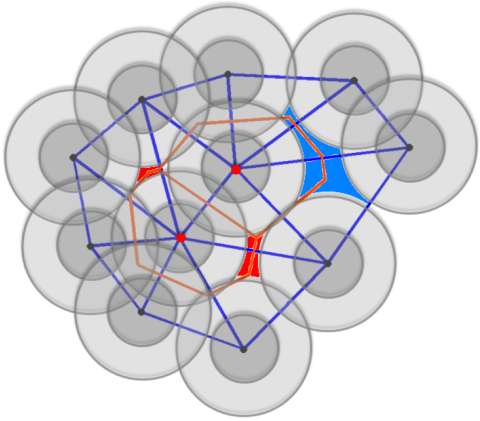
Theoretical physicist Moumita Maiti and colleagues at the Jawaharlal Nehru Centre for Advanced Scientific Research in Bangalore, India, have now implemented an algorithm for analysing void space in sphere packing, where the spheres need not all be the same size. This method, about to be published in European Physical Journal E, could be applied to analyse the geometry of liquids present between multi-sized spheres that are akin to a model for porous material. This provides a tool for studying the flow of such fluids through porous material. More importantly, it can also be used to study the packing geometry of proteins.

There have been several previous attempts to calculate the volume and the surface area of packing of spheres. But few methods have taken into account the connectivity of empty space between spheres, which matters, for example, when detecting buried cavities in proteins.

To remedy this issue, the authors have relied on a programme capable of performing a very detailed study of the size distribution of the free volumes of individual spheres-that is, the volume swept by the centre of the sphere without overlapping with any of the other spheres-in jammed sphere packing.. It also makes it possible to calculate the exact volumes and surface areas of cavities by detecting the disconnected components of cavities.

The team applied this method to the analysis of protein structures. This led them to compute various key quantities such as the distribution of sizes of buried cavities and pockets between spheres, the matching of areas accessible to solvent in which protein are found with the corresponding volumes and the composition of residues lining cavities.

Ultimately, the authors are planning to prepare this algorithm for distribution as .

Explore further: Nanotechnologists create minuscule soccer balls

More information: M. Maiti, A. Laxminarayanan and S. Sastry (2013), Characterization of Void Space in Polydisperse Sphere Packings: Applications to hard sphere packings and to protein structure analysis, European Physical Journal E, DOI 10.1140/epje/i2013-13005-4

add to favorites email to friend print save as pdf

Related Stories

Nanotechnologists create minuscule soccer balls

Sep 28, 2012

Nanotechnologists at the University of Twente's MESA+ research institute have developed a method whereby minuscule polystyrene spheres, automatically and under controlled conditions, form an almost perfect ...

Physicists develop potent packing process

Feb 28, 2011

New York University physicists have developed a method for packing microscopic spheres that could lead to improvements in commercial products ranging from pharmaceutical lotions to ice cream. Their work, which relies on an ...

Calcium carbonate templates for drug delivery

Jul 03, 2012

(Phys.org) -- The fast and targeted delivery of drugs to the focus of a disease could soon be made easier. Helmuth Möhwald and his colleagues from the Max Planck Institute of Colloids and Interfaces in ...

Recommended for you

Lab sets a new record for creating heralded photons

14 hours ago

(Phys.org) —Entanglement, by general consensus of physicists, is the weirdest part of quantum science. To say that two particles, A and B, are entangled means that they are actually two parts of an inseparable ...

Breakthrough calls time on bootleg booze

21 hours ago

(Phys.org) —Using a laser, the St Andrews scientists can now carry out detailed analysis of a spirit sample no bigger than a teardrop and can even confirm whether it is toxic or not. It's hoped the testing ...

Competition in the quantum world

May 20, 2013

Innsbruck physicists led by Rainer Blatt and Peter Zoller experimentally gained a deep insight into the nature of quantum mechanical phase transitions. They are the first scientists that simulated the competition ...

Promising doped zirconia

May 17, 2013

Materials belonging to the family of dilute magnetic oxides (DMOs)—an oxide-based variant of the dilute magnetic semiconductors—are good candidates for spintronics applications. This is the object of ...

User comments : 0

More news stories

Lab sets a new record for creating heralded photons

(Phys.org) —Entanglement, by general consensus of physicists, is the weirdest part of quantum science. To say that two particles, A and B, are entangled means that they are actually two parts of an inseparable ...

Breakthrough calls time on bootleg booze

(Phys.org) —Using a laser, the St Andrews scientists can now carry out detailed analysis of a spirit sample no bigger than a teardrop and can even confirm whether it is toxic or not. It's hoped the testing ...

Holding drivers' attention

Each day, an average of nine people are killed in the United States and more than 1,000 injured by drivers doing something other than driving.