February 5, 2013 weblog
Fujifilm shows off bendable 'Beat' diaphragm speaker
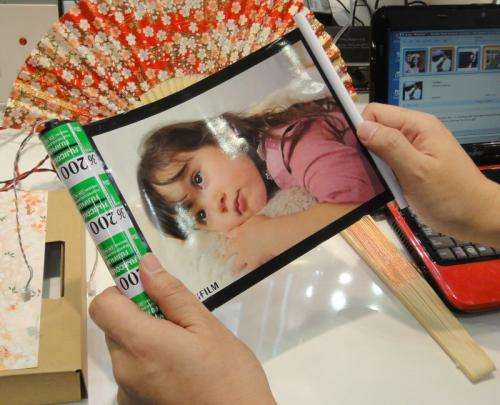
(Phys.org)—Japanese film maker Fujifilm has unveiled a new kind of bendable speaker at this year's Nanotech 2013 tradeshow, currently running in Tokyo. It's based on a thin bendable diaphragm the company calls "Beat."
There has been a lot of press given in the past couple of years to bendable screens, but thus far, little or no attention given to speakers that can be bent. That might change as actual bendable consumer products begin to appear and because Fujifilm has figured out a way to make functioning bendable speakers. Traditionally, speaker diaphragms have been made of stiff material, a necessity for conveying the vibration that produces the sound. Fujifilm has discovered a way to make a type of viscoelastic polymer (plastic) that is bendable but also is able to carry vibrations.
The engineers on the project developed a viscoelastic polymer that when created, results in a soft material that is able to be bent (in the several hertz range) but is hard in the audible range (20Hz to 20kHz). The polymer was then mixed with a piezoelectric ceramic to create a composite and then sandwiched between two layers of protective material that also served to house the electrodes. Applying electric current causes the ceramic to vibrate, which is propagated across the polymer as a diaphragm.
To demonstrate the Beat diaphragm, the company showed off three types of speaker products that make use of it: one looks like a roll-up photograph, another like a traditional Japanese sensu (fan) and a third that looks like a very thin traditional speaker. The wide variety demonstrates the nearly limitless ways speakers with a thin bendable diaphragm could be shaped. It's not hard to imagine photographs, or even paintings that hang on walls emitting sound, or drinking glasses, greeting cards, etc.
What's not yet clear is what level of sound quality the speakers will be able to deliver. At this time, it appears they would likely be suitable for demonstration purposes, but likely not up to the standards people look for when listing to music. That could change of course, as the technology matures. In the meantime, consumers who buy fold-up hand held electronics in the near future, might want to start scouting the possibility of carrying fold-up speakers with them as well.
© 2013 Phys.org


