Famous fraud cases foster a revolution in photograph conservation research
Feb 27, 2013

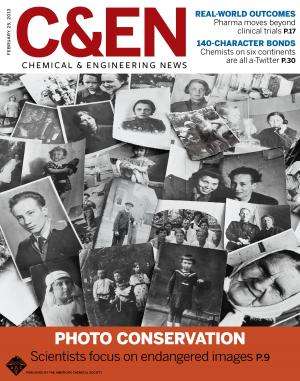
Two fraud cases that sent shock waves through the world of photography are helping to trigger a revolution in photo conservation science, according to the cover story in the current edition of Chemical & Engineering News.

Sarah Everts, C&EN European correspondent, explains that the prestige and prices of photographs—long dismissed by the art establishment as a second-tier medium—began to rival those of paintings and sculptures in the 1980s. Collectors began paying hundreds of thousands of dollars and even up to $1 million for vintage and contemporary photographs. Fraud cases appeared in parallel with that rise in popularity.

The article describes those cases, and explains how they led to million-dollar settlements that helped stimulate photo conservation research, transforming a niche field into what is now a mature science. Those conservation efforts embrace everything from family snapshots to priceless masterpieces, the article points out.

Explore further: Celebrating the centennial of a landmark in culinary chemistry

More information: Saving Endangered Images, Chemical & Engineering News. cenm.ag/photohistory

add to favorites email to friend print save as pdf

Related Stories

Keeping acrylic paintings clean poses big challenges

Oct 19, 2011

the medium made famous by artists like Mark Rothko, Andy Warhol, Robert Motherwell, and David Hockney —pushing 60 years of age, scientists specializing in art conservation are seeking ways to rejuvenate these paintings ...

Focus on fats

Oct 12, 2011

Almost everyone knows that fats are the culprits in expanding waistlines and killer diseases, but scientific understanding of the roles of "lipids" -- fats and oils -- inside cells in the body got short shrift until launch ...

Recommended for you

Long distance calls by sugar molecules

13 hours ago

All our cells wear a coat of sugar molecules, so-called glycans. ETH Zurich and Empa researchers have now discovered that glycans rearrange water molecules over long distances. This may have an effect on ...

Counting small RNA in disease-causing organisms

20 hours ago

Small molecules of RNA (tens to hundreds of nucleotides in length) play a key regulatory role in bacteria. Due to their small size, directly measuring the number of small RNA (sRNA) present in a single bacterium ...

User comments : 2

Adjust slider to filter visible comments by rank

Display comments: newest first

tscati
3.7 / 5 (3) Feb 27, 2013
How is a trailer for a magazine article appropriate material for phys.org?
InterestedAmateur
1 / 5 (1) Mar 04, 2013
Hmmm another advert...

More news stories

Long distance calls by sugar molecules

All our cells wear a coat of sugar molecules, so-called glycans. ETH Zurich and Empa researchers have now discovered that glycans rearrange water molecules over long distances. This may have an effect on ...

Counting small RNA in disease-causing organisms

Small molecules of RNA (tens to hundreds of nucleotides in length) play a key regulatory role in bacteria. Due to their small size, directly measuring the number of small RNA (sRNA) present in a single bacterium ...

Dish won't submit revised bid for Sprint

Satellite TV operator Dish Network Corp. said Tuesday it would not submit a revised bid for Sprint, leaving the path open for the wireless carrier to accept what it already considers a superior offer from Japan's Softbank.

Cape Wind gets $200M investment from Danish fund

The Cape Wind offshore wind project has secured a $200 million investment from a Danish pension fund in what the wind farm's president said Tuesday is a milestone for the long-delayed project.