Evolution and the ice age: Tracing the effects of climate change on prehistoric and future environments
Dr John Stewart has made important contributions to a growing body of work that shows how the evolution of ecosystems has to be taken into account when speculating between different geological eras. Go back to the time of the dinosaurs or to the single-celled organisms at the origins of life, and it is obvious that ecosystems existing more than 65 million years ago and around four billion years ago cannot be simply surmised from those of today.
Although the most drastic evolutionary changes occur over long spans of time, the effects can be seen relatively recently, argues Dr Stewart.
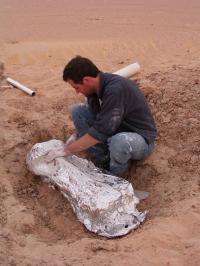
Stewart has studied the interaction between ancient ecosystems - paleoecology - and evolution of humans and other organisms over the past 100,000 years, undertaking everything from excavating cave sites in Belgium to exploring the desert of Abu Dhabi.
In one milestone collaborative study, Dr Stewart has taken existing knowledge of the geographical spread of plant and animal species throughout the warming and cooling of the Ice Ages to provide insights into human origins, including the evolution and extinction of Neanderthals.
He has also examined the rise of the 'first Europeans', along with the Denisovans - a newly discovered group - mysterious cousins of the Neanderthals, who occupied a vast realm stretching from the chill expanse of Siberia to the tropical forests of Indonesia.
The key insight in this work, conducted alongside Prof Chris Stringer of London's Natural History Museum, came from understanding the important role of the refuge taken by a species from harsher conditions – known as a refugium - which has a tremendous influence on the evolutionary future of the species. Once the climate changes again, for instance as ice sheets melt, these refuges can expand or connect up again.
But, of course, there's a twist. Evolution has also had a huge influence. The inhabitants are not the same as the original populations as a result of genetic mutations. The time spent apart in refuge generally serves to splinter a once unified species.
Previous research into hedgehogs, polar bears and other animals suggest that, even once an Ice Age ends and the different populations start intermingling again, they never really merge back together as a single group. This process drives important evolutionary changes, which can ultimately lead to the origins of a new species.
Ultimately, this explains why Homo sapiens are still here and our archaic human cousins went extinct some 30,000 years ago: our ancestors chose the right refuge to wait out the Ice Age.
Today, Dr Stewart's work has shifted away from fossil remains to ancient DNA. Traditionally insights into the evolution of species have come from fossils, but we now know that the genetic changes that underlie a major change in body shape can be minor.
"The most exciting development in my field has been the ability to analyse ancient DNA, which has begun to allow us to see evolution happening over the last several dozen thousand years," explains Dr Stewart.
His claim that climate change caused the Neanderthals' demise is supported by work by Love Dalén at the Swedish Museum of Natural History in Stockholm, who has looked at the genes in 13 Neanderthal fossils found in southern Europe and western Asia.
All Neanderthal fossils more than 48,000 years old, and those found in Asia, had a higher level of genetic diversity than later European fossils, suggesting that the Neanderthals probably went through an evolutionary 'bottleneck' where a significant percentage of them perished.
When a bottleneck occurs, the remaining individuals are often a much less diverse group, which makes it more difficult for them to evolve and adapt to a changing environment.
Dr Stewart, who is doing DNA studies in collaboration with teams at the Natural History Museum in Stockholm and the Universities of York and Royal Holloway, is now focusing on using genetics to elucidate the evolution of a wide range of creatures.
He has conducted recent studies at the cave site of Trou Al'Wesse, a refugium once occupied by Neanderthals, in Belgium. He is studying how animal populations changed as a result of Ice Age climate change to understand the evolutionary processes that have taken place over the last 50,000 years.
But his work is not confined to the past. It informs the present too. Recently there had been a proposal to eradicate the Eagle Owl because it killed other birds, such as hen harriers, and was not thought to be a native species. But Dr Stewart's studies of fossils and more recent archaeological records revealed the bird, or something like it, has been present in Britain for up to 700,000 years. The plan to cull the birds has now been abandoned.
And his research can help us predict the future. The fear is that our ever-expanding impact on the planet will trigger ecological collapse. But the only way to know for sure is to look back into the past.
"By studying how organisms have reacted to past climate change," explains Dr Stewart, "we can learn lessons about what may take place due to human-caused global warming."
Provided by Bournemouth University


