Time for Europe to beef up asteroid vigilance, ESA says
Feb 21, 2013
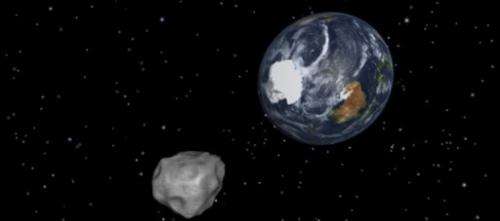
This NASA graphic obtained February 8, 2013 depicts the Earth flyby of asteroid 2012DA14. Europe must strengthen its watch for dangerous space rocks, the head of the European Space Agency's asteroid surveillance programme said Thursday, a week after a meteor struck Russia in a blinding fireball.

Europe must strengthen its watch for dangerous space rocks, the head of the European Space Agency's asteroid surveillance programme said Thursday, a week after a meteor struck Russia in a blinding fireball.

Nicolas Bobrinsky, in charge of ESA's four-year-old Space Situational Awareness (SSA) programme, said his unit would inaugurate a centre in Rome on May 22 to coordinate observatories' sightings of passing asteroids.

The SSA is also working on a prototype "fly's eye" telescope, with specially-designed wide vision, to help surveillance of the cosmos, he said.

But Bobrinsky said this was not enough, given the risk from smaller asteroids of the kind that exploded over the central Russian city of Chelyabinsk last Friday, injuring more than 1,200 people.

He called for help to build an automated network with six such telescopes so that the would be scrutinised around the world.

"The fact that we are pursuing this programme is very satisfying, but the take-home message is that we have to step up our efforts so that the necessary protection is put in place," Bobrinsky said.

Such a network could give three months' warning of a dangerous , "enough to evacuate a threatened region if necessary or possibly launch a mission to change (the asteroid's) trajectory," he said in a phone interview.

The Chelyabinsk rock is estimated to have been 17 metres (56 feet) across.

It struck just hours before a 45-metre asteroid, 2012 DA 14, skimmed past the Earth at a distance of about 27,000 kilometres (7,200 miles)—the closest ever by any predicted object.

Thanks to a -led programme, are making headway in identifying very large asteroids measuring a kilometre or more across that may stray into our neighbourhood.

"Around 99 per cent of these big asteroids have already been spotted," Bobrinsky said.

"The real danger now comes from small asteroids, which are far more numerous," he said.

Around a million asteroids measuring 50 metres (165 feet) or more orbit the Sun, said Bobrinsky.

How many of them are "geo-cruisers," meaning that they come close to the orbit of the Earth, is unknown. So far, fewer than 10,000 asteroids in this category have been detected, he said.

"Most of the objects that may one day pose an impact risk have not been detected," said Bobrinsky. "There is a colossal amount of work to be done."

The SSA has a five-million-euro ($6.6-million) budget throughout 2013-2016, with which it has to monitor space storms and orbital debris as well as track asteroids.

Explore further: Stranger in the night: space rock to make close Earth flyby

add to favorites email to friend print save as pdf

Related Stories

Near-miss asteroid will return next year

Mar 16, 2012

(PhysOrg.com) -- When it whizzes past Earth in 2013, a newly discovered asteroid is going to miss our planet – but not by much. The 50 m space rock is expected to come closer than many satellites, highlighting ...

Amateur astronomers boost ESA's asteroid hunt

May 15, 2012

A partnership with the UK’s Faulkes Telescope Project promises to boost the Agency’s space hazards research while helping students to discover potentially dangerous space rocks.

Russia asteroid impact: ESA update and assessment

Feb 19, 2013

The first firm details of the 15 February asteroid impact in Russia, the largest in more than a century, are becoming clear. ESA is carefully assessing the information as crucial input for developing the ...

You just got a haircut from Asteroid 2012 JU

May 15, 2012

OK, we admit that’s a bit of an exaggeration, but an asteroid about the size of a school bus did come fairly close to Earth yesterday! On May 13, Asteroid 2012 JU passed harmlessly between Earth and Moon. ...

Rare near-Earth asteroid fly-by set for Tuesday

Nov 03, 2011

A massive asteroid will make a rare fly-by Tuesday, and although it poses no danger of crashing to Earth, US scientists said this week they are looking forward to getting a closer look.

Recommended for you

Russia retrieves mice, newts from space

2 hours ago

A Russian capsule filled with 45 mice and 15 newts along with other small animals returned from a month's mission in orbit on Sunday with data scientists hope will pave the way for a manned flight to Mars.

Mars rover Opportunity examines clay clues in rock

May 18, 2013

(Phys.org) —NASA's senior Mars rover, Opportunity, is driving to a new study area after a dramatic finish to 20 months on "Cape York" with examination of a rock intensely altered by water.

NASA's STEREO detects a CME from the sun

May 17, 2013

On 5:24 a.m. EDT on May 17, 2013, the sun erupted with an Earth-directed coronal mass ejection or CME, a solar phenomenon that can send billions of tons of solar particles into space that can reach Earth ...

Nine-year-old Mars rover passes 40-year-old record

May 17, 2013

While Apollo 17 astronauts Eugene Cernan and Harrison Schmitt visited Earth's moon for three days in December 1972, they drove their mission's Lunar Roving Vehicle 19.3 nautical miles (22.210 statute miles ...

Bright explosion on the Moon

May 17, 2013

For the past 8 years, NASA astronomers have been monitoring the Moon for signs of explosions caused by meteoroids hitting the lunar surface. "Lunar meteor showers" have turned out to be more common than anyone ...

User comments : 0

More news stories

Russia retrieves mice, newts from space

A Russian capsule filled with 45 mice and 15 newts along with other small animals returned from a month's mission in orbit on Sunday with data scientists hope will pave the way for a manned flight to Mars.

Galaxy's Ring of Fire

Johnny Cash may have preferred this galaxy's burning ring of fire to the one he sang about falling into in his popular song. The "starburst ring" seen at center in red and yellow hues is not the product of ...

Honeybees trained in Croatia to find land mines

(AP)—Mirjana Filipovic is still haunted by the land mine blast that killed her boyfriend and blew off her left leg while on a fishing trip nearly a decade ago. It happened in a field that was supposedly ...

German energy shift faces headwinds

Tense engineers have their eyes peeled on complex colour-coded diagrams on a wall-sized screen that makes their control room look like the inside of a spaceship.

Internet in 'coma' as Iran election looms

Iran is tightening control of the Internet ahead of next month's presidential election, mindful of violent street protests that social networkers inspired last time around over claims of fraud, users and ...