Estonia plugs electric cars as power prices soar
Feb 21, 2013
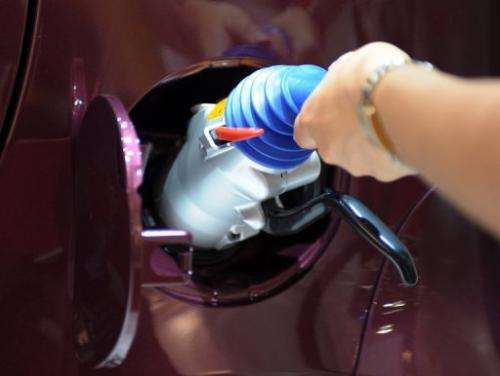
An electric car is charged at the Paris Auto Show on September 30, 2010. It brought the world Skype, Europe its first capital with free public transport, and now Estonia is touting the globe's first fast-charging network for electric vehicles.

It brought the world Skype, Europe its first capital with free public transport, and now Estonia is touting the globe's first fast-charging network for electric vehicles.

But its this week was overshadowed by public outrage over skyrocketing since power market deregulation here in January.

Intended to cut , the network now has 151 charging-stations up and running across the small northern Baltic state, with 14 more planned by this summer, according to KredEx, the public agency in charge of building it.

But the move comes as the price of electricity soared 23.6 percent from December to January as a result of deregulation in the eurozone country of 1.3 million, Statistics Estonia figures show.

The nation's has begun proceeding "in order to control the charged by Eesti Energia for power supplied to the general public," Maarja Uulits, Competition Authority spokeswoman told AFP on Thursday.

Eesti Energia is entirely owned by the Estonian state, which also financed the new fast-charging network created by ABB, a Swiss engineering firm.

Funding for the network came from a 2010 carbon credit deal in which the Estonian government sold its CO2 quota to Japan's Mitsubishi Corporation.

The new charging stations dot all major highways at intervals of 40-60 kilometres (25-40 miles). It takes 20 to 40 minutes to charge up a 16-kilowatt-per-hour battery from 0-80 percent of capacity, according to KredEx.

In 2011, the centre-right government of Prime Minister Andrus Ansip bought 500 Mitsubishi i-MiEV electric cars for use by social workers and has subsidies of up to 18,000 euros ($24,000) for private individuals to get electric wheels.

Estonia joined the EU in 2004 and eurozone in 2011.

Explore further: German energy shift faces headwinds

add to favorites email to friend print save as pdf

Related Stories

Electric cars rolling out

Dec 16, 2009

(PhysOrg.com) -- Electric vehicles are far from new, but we are still a long way from electric cars being the norm. Now two new electric cars may bring that goal a step closer.

Electric cars take off in Norway

May 10, 2011

They speed past gas guzzlers in traffic, ignore congestion charges and get city centre parking for free. In a country whose wealth is fuelled by oil, Oslo has become the world capital of the electric car.

Mitsubishi rolls out new electric car in Hong Kong

May 20, 2010

Japan's Mitsubishi Motors unveiled its i-MiEV electric car in Hong Kong on Thursday, its first foreign launch of the vehicle as competition accelerates in the clean-energy auto sector.

Toyota to release solar charger for electric vehicles

Oct 27, 2009

(PhysOrg.com) -- Toyota is developing a solar charging station for electric cars and plug-in hybrids, making a green technology even greener. It has also designed a battery charger for mounting inside an electric ...

Recommended for you

German energy shift faces headwinds

14 hours ago

Tense engineers have their eyes peeled on complex colour-coded diagrams on a wall-sized screen that makes their control room look like the inside of a spaceship.

Morocco to harness the wind in energy hunt

May 18, 2013

Morocco is ploughing ahead with a programme to boost wind energy production, particularly in the southern Tarfaya region, where Africa's largest wind farm is set to open in 2014.

Energy-positive with natural ventilation

May 17, 2013

Buildings can be air-conditioned using entirely natural means, without mechanical ventilation systems. This is the claim made by 78-year-old Benjamin Bronsema, who will be awarded his PhD for his thesis on the subject at ...

User comments : 4

Adjust slider to filter visible comments by rank

Display comments: newest first

kochevnik
1 / 5 (2) Feb 21, 2013
Poor Estonia is another victim of Randite libtard politics
mrlewish
3 / 5 (2) Feb 21, 2013
Ah the "Argue the exact opposite of what really happened remark".

This happened because they went to a "free market" for the energy.
This is the republican version of capitalism. Privatize the profits and socialize the losses.
Eikka
5 / 5 (1) Feb 22, 2013

Power companies are always a problem, state owned or private, because they're necessarily monopolies in their area. It would make little sense to build parallel infrastructure because it would double the prices just to get competition going on.

Estonia btw. is one of the "weird" countries in the world where they employ a flat tax rate instead of robin-hood progressive taxation, and it seems to be working quite well for them. It's less socialist than the US in that respect.
ronwagn
1 / 5 (1) Feb 24, 2013
Estonia needs to start fracking, and developing biogas etc.

Natural gas is the future of energy. It is replacing dirty old coal plants, and dangerous expensive nuclear plants. It will fuel cars, trucks, vans, buses, locomotives, aircraft, ships, tractors, engines of all kinds. It costs far less. It will help keep us out of more useless wars, where we shed our blood and money. It is used to make many products. It will bring jobs and boost our economy. It lowers CO2 emissions, and pollution. Over 5,000 select natural gas story links on my free blog. An annotated and illustrated bibliography of live links, updated daily. The worldwide picture of natural gas. Read in 75 nations. ronwagnersrants . blogspot . com

More news stories

German energy shift faces headwinds

Tense engineers have their eyes peeled on complex colour-coded diagrams on a wall-sized screen that makes their control room look like the inside of a spaceship.

Internet in 'coma' as Iran election looms

Iran is tightening control of the Internet ahead of next month's presidential election, mindful of violent street protests that social networkers inspired last time around over claims of fraud, users and ...

China police billions spell profit opportunity

Mannequins in riot gear, armoured cars and drones line a police equipment and "anti-terrorism technology" trade fair in Beijing as vendors seek to profit from China's huge internal security budget.

Heat-related deaths in Manhattan projected to rise

Residents of Manhattan will not just sweat harder from rising temperatures in the future, says a new study; many may die. Researchers say deaths linked to warming climate may rise some 20 percent by the 2020s, ...

Kinks and curves at the nanoscale

One of the basic principles of nanotechnology is that when you make things extremely small—one nanometer is about five atoms wide, 100,000 times smaller than the diameter of a human hair—they are going ...