Eruption risk perception disconnected from detected threat
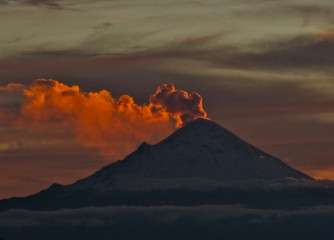
The perceived risk of having a volcanic eruption needs to match the actual risk, detected through combined technologies including remote sensing of volcanic gasses, before dire consequences can be prevented.
Just like earthquakes, volcanic eruptions are extremely difficult to accurately predict. Yet, the eruption of the Santa Ana Volcano in El Salvador was predicted a few days before it happened on 1st October 2005. "On the last day of September [the authorities] evacuated 200 people from the slopes of the volcano, and the next day, at ten o 'clock the volcano exploded," remembers Bo Galle, an atmospheric scientist at Chalmers University of Technology in Gothenburg, Sweden. His team was involved in raising the alarm of the risk of eruption.
At the time, Galle was the chosen coordinator of EU funded NOVAC project designed "to find out if [volcanic gasses] remote sensing was useful for [eruption] risk assessment." This approach relies on a technology called spectroscopic remote-sensing, traditionally used to detect gasses produced by agriculture, pollution, or natural sources, such as peat mosses. The efficiency of the system was dramatically demonstrated on the first day of the project. Indeed, monitoring had started more than a month before the official EU research project contract was signed. The team took the hint from local researchers detecting a sudden and dramatic ten-fold increase of gas emission during the end of September that year.
The technique is similar to the so-called spectroscopic observation of molecules in the atmosphere of planets. "Ten years ago we realised that there was a strong development in optical remote sensing of gasses that was not really exploited with volcanoes." says Galle. Typically the remote-sensing spectrometer is set up about 5 km from the volcano, looking for traces of gasses such as sulphur dioxide and bromine oxide. "These gasses are dissolved deep down in the magma, and if you have changes of temperature or pressure, it affects the solubility and the amount of gas that comes out," explains Galle.
Experts welcome such approach, but only as a complement to existing detection methods. "Remote sensing is not sufficient, but it is a very useful addition to monitor a volcano. You also need seismic and ground deformation monitoring," Paolo Gasparini tells youris.com. He is an expert on geothermal studies at the University of Naples, Italy, involved in monitoring the Vesuvius volcano, albeit not as part of the NOVAC consortium.
However effective the combination of detection technologies may be, risk perception may be the biggest hurdle in adequately preventing volcanic eruptions to have dire consequences. Gasparini points to the example of the Campi Flegrei, a large volcano on the West of Naples. Although its seismicity is currently low, gas emission studies shows a variability in the chemical composition of gasses it emits. This could be an early signal of renewed volcanic activity.
Despite the activity warnings provided by advance in remote gas sensing, the danger the Campi Flegrei poses to the population is much less understood, according to Amy Donovan, a research fellow studying the use of volcanological science in the political management of eruptions at the University of Cambridge, UK. "It is capable of very large magnitude eruptions and quite a lot of people live inside the caldera itself."
In Donovan's view, scientists have done a great deal of work in communicating the risk, evaluated by combing detection technologies. However, the local population does not have an accurate perception of the risk. "There is a feeling among Italian scientists that people do not listen, or are simply unaware, particularly of the risk from Campi Flegrei," she says. However, it is clear that the authorities are quite uncomfortable about the situation. "I actually tried to do risk perception surveys in Naples, but it proved difficult to set up for political reasons," she says.
For now, the NOVAC network is still in place. 24 volcanoes—80% of those monitored by the project—are still fully monitored by remote sensing that is funded by local risk observatories mainly in South America. Indeed further funding by the EU did not materialise when the project ended in 2010. "This is a serious problem," says Galle. "If I write a proposal which contains the words 'network' and 'long-term,' nobody wants to touch it."
More information: www.novac-project.eu/
Provided by Youris.com


