Deadly bacteria attack not only us, but each other as well, with remarkable precision
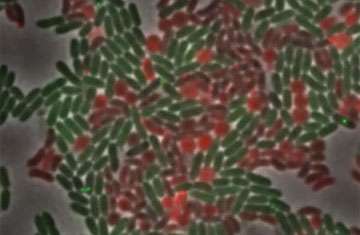
Vibrio cholerae, the scourge of nations lacking clean water. Pseudomonas aeruginosa, the microbe that plagues people with cystic fibrosis. Acinetobacter species, opportunistic organisms that can infect vulnerable people. Escherichia coli, a culprit in food-borne illnesses.
When these bacteria invade their human hosts, they can cause misery and death. But these pathogens also do battle with each other—if provoked. New research sheds light on the tiny war machines that bacteria wield in surprisingly precise and selective counterattacks against their bacterial foes. Real-time fluorescent microscopy catches what HMS scientists call "bacterial tit-for-tat."
John Mekalanos, HMS Adele Lehman Professor of Microbiology and Molecular Genetics and head of the Department of Microbiology and Immunobiology, last year noted "T6SS dueling" among bacteria of the same species. The name describes the interactions between two sister cells' type 6 secretion systems. These dynamic nanomachines can deliver a toxic protein by piercing the threatening cell. A previous postdoctoral fellow in the Mekalanos lab, Joseph Mougous (now at the University of Washington, Seattle) discovered that immunity proteins likely protect these sister cells from such attacks. But the fact that the sisters fight back was appreciated only when Marek Basler, a research fellow in Microbiology and Immunobiology, and Mekalanos watched these pitched battles under the microscope.
In a new report appearing in the current issue of Cell, Mekalanos, Basler and graduate student Brian Ho look further into this phenomenon, asking what happens when bacteria encounter other bacterial species wielding T6SS weapons. They found that P. aeruginosa uses this same smart strategy to detect and then counterattack bacterial foes that dare use their T6SS weapon against it.
To tease out the tactics playing out on this bacterial battlefield, the three scientists first pitted P. aeruginosa—the pathogen dangerous for people with cystic fibrosis—against V. cholerae, the microbe that causes cholera. They observed how cells with and without active T6 secretion systems acted, finding remarkable consistency in the results. When P. aeruginosa sensed T6SS-armed V. cholerae, it rapidly responded in kind, counterattacking with its own T6SS barrage at the precise point where it had been targeted. When the scientists inactivated the T6SS in V. cholerae cells, the P. aeruginosa left them alone. In a three-way experiment with aggressive, T6SS-bearing V. cholerae cells and peaceful, non-T6SS carrying V. cholerae cells, P. aeruginosa used its T6SS machine specifically against the T6SS-positive V. cholerae but ignored the rest of the bacteria in the mixed population. To see whether other bacteria elicited the same response, the scientists also included Acinetobacter baylyi and E. coli, with the same results. Only T6SS-positive A. baylyi cells were counterattacked by Pseudomonas cells, while the peaceful E. coli were left unharmed.
"This really proves that the system is extraordinarily good at detecting the attacking cell and killing only that cell while causing no collateral damage," Mekalanos said.
There's a good reason for such efficient behavior, Basler said. "It's better for the cell to have a very good aim than to fire indiscriminately—that is wasted energy."
Bacteria live in huge communities that involve cooperation as well as competition.
"This may reflect ecological decisions that are made by bacteria to form mixed biofilms living together, either in the extracellular environment or even inside the human host where they coexist in large, diverse communities," Mekalanos said. "When we first embarked on this work, we were really surprised to find out that the bacteria could respond to each other in such an intimate and dynamic way."
More information: www.cell.com/abstract/S0092-8674%2813%2900134-7
Journal information: Cell
Provided by Harvard Medical School


