Combining quantum information communication and storage
Feb 14, 2013
Combining quantum information communication and storage
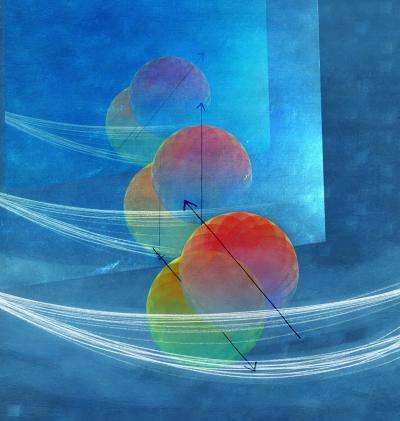
This shows a merger of three quantum systems: a superconducting quantum qubit, or, qubit (spheres) interacting with two different resonant cavities. A low frequency phonon cavity (vibrating string) was used as storage of quantum information from the qubit, whereas an electrical microwave cavity (represented by the mirrors) acted as a means of communicating to the outside world. The idea could be used as a building block in the emerging field of quantum information and communication. Credit: Juha Juvonen

(Phys.org)—Aalto University researchers in Finland have successfully connected a superconducting quantum bit, or qubit, with a micrometer-sized drum head. Thus they transferred information from the qubit to the resonator and back again.

- This work represents the first step towards creating exotic mechanical quantum states. For example, the transfer makes it possible to create a state in which the resonator simultaneously vibrates and doesn't vibrate, says professor Mika Sillanpää from Aalto University, who runs the research group.

A qubit is the quantum-mechanical equivalent of the bits we know from computers. A traditional bit can be in a state of 0 or 1, while a qubit can be in both states at the same time. In theory, this inconceivable situation allows for a in which the operations are performed simultaneously for all possible numbers. In the case of a single qubit, this means zero and one, but as the number of qubits increases, the amount of possible numbers and simultaneous calculations grows exponentially. The of a qubit is very fragile and easily disturbed between and during the operations. The key to successful quantum calculation is being able to protect the qubit state from disturbances in the environment.

- In this case, the qubit state can be stored as vibration, thus preserving the state for much longer than the qubit itself. The resonator also functions as a mechanical , which is something that an ordinary memory can't do, explains Juha Pirkkalainen from Aalto University, who is doing his dissertation on the topic.

The work combines the achievements of two Nobel Prize winners

The work combined the achievements of both winners of this year's Nobel Prize for Physics. The qubit state was measured using a superconducting cavity in the same way that Serge Haroche measured atoms, and the state was also linked to mechanical movement as in David Wineland's experiments. In contrast to these larger-scale measurement arrangements, the experiment at the O.V. Lounasmaa Laboratory was prepared for a tiny silicon microchip. This made it possible to cool the sample to near absolute zero temperatures and then use microwaves.

Explore further: Researchers determine spin rate of qubit by measuring microwave field inside superconducting circuit

More information: www.nature.com/nature/journal/v494/n7436/full/nature11821.html

Related Stories

Turning down the noise in quantum data storage

Jan 19, 2010

Researchers who hope to create quantum computers are currently investigating various methods to store data. Nitrogen atoms embedded in diamond show promise for encoding quantum bits (qubits), but the process ...

Making quantum computing scalable

Mar 20, 2009

(PhysOrg.com) -- Quantum information processing is one of the hottest areas of science and technology right now. Making quantum information processing scalable is an important part of the efforts involved with regard to practical ...

Recommended for you

A quantum simulator for magnetic materials

May 23, 2013

Physicists understand perfectly well why a fridge magnet sticks to certain metallic surfaces. But there are more exotic forms of magnetism whose properties remain unclear, despite decades of intense research. ...

Researchers forward quest for quantum computing

May 23, 2013

Research teams from UW-Milwaukee and the University of York investigating the properties of ultra-thin films of new materials are helping bring quantum computing one step closer to reality.

Hydrogen atoms under the magnifying glass

May 22, 2013

To describe the microscopic properties of matter and its interaction with the external world, quantum mechanics uses wave functions, whose structure and time dependence is governed by the Schrödinger equation. ...

Making quantum encryption practical

May 21, 2013

One of the many promising applications of quantum mechanics in the information sciences is quantum key distribution (QKD), in which the counterintuitive behavior of quantum particles guarantees that no one can eavesdrop on ...

Lab sets a new record for creating heralded photons

May 20, 2013

(Phys.org) —Entanglement, by general consensus of physicists, is the weirdest part of quantum science. To say that two particles, A and B, are entangled means that they are actually two parts of an inseparable ...

User comments : 0

More news stories

Lab sets a new record for creating heralded photons

(Phys.org) —Entanglement, by general consensus of physicists, is the weirdest part of quantum science. To say that two particles, A and B, are entangled means that they are actually two parts of an inseparable ...

Theorists weigh in on where to hunt dark matter

(Phys.org) —Now that it looks like the hunt for the Higgs boson is over, particles of dark matter are at the top of the physics "Most Wanted" list. Dozens of experiments have been searching for them, but ...

Yahoo, pay-TV operators among Hulu bidders

Online video site Hulu is again up for sale, with Yahoo and pay TV operators DirecTV and Time Warner Cable among the seven bidders, according to a person with direct knowledge of the matter.