Apple, Samsung face onslaught at mobile fair
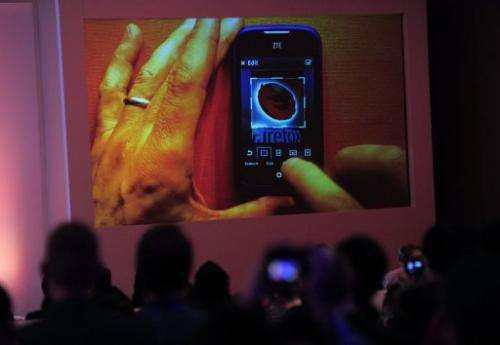
Chinese handset makers will lead an onslaught on smartphone titans Samsung and Apple when the world's biggest mobile fair opens Monday in Barcelona, Spain.
Offering big-screen, slick, slim smartphones at lower prices, Chinese manufacturers Huawei, ZTE and Lenovo will leverage the Mobile World Congress to chip away at the mighty duopoly, analysts say.
The handset battle is part of a broader revolt against a handful of companies with a stranglehold on the booming industry's handsets, operating systems and microchips, they say.
Apple, as usual, is steering clear of the February 25-28 congress that draws 1,500 exhibitors to this Mediterranean city in northeastern Spain, and Samsung is not expected to launch its next big offer, the Galaxy S4, until some time after the show.
That may leave the field clear for rivals to tout their ambitions for a slice of the smartphone market, which is set to grow to a record one billion handset shipments in 2013 according to a forecast by global consultancy Deloitte.
"I think we will see challengers trying to make noise at the Mobile World Congress this year," said Ian Fogg, London-based senior mobile analyst at research house IHS.
New players face a daunting task, though.
Samsung and Apple accounted for more than half of all smartphone sales in the final quarter of 2012—29.0 percent for Samsung and 22.1 percent for Apple—according to research firm Strategy Analytics.
Behind Samsung and Apple, however, Chinese firms held the third, fourth and fifth spots—with 5.3 percent for Huawei, 4.7 percent for ZTE and 4.4 percent for Lenovo.
Demand for smartphones in developing countries could give Chinese firms a bigger opening, said Magnus Rehle, senior partner at telecommunications management consultancy group Greenwich Consulting.
"Hundreds of millions of Africans and Indians and Asians want to have a smartphone and so far the blocking point has been the price," said Rehle, speaking from Ghana.
Now the Chinese firms were offering attractive smartphones at lower prices, he said.
"I think they will be quite successful in grabbing the new market outside of Europe and the US, and that is where the growth is," Rehle said.
An even mightier duopoly holds sway over the operating system software that makes the smartphones work.
Google's Android ran 69 percent of all handsets sold last year and Apple's iOS 22 percent, said a study by independent analytical house Canalys.
Yet they face challengers, too, including Mozilla's new open-sourced Firefox OS, backed by an array of mobile phone operators.
Microsoft's new Windows Mobile operating system is struggling, however.
"The number of apps that is available is one thing that is blocking Windows from being successful," Rehle said.
"They have had problems and everybody is hoping this will change because the duopoly is maybe not good for the market."
Firefox could face similar difficulties, he predicted.
A battle has broken out, too, over the processor chips that run the smartphones.
Santa Clara, California-based Intel is offering new high-performance chips to break its way into smartphones, of which almost all now use chip technology licenced by ARM, based in Cambridge, England.
Chinese group Lenovo, for example, is launching a new handset, the IdeaPhone K900, just 6.9mm thick with a 5.5-inch high definition screen, which contains an Intel Clover Trail processor.
The potential rewards for Intel could be rich: the market in processor chips for smartphone applications was worth nearly seven billion euros ($9 billion) last year, said Francis Sideco, communications technology analyst at IHS.
Despite robust growth in smartphones and tablet sales, however, the mobile industry still faces a major challenge moving customers over to new ultrafast fourth generation, or 4G, networks, which can offer speeds similar to a fixed fibre-optic connection.
"There are 3G networks in many parts of the world like in Sweden that have been overcrowded and then you have parallel 4G networks that are almost empty," said Greenwich Consulting's Rehle.
Network operators need to convince their customers to pay a little more for the faster speeds, he said, pointing to videos as the "killer application" to lure people to the system over the longer term.
If the operators succeed, they can make more money and invest in greater capacity, the analyst said.
"Otherwise, they will have problems."
(c) 2013 AFP


