Sun shoots out two coronal mass ejections

Jan 24, 2013
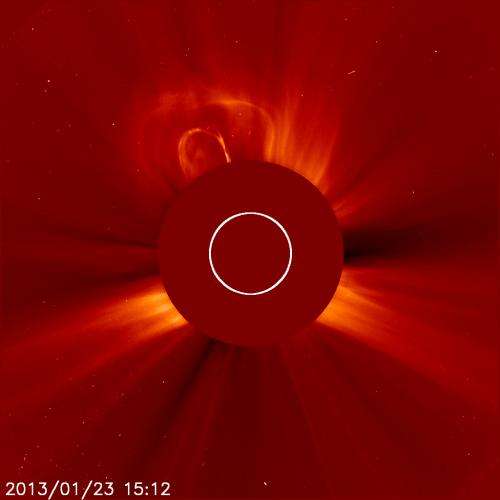
The second of two coronal mass ejections (CMEs) on Jan. 23, 2013, is seen erupting in the top of the picture, away from the sun, which is obscured by the disk in the center. The Solar and Heliospheric Observatory captured this image, called a coronagraph: the bright light of the sun itself is blocked to provide a better view of the sun's atmosphere, the corona. This CME left the sun at speeds of 375 miles per second (1.35 million mph), which is almost 10 times lower than the very fastest CMEs. Credit: ESA, NASA/SOHO

On Jan. 23, 2013, at 9:55 a.m. EST, the sun erupted with an Earth-directed coronal mass ejection, or CME. Experimental NASA research models, based on observations from the Solar Terrestrial Relations Observatory (STEREO) and ESA/NASA's Solar and Heliospheric Observatory, show that the CME left the sun at speeds of around 375 miles per second, which is a fairly typical speed for CMEs.

Not to be confused with a solar flare, a CME is a solar phenomenon that can send solar particles into space and reach Earth one to three days later.

Sun shoots out 2 coronal mass ejections
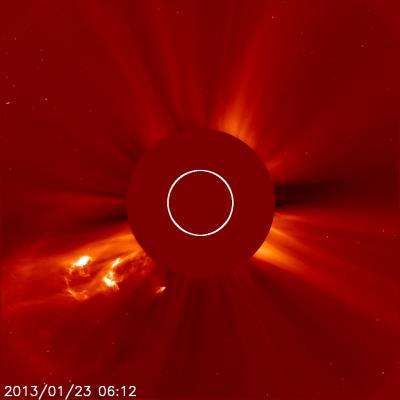
The first of two coronal mass ejections (CMEs) on Jan. 23, 2013, can be seen erupting in the lower left portion of this image, from the Solar and Heliospheric Observatory. This CME was not Earth-directed. This image is what's known as a coronagraph, in which the bright light of the sun itself is blocked in order to better see the sun's atmosphere, the corona. Credit: ESA, NASA/SOHO

Earth-directed CMEs can cause a space called a geomagnetic storm, which occurs when they connect with the outside of the Earth's magnetic envelope, the magnetosphere, for an extended period of time. In the past, CMEs of this speed have not caused substantial geomagnetic storms. They sometimes cause auroras near the poles but are unlikely to affect electrical systems on Earth or interfere with GPS or satellite-based communications systems.

This video is not supported by your browser at this time.
This movie shows two coronal mass ejections (CMEs) erupting from the sun on Jan. 23, 2013. The first was not directed at Earth; the second one is, but is not expected to have a strong impact. The movie was captured by the joint ESA/NASA mission the Solar and Heliospheric Observatory (SOHO), beginning at 7 p.m. EST on Jan. 22 and ending at 5:30 p.m. Jan. 23. Credit: ESA, NASA/SOHO/Goddard Space Flight Center

A slightly slower CME that was not Earth-directed, also erupted earlier in the day.

NOAA's Center is the United States government's official source for space weather forecasts.

Explore further: Continuing Thanksgiving eruptions on the Sun

Related Stories

Continuing Thanksgiving eruptions on the Sun

Nov 26, 2012

On Nov. 23, 2012, at 8:54 a.m. EST, the sun erupted with an Earth-directed coronal mass ejection or CME. Experimental NASA research models, based on observations from the Solar Terrestrial Relations Observatory ...

NASA spacecraft observe Nov. 20 solar eruption

Nov 20, 2012

On Nov. 20, 2012, at 7:09 a.m. EST, the sun erupted with a coronal mass ejection or CME. Not to be confused with a solar flare, a CME is a solar phenomenon that can send solar particles into space and can ...

NASA spacecraft observe a Thanksgiving CME

Nov 23, 2012

(Phys.org)—On Nov. 21, 2012, at 11:24 a.m. EST, the sun erupted with an Earth-directed coronal mass ejection or CME. Experimental NASA research models, based on observations from the Solar Terrestrial Relations ...

New sunspots producing space weather

Jan 14, 2013

On Jan. 13, 2013, at 2:24 a.m. EST, the sun erupted with an Earth-directed coronal mass ejection or CME. Not to be confused with a solar flare, a CME is a solar phenomenon that can send solar particles into ...

Sun releases slow moving CME

Nov 12, 2012

On Nov. 9, 2012, at 10:24 a.m. EST, the sun emitted an Earth-directed coronal mass ejection (CME). A CME is a solar phenomenon that can send billions of tons of solar particles into space and can reach Earth ...

NASA sees sun unleash a wide, but benign, CME

Sep 28, 2012

The sun erupted with a wide, Earth-directed coronal mass ejection (CME) on Sept. 27, 2012 at 10:25 p.m. EDT. CMEs are a phenomenon that can send billions of tons of solar particles into space that can reach ...

Recommended for you

Mars rover Opportunity examines clay clues in rock

13 hours ago

(Phys.org) —NASA's senior Mars rover, Opportunity, is driving to a new study area after a dramatic finish to 20 months on "Cape York" with examination of a rock intensely altered by water.

NASA's STEREO detects a CME from the sun

May 17, 2013

On 5:24 a.m. EDT on May 17, 2013, the sun erupted with an Earth-directed coronal mass ejection or CME, a solar phenomenon that can send billions of tons of solar particles into space that can reach Earth ...

Nine-year-old Mars rover passes 40-year-old record

May 17, 2013

While Apollo 17 astronauts Eugene Cernan and Harrison Schmitt visited Earth's moon for three days in December 1972, they drove their mission's Lunar Roving Vehicle 19.3 nautical miles (22.210 statute miles ...

Bright explosion on the Moon

May 17, 2013

For the past 8 years, NASA astronomers have been monitoring the Moon for signs of explosions caused by meteoroids hitting the lunar surface. "Lunar meteor showers" have turned out to be more common than anyone ...

User comments : 0

More news stories

Galaxy's Ring of Fire

Johnny Cash may have preferred this galaxy's burning ring of fire to the one he sang about falling into in his popular song. The "starburst ring" seen at center in red and yellow hues is not the product of ...

Alaska volcano shoots ash 15,000 feet into the air

(AP)—One of Alaska's most restless volcanoes has shot an ash cloud 15,000 feet into the air in an ongoing eruption that has drawn attention from a nearby community but isn't expected to threaten air traffic.

Chinese, Indian airlines face EU pollution fines

Eight Chinese and two Indian airlines face fines of up to several million euros for not paying for their greenhouse gas emissions during flights within the bloc, the European Commission said on Friday.

Morocco to harness the wind in energy hunt

Morocco is ploughing ahead with a programme to boost wind energy production, particularly in the southern Tarfaya region, where Africa's largest wind farm is set to open in 2014.

US seizes Bitcoin operator accounts

US authorities seized the accounts of a Bitcoin digital currency exchange operator, claiming it was functioning as an "unlicensed money service business," court documents showed Friday.