Smartphone sales exploded in 2012, surveys show
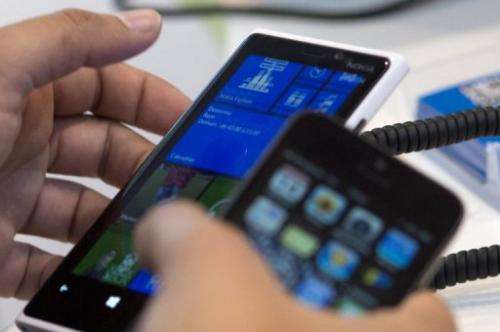
Global smartphone sales soared in 2012, taking a huge slice of a mobile phone market that was otherwise flat, survey data showed Friday.
A report by the research firm IDC showed a 44 percent jump in smartphone sales for the year, with 712 million units sold. That accounted for 45.5 percent of all mobile phone shipments.
The rest of the mobile phone market was lackluster, suggesting customers were trading in their older handsets for smartphones. The global market for all mobile phones grew just 1.2 percent to 1.7 billion units, IDC said.
IDC said Samsung extended its dominance of the market in both smartphones and overall mobile phones.
The South Korean giant captured 29 percent of the smartphone market, to Apple's 21.8 percent, and 23 percent of the overall market, ahead of Nokia's 17.9 percent.
But a big surge came from Chinese manufacturers Huawei and ZTE, which broke into the top ranks of smartphone vendors thanks to growth in emerging markets, IDC said.
Huawei grabbed 4.9 percent of the smartphone market, making it the third largest, and ZTE was in fifth place with 4.3 percent share, just behind Japan's Sony at 4.5 percent.
"The fact that Huawei and ZTE now find themselves among the top five smartphone vendors marks a significant shift for the global market," said IDC analyst Ramon Llamas.
"Both companies have grown volumes by focusing on the mass market, but in recent quarters they have turned their attention toward higher-end devices. In addition, both companies have pushed the envelope in terms of industrial design with larger displays and smaller form factors, as well as innovative applications and experiences."
Research firm Strategy Analytics said its survey showed global smartphone shipments grew 43 percent to 700 million units in 2012, with Samsung capturing more than 30 percent of the market.
The report showed smartphones accounted for close to half of the 1.6 billion mobiles sold in 2012. With all phones combined, the market grew just two percent, according to the report.
The report showed Apple holding 19.4 percent of the global smartphone market, trailing Samsung at 30.4 percent.
"Samsung and Apple together accounted for half of all smartphones shipped worldwide in 2012," said Linda Sui at Strategy Analytics.
"Large marketing budgets, extensive distribution channels and attractive product portfolios have enabled Samsung and Apple to tighten their grip on the smartphone industry."
Strategy Analytics data showed Nokia retained its position as the third largest smartphone vendor for 2012 but that its market share fell sharply from 16 percent to five percent.
ABI Research said in a separate report that 653 million smartphones were shipped during the year, more than 40 percent of the 1.6 billion handsets.
That survey showed Samsung with 31 percent of total smartphone shipments to 21 percent for Apple. But ABI said Apple appears to be facing tougher competition.
"It is clear that the iPhone's hyper growth has ended, and ABI Research believes that Apple's market share will peak in 2013 at 22 percent," said analyst Michael Morgan.
"Unless Apple is willing to trade iPhone margins for low cost iPhone shipments, Apple's handset market share will become dependent on customer loyalty."
(c) 2013 AFP


