Pythons, lionfish and now willow invade Florida's waterways
Foreign invaders such as pythons and lionfish are not the only threats to Florida's natural habitat. The native Carolina Willow is also starting to strangle portions of the St. Johns River.
Biologists at the University of Central Florida recently completed a study that shows this slender tree once used by Native Americans for medicinal purposes, may be thriving because of water-management projects initiated in the 1950s. Canals were built to control runoff and provide water for agriculture. The unintended consequence—stable water levels—allowed Carolina Willow to spread and thrive.
They now cover thousands of acres. Willows form impenetrable thickets that prevent boating and eliminate duck habitat. Willow thickets also use tremendous amounts of water, leaving less available for wildlife and people.
The findings were published today in Restoration Ecology, the peer-reviewed journal of the Society for Ecological Restoration. The St. Johns Water Management District funded the study.
While the trees previously were kept in check by natural annual flooding, they can now be found thriving in wetlands, swamps and marshes. Some trees grow as tall as 35 feet. The leaves of the tree contain salicin, which is the compound behind the pain-relieving effect of salicylic acid found in aspirin.
UCF professors Pedro F. Quintana-Ascencio and John Fauth worked with Kimberli Ponzio and Dianne Hall, scientists from the St. Johns River Water Management District, to run experiments that found ways to control the willow, which is taking over marshes in the upper St. Johns River basin.
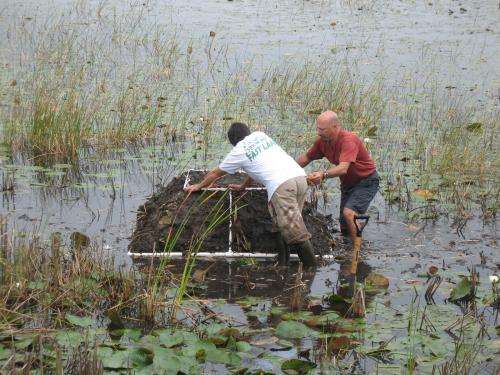
UCF students helped plant hundreds of willow seedlings and saplings onto small islands built for the project by the St. Johns River Water Management District's staff. Willows planted low on the islands drowned during summer floods, but plants above the waterline grew and flowered one year later.
The biologists confirmed the importance of water fluctuation using experimental ponds on UCF's main campus. Willow seedlings and saplings planted on the pond banks grew poorly when the biologists raised the water level and flooded the plants for several months. At the same time, control plants just above the waterline grew over 3 feet tall.
Combined, the two experiments show that the key to controlling willow is allowing water levels to fluctuate in early spring. Seedlings and small saplings cannot survive dry conditions and are easily drowned in wet marshes. Once plants become larger, willows can survive droughts and tolerate floods and are very difficult to eradicate, Fauth said.
Based on the conclusions of the study, the UCF biologists are helping scientists at the water district develop new ways to reduce willow cover and slow down the expansion, Fauth said.
"It's important that these trees be controlled to maintain water quality and availability, conserve wildlife and continue enjoying recreational activities in the river, " Fauth said.
The study may also aid other countries fighting the Carolina willow, including Australia and South Korea where they were introduced for erosion control.
Quintana-Ascencio joined UCF in 2003 after working at El Colegio de la Frontera Sur, in San Cristóbal de Las Casas, Chiapas, Mexico. He has a Ph.D. in ecology and evolution from State University of New York at Stony Brook. He has been a guest scholar at institutions around the world including the University of Melbourne in Victoria, Australia, and the Universidad Rey Juan Carlos in Madrid, Spain. He also has earned several fellowships and has published more than 60 articles and book chapters.
Fauth also joined UCF in 2003. Previously he had worked at the College of Charleston and at Denison University. He has a Ph.D. in zoology from Duke University. He has written more than 35 articles and book chapters. He also serves on several boards and was a founding member of the Coral Disease and Health Consortium.
Provided by University of Central Florida


