First detailed postcranial anatomy supporting Jeholosaurus as a basal ornithopod
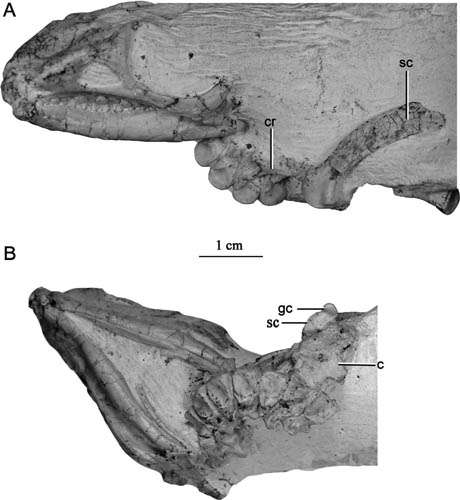
Phylogenetic relationships among basal ornithopod dinosaurs are poorly understood and the published tree topologies for these taxa, and other basal cerapodans, have only weak statistical support. Jeholosaurus shangyuanensis is a small ornithischian dinosaur from the Lower Cretaceous Yixian Formation of the Lujiatun locality, Liaoning Province, China. A recent study published in the journal of Vertebrate Paleontology 32(6) provides the first detailed description of its postcranial skeleton based on the holotype and four other well-preserved skeletons. A phylogenetic analysis incorporating these new postcranial data confirms previous suggestions that Jeholosaurus is a basal ornithopod, and indicates that it forms a clade with Changchunsaurus and Haya. The name Jeholosauridae is proposed for this apparently endemic group of Cretaceous East Asian taxa.
Jeholosaurus was preliminarily described and assigned to a basal position within Ornithopoda in 2000. It was shown to possess a combination of features present in both ornithopods and marginocephalians, making attribution to either one of these clades difficult. However, all previous phylogenetic analyses that include Jeholosaurus have generally recovered it as a basal ornithopod, often in a clade with Changchunsaurus from the Quantou Formation (Aptian–Cenomanian) of Jilin Province, China, and Haya griva from the Javkhlant Formation of Mongolia.
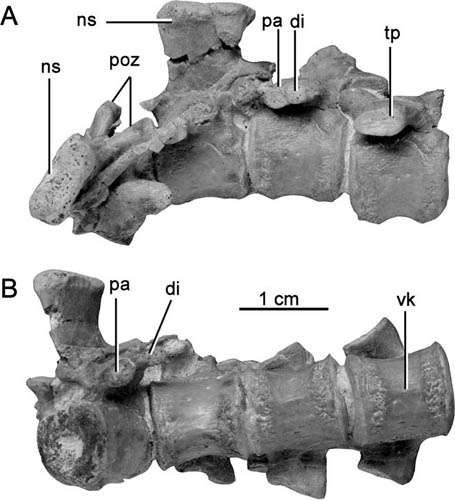
Paleontologists compared Jeholosaurus with material of other primitive cerapodans, and found it can be diagnosed on the basis of one postcranial autapomorphy, relating to the absence of parapophyses from the anterior dorsal vertebrae, and a unique combination of postcranial characters, but its anatomy is otherwise similar to that of many other basal ornithischians.
Although Changchunsaurus, Haya, and Jeholosaurus are very similar in overall anatomy, they can be distinguished by sets of cranial and postcranial autapomorphies, as well as unique combinations of character states, and probably represent a genuine radiation of small-bodied taxa.Researchers inferred that Koreanosaurus and Yueosaurus might also be closely related to, or included within this clade, Jeholosauridae, though additional material of both will be required to test this hypothesis.
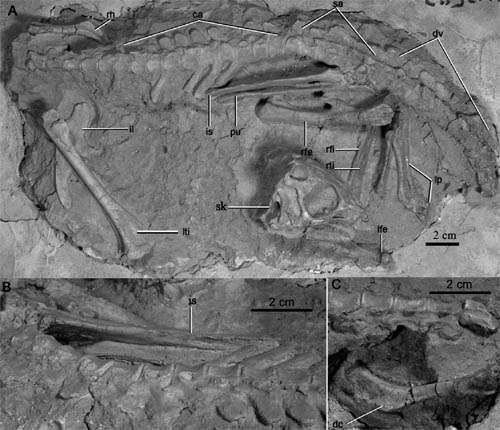
"Although our analysis places Jeholosaurus within Ornithopoda, it should be noted that relationships among basal cerapodan taxa remain weakly supported, and it is possible that the addition of new taxa or characters will have a major influence on tree topology, especially because some basal ornithopods and basal marginocephalians are now known to be more similar to each other than acknowledged previously", said first author HAN Fenglu, a Ph. D. student of the Institute of Vertebrate Paleontology and Paleoanthropology (IVPP), Chinese Academy of Sciences.
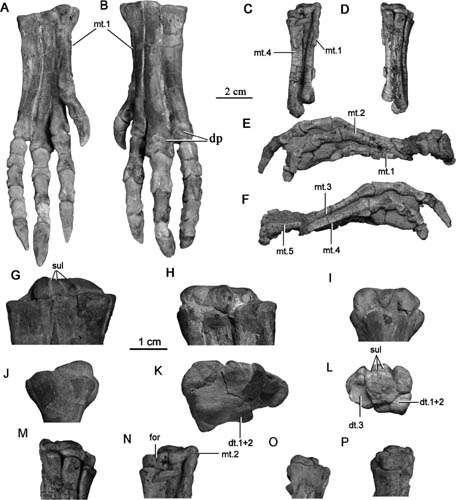
"Small ornithopods are generally rare in Eastern Asia. More work is necessary to resolve further the phylogenetic affinities of taxa including 'Gongbusaurus' wucaiwanensis and Yandusaurus hongheensis in order to determine if any other Chinese taxa might shed light on the early evolution of Jeholosauridae, or if they belong to other ornithischian lineages", said XU Xing of the IVPP, project designer and coauthor of the study.
More information: www.bioone.org/doi/full/10.1080/039.032.0601


