NASA sees Tropical Cyclone Garry continue to intensify
Jan 24, 2013
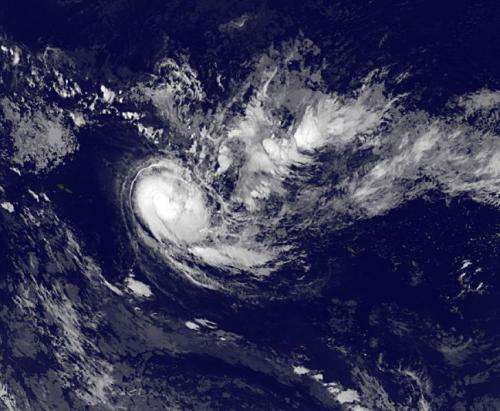
NOAA's GOES-15 satellite captured this infrared image of Tropical Storm Garry about 330 miles east of Pago Pago, American Samoa. The image was taken Jan. 24 at 1500 UTC (10 a.m. EST). The bright white circle of clouds are strong thunderstorms wrapping around the center of circulation as Garry continues to intensify. Credit: NASA's GOES Project

Tropical Cyclone Garry is in a good environment to intensify and satellite imagery from NOAA's GOES-15 satellite helped confirm that the storm has become more organized.

NOAA's GOES-15 captured an infrared image of Tropical Storm Garry when it was located about 330 nautical miles (379.8 miles/ 611.2 km) east of Pago Pago, American Samoa. The image, created by the NASA GOES Project at the NASA Goddard Space Flight Center in Greenbelt, Md., was taken Jan. 24 at 1500 UTC (10 a.m. EST). The image showed a bright white circle of clouds that indicate strong thunderstorms were wrapping around the center of circulation as Garry continues to intensify. The latest bulletin from the Joint noted that imagery confirmed deep convection wrapping almost entirely around Garry's well-defined low level circulation center.

NOAA's GOES-15 satellite is in a fixed orbit over the Pacific Ocean, midway between Hawaii and the West Coast and 22,300 miles above the equator. GOES-15 provides a good view of what is happening in U.S. west and in the Pacific Ocean.

On Jan. 24 at 0900 UTC, Garry's had increased to 60 knots (69 mph/111.1 kph). Garry's tropical-storm-force winds extend about 55 nautical miles (63.3 miles/102 km) from the center, making it a compact tropical cyclone. It was centered near 14.0 south latitude and 164.9 west longitude and moving to the southeast at 11 knots (12.6 mph/20.3 kph).

Forecasters at JTWC expect that Garry will continue moving southeast and is expected to pass far south of French Polynesia. Garry is expected to briefly reach cyclone (hurricane) strength before wind shear weakens and dissipates the storm.

Explore further: NASA eyes Typhoon Prapiroon intensifying

add to favorites email to friend print save as pdf

Related Stories

NASA eyes Typhoon Prapiroon intensifying

Oct 09, 2012

Typhoon Prapiroon is the twenty-second tropical cyclone of the western North Pacific Ocean, making for a very active season. NASA's Terra satellite passed over the storm as it was intensifying into a typhoon ...

NASA sees Cyclone Evan blown apart by wind shear

Dec 20, 2012

Cyclone Evan is no more than a remnant low pressure area in the South Pacific Ocean now. NOAA's GOES-15 satellite captured an image of the remnants from its fixed orbit in space on Dec. 20 that showed strong ...

Recommended for you

Origins of human culture linked to rapid climate change

2 hours ago

Rapid climate change during the Middle Stone Age, between 80,000 and 40,000 years ago, during the Middle Stone Age, sparked surges in cultural innovation in early modern human populations, according to new research.

Bangladeshi, South Korean climbers die on Everest

8 hours ago

A climber from Bangladesh and another from South Korea have died on Mount Everest as hundreds flock to the world's highest peak during good weather, Nepalese tourism officials said Tuesday.

User comments : 0

More news stories

Moore tornado a rarity, experts say

Tornados, among the most violent of atmospheric storms, rarely reach the size and brutality of the twister that swept through an Oklahoma City suburb on Monday, experts say.

Building a better team—on Mars

Sometime in the next quarter-century, NASA plans to send the first humans to Mars, a mission that will push the boundaries of teamwork for a handful of astronauts who will spend as long as three years together ...

B vitamins could delay dementia

(Medical Xpress)—Despite spending billions of dollars on research and development, drug companies have been unable to come up with effective treatments for dementia and Alzheimer's Disease (AD). Now, A. ...

Game system castAR debuts at Maker Faire

(Phys.org) —Two tech talents, formerly employees at video game publisher Valve, have been working on their own vision in the form of game-ready glasses. Their company, Technical Illusions, will seek to ...