NASA readies famous 'Chamber A' to welcome the James Webb Space Telescope
Jan 24, 2013
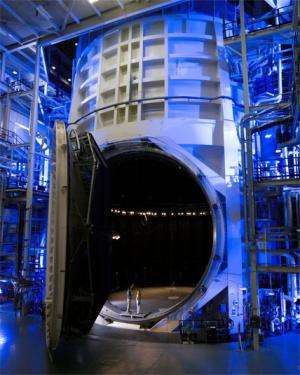
Johnson Space Center's Chamber A is a 16.8 m (55 ft) diameter x 27.4 m (90 ft) high, thermal-vacuum test facility and is famous for testing the Apollo spacecraft, with and without the mission crew. Credit: NASA Johnson

NASA's "Chamber A" thermal vacuum testing chamber famous for being used during Apollo missions has now been upgraded and remodeled to accommodate testing the James Webb Space Telescope.

When the next-generation space telescope was being designed, engineers had to ensure there was a place large enough to test it, considering it's as big as a tennis court. That honor fell upon the famous " A" in the thermal-vacuum test facility at NASA's Johnson Space Center in Houston, Texas.

Chamber A is now the largest high-vacuum, cryogenic-optical test chamber in the world, and made famous for testing the space capsules for NASA's Apollo mission, with and without the mission crew. It is 55 feet (16.8 meters) in diameter by 90 feet (27.4 meters) tall. The door weighs 40 tons and is opened and closed hydraulically.

This video is not supported by your browser at this time.
The largest thermal vacuum chamber in the world gets a major upgrade to test the largest space telescope ever built, the Webb Telescope. Credit: NASA/SVS, Mike McClare

For three years, NASA Johnson engineers have been building and remodeling the chamber interior for the temperature needed to test the Webb. Testing will confirm the telescope and systems will perform properly together in the of space. Additional test support equipment includes mass spectrometers, and television cameras so engineers can keep an eye on the Webb while it's being tested.

"Some of the things we've done is upgraded our helium system, our system, and air flow management," said Virginia Rivas-Yancy, project manager, Air Flow Management System at NASA Johnson. Temperatures in Chamber A can now drop farther than ever—down to -439.9 Fahrenheit (-262.1 Celsius or 11 degrees Kelvin) which is 11 degrees above absolute zero.

"The air in the chamber weighs 25 tons, about 12 1/2 Volkswagen Beetles; when all the air is removed the mass left inside will be the equivalent of half of a staple," said Ryan Grogan, Webb Telescope Chamber A project engineer at NASA Johnson.

A very large clean room is also being prepared near Chamber A where the observatory will be prepped for testing. The test itself will take 90 days. The first 30 days will consist of cooling the chamber down. The next few weeks will include tests on the Webb's operating systems, and the remainder of the time will be spent warming up the chamber to room temperature.

Test articles are normally inserted into the chamber by means of a precision mobile crane, but the Webb is so large, it will be folded up and wheeled in.

Explore further: New NASA video serves 'COCOA' to test Webb Telescope component

add to favorites email to friend print save as pdf

Related Stories

Scanning Webb's surrogate eye

Jul 06, 2012

(Phys.org) -- Engineer Erin Wilson adds aluminum tape to electrical cables to protect them from the cold during environmental testing of special optical equipment. These tests will verify the alignment of ...

The Webb Telescope's 'Golden Spider'

Aug 24, 2012

What looks like a giant golden spider weaving a web of cables and cords, is actually ground support equipment, including the Optical Telescope Simulator (OSIM), for the James Webb Space Telescope. OSIM's ...

Image: NASA's world's largest vacuum chamber

Feb 03, 2011

(PhysOrg.com) -- The world's largest vacuum chamber resides at the NASA Glenn Research Center's Space Power Facility, located at Plum Brook Station in Sandusky, Ohio.

Recommended for you

NASA head views progress on asteroid lasso mission

13 hours ago

Surrounded by engineers, NASA chief Charles Bolden inspected a prototype spacecraft engine that could power an audacious mission to lasso an asteroid and tow it closer to Earth for astronauts to explore.

Ecuador satellite collides with Russian space junk

13 hours ago

A small Ecuadoran satellite collided in orbit with the remains of a Russian rocket, but it is too soon to know how much damage it might have sustained, Quito's space agency said Thursday.

Forecast for Titan: Wild weather could be ahead

May 22, 2013

(Phys.org) —Saturn's moon Titan might be in for some wild weather as it heads into its spring and summer, if two new models are correct. Scientists think that as the seasons change in Titan's northern hemisphere, ...

SDO observes mid-level solar flare

May 22, 2013

UPDATE 16:30 p.m. EDT: The M7-class flare was also associated with a coronal mass ejection or CME, another solar phenomenon that can send billions of tons of particles into space. While this CME was not Ea ...

User comments : 0

More news stories

A hidden population of exotic neutron stars

(Phys.org) —Magnetars – the dense remains of dead stars that erupt sporadically with bursts of high-energy radiation - are some of the most extreme objects known in the Universe. A major campaign using ...

Hubble reveals the ring nebula's true shape

(Phys.org) —The Ring Nebula's distinctive shape makes it a popular illustration for astronomy books. But new observations by NASA's Hubble Space Telescope of the glowing gas shroud around an old, dying, ...

Century-old science helps confirm global warming

(Phys.org) —Ocean measurements taken more than 135 years ago during the scientific expedition of HMS Challenger have provided further confirmation of human-produced global warming over the past century.

Hormone replacement therapy—clarity at last

The British Menopause Society and Women's Health Concern have today released updated guidelines on Hormone Replacement Therapy (HRT) to provide clarity around the role of HRT, the benefits and the risks. The new guidelines ...

Controlling mood through the motions of mitochondria

(Medical Xpress)—Regulating the distribution of power in neurons is done by a system that makes the national electric grid look simple by comparison. Each neuron has several thousand mitochondria confined ...