Study provides new insights on drought predictions in East Africa
(Phys.org)—With more than 40 million people living under exceptional drought conditions in East Africa, the ability to make accurate predictions of drought has never been more important. In the aftermath of widespread famine and a humanitarian crisis caused by the 2010-2011 drought in the Horn of Africa—possibly the worst drought in 60 years— researchers are striving to determine whether drying trends will continue.
While it is clear that El Niño can affect precipitation in this region of East Africa, very little is known about the drivers of long-term shifts in rainfall. However, new research described in the journal Nature helps explain the mechanisms at work behind historical patterns of aridity in Eastern Africa over many decades, and the findings may help improve future predictions of drought and food security in the region.
"The problem is, instrumental records of temperature and rainfall, especially in East Africa, don't go far enough in time to study climate variability over decades or more, since they are generally limited to the 20th century," explains first author Jessica Tierney, a geologist at the Woods Hole Oceanographic Institution (WHOI). Tierney and her colleagues at WHOI and the Lamont-Doherty Earth Observatory of Columbia University used what is known as the paleoclimate record, which provides information on climate in the geologic past, to study East African climate change over a span of 700 years.
The paleoclimate record in East Africa consists of indicators of moisture balance—including pollen, water isotopes, charcoal, and evidence for run-off events – measured in lake sediment cores. Tierney and her colleagues synthesized these data, revealing a clear pattern wherein the easternmost sector of East Africa was relatively dry in medieval times (from 1300 to 1400 a.d.), wet during the "Little Ice Age" from approximately 1600 to 1800 a.d., and then drier again toward the present time.
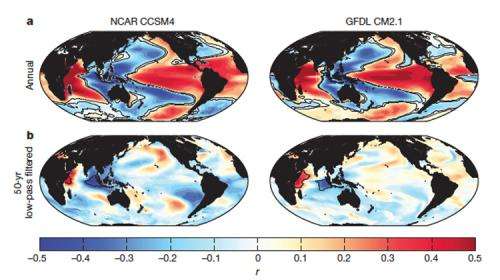
Climate model simulations analyzed as part of the study revealed that the relationship between sea surface temperatures and atmospheric convection in the Indian Ocean changes rainfall in East Africa. Specifically, wet conditions in coastal East Africa are associated with cool sea surface temperatures in the eastern Indian Ocean and warm sea surface temperatures in the western Indian Ocean, which cause ascending atmospheric circulation over East Africa and enhanced rainfall. The opposite situation—cold sea surface temperatures in the western Indian Ocean and warmer in the East—causes drought. Such variations in sea-surface temperatures likely caused the historical fluctuations in rainfall seen in the paleorecord.
The central role of the Indian Ocean in long-term climate change in the region was a surprise. "While the Indian Ocean has long been thought of as a 'little brother' to the Pacific, it is clear that it is in charge when it comes to these decades-long changes in precipitation in East Africa," says Tierney.
Many questions remain, though. "We still don't understand exactly what causes the changes in sea surface temperatures in the Indian Ocean and the relationship between those changes and global changes in climate, like the cooling that occurred during the Little Ice Age or the global warming that is occurring now," says Tierney. "We'll need to do some more experiments with climate models to understand that better."
In the past decade, the easternmost region of Africa has gotten drier, yet general circulation climate models predict that the region will become wetter in response to global warming. "Given the geopolitical significance of the region, it is very important to understand whether drying trends will continue or if the model projections will eventually prove right, or need to be revised," says co-author Jason Smerdon, of the Lamont-Doherty Earth Observatory.
While it's currently unclear which theory is correct, the discovery of the importance of the Indian Ocean may help solve the mystery. "In terms of forecasting long-term patterns in drought and food security, we would recommend that researchers make use of patterns of sea surface temperature changes in the Indian Ocean rather than just looking at the shorter term El Niño events or the Pacific Ocean," says Tierney.
In addition, Tierney and her colleagues lack paleoclimate data from the region that is most directly affected by the Indian Ocean—the Horn of Africa. The paleoclimate data featured in this study are limited to more equatorial and interior regions of East Africa. With support from National Science Foundation, Tierney and her colleagues are now developing a new record of both aridity and sea surface temperatures from the Gulf of Aden, at a site close to the Horn.
"This will give us the best picture of what's happened to climate in the Horn, and in fact, it will be the first record of paleoclimate in the Horn that covers the last few millennia in detail. We're working on those analyses now and should have results in the next year or so," says Tierney.
More information: Multidecadal variability in East African hydroclimate controlled by the Indian Ocean, Published in Nature, www.nature.com/nature/journal/ … ull/nature11785.html
Journal information: Nature
Provided by Woods Hole Oceanographic Institution


