Will changes in climate wipe out mammals in Arctic and sub-Arctic areas?
Jan 14, 2013
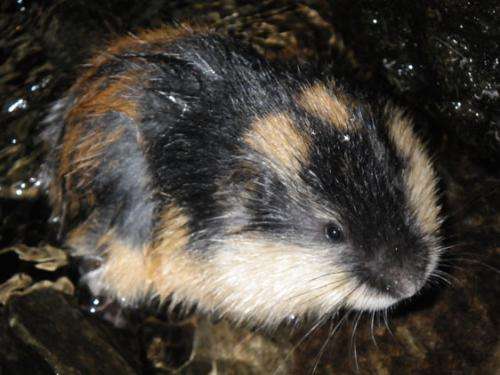
The lemming is a species that will decline if the climate changes in the way climatologists predict. This lemming is a bit wet following a swim in the Vindel River in northern Sweden. Credit: Christer Nilsson

The climate changes depicted by climatologists up to the year 2080 will benefit most mammals that live in northern Europe's Arctic and sub-Arctic land areas today if they are able to reach their new climatic ranges. This is the conclusion drawn by ecologists at Umeå University in a recently published article in the journal Plos ONE.

The scientists Anouschka Hof, Roland Jansson, and Christer Nilsson of the Department of Ecology and Environmental Science at Umeå University investigated how future climate changes may come to impact mammals in 's Arctic and sub-Arctic , excluding the Arctic seas and islands. These land masses are assumed to undergo major changes in climate, and their natural ecology is also regarded as especially susceptible to changes.

By modeling the distribution of species, the researchers have determined that the predicted climate changes up to the year 2080 will benefit most mammals that live in these areas today, with the exception of some specialists in , such as the Arctic fox and the lemming.

"This will be the case only on the condition that the species can reach the areas that take on the climate these animals are adapted to. We maintain that it is highly improbable that all mammals will be able to do so, owing partly to the increased fragmentation of their living environments caused by human beings. Such species will reduce the extent of their distribution instead," says Christer Nilsson, professor of .

The researchers also show that even if climate changes as such do not threaten the majority of Arctic and sub-Arctic mammals, changes in the species mix may do so, for instance because predators and their potential prey that previously did not live together may wind up in the same areas.

Explore further: Chinese, Indian airlines face EU pollution fines

More information: Future Climate Change Will Favour Non-Specialist Mammals in the (Sub)Arctics, www.plosone.org/article/info%3Adoi%2F10.1371%2Fjournal.pone.0052574

add to favorites email to friend print save as pdf

Related Stories

Arctic marine mammals on thin ice

Apr 23, 2008

The loss of sea ice due to climate change could spell disaster for polar bears and other Arctic marine mammals. The April Special Issue of Ecological Applications examines such potential effects, puts them in historical ...

Change is the order of the day in the Arctic

May 11, 2011

Climate change in the Arctic is occurring at a faster and more drastic rate than previously assumed, according to experts attending the AMAP conference in Copenhagen. The latest scientific data show that developments in the ...

Are Ice Age relics the next casualty of climate change?

Apr 24, 2008

The Wildlife Conservation Society (WCS) recently launched a four-year study to determine if climate change is affecting populations of a quintessential Arctic denizen: the rare musk ox. Along with collaborators ...

Arctic animals doing better, but not close to pole

Mar 17, 2010

(AP) -- The overall number of animals in the Arctic has increased over the past 40 years ago, according to a new international study. But critters who live closest to the North Pole are disappearing.

Recommended for you

Chinese, Indian airlines face EU pollution fines

19 hours ago

Eight Chinese and two Indian airlines face fines of up to several million euros for not paying for their greenhouse gas emissions during flights within the bloc, the European Commission said on Friday.

Fracking risks to ground water assessed

May 17, 2013

(Phys.org) —Extraction of "unconventional" gas from sedimentary rocks such as shale could provide a clean energy source and help some regions to become energy independent, but concerns have been raised ...

Caribbean talks conservation on Branson's island

May 17, 2013

(AP)—Surrounded by a turquoise sea and a menagerie of exotic animals on a billionaire's private island, political and business leaders gathered Friday to back an initiative aimed at expanding protection ...

User comments : 4

Adjust slider to filter visible comments by rank

Display comments: newest first

ScooterG
1.6 / 5 (7) Jan 15, 2013
Question: "Will changes in climate wipe out mammals in Arctic and sub-Arctic areas?"

Answer: Yes. Climate change will wipe out all mammals everywhere, even those in Arctic and sub-Arctic areas.
ScooterG
1.6 / 5 (7) Jan 15, 2013
Question: But the animals are sooo cute! Is there any way to save them?

Answer: Yes. Do not drive your car, do not heat or cool your home or office (totally disconnect from the grid), do not use your computer or cell phone, do not purchase any product that requires energy to manufacture, do not eat unless you grow the food in your back yard. Only then can the animals avoid being "wiped out".

For more animal-saving tips and "what you can do to undo what you are doing", visit our website: http://www. Guilt-RiddenChumps-R-Us. com
FrankHerbert
2.3 / 5 (9) Jan 15, 2013
It's curious that even though you claim AGW is totally false, you still defend it as if it were true.
VendicarD
2.7 / 5 (7) Jan 15, 2013
ScooTard irrational and emotional response provides us with a wonderful example of why compliance to rational goals will require economic and regulatory coercion.

He has only himself to blame.

More news stories

Galaxy's Ring of Fire

Johnny Cash may have preferred this galaxy's burning ring of fire to the one he sang about falling into in his popular song. The "starburst ring" seen at center in red and yellow hues is not the product of ...

Alaska volcano shoots ash 15,000 feet into the air

(AP)—One of Alaska's most restless volcanoes has shot an ash cloud 15,000 feet into the air in an ongoing eruption that has drawn attention from a nearby community but isn't expected to threaten air traffic.

Chinese, Indian airlines face EU pollution fines

Eight Chinese and two Indian airlines face fines of up to several million euros for not paying for their greenhouse gas emissions during flights within the bloc, the European Commission said on Friday.

Morocco to harness the wind in energy hunt

Morocco is ploughing ahead with a programme to boost wind energy production, particularly in the southern Tarfaya region, where Africa's largest wind farm is set to open in 2014.

US seizes Bitcoin operator accounts

US authorities seized the accounts of a Bitcoin digital currency exchange operator, claiming it was functioning as an "unlicensed money service business," court documents showed Friday.