ARS scientists test improved stink bug trapping methods
Jan 18, 2013
ARS scientists test improved stink bug trapping methods
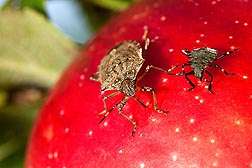
Black, pyramid-shape traps baited with a pheromone and placed on the ground appear to be the best at catching stink bugs, which have become a major pest for farmers and home owners. Credit: Stephen Ausmus.

Baited black traps in a pyramid shape attract significantly more brown marmorated stink bugs than other traps, according to U.S. Department of Agriculture (USDA) scientists. Evaluating stink bug responses to different visual stimuli may help manufacturers design better traps for monitoring the bugs.

Entomologist Tracy Leskey at the Agricultural Research Service (ARS) Appalachian Fruit Research Station in Kearneysville, W.V., focused on that can attract the to traps that will help farmers monitor the level of infestation in their fields and orchards.

ARS is USDA's principal intramural scientific research agency, and this research supports the USDA priority of promoting international food security.

In field trials in 2009 and 2010, Leskey and her colleagues found that significantly more stink bug adults and juvenile bugs, called nymphs, were captured in the baited black pyramid traps than in other traps. The researchers also found that more adults and nymphs were captured in a trap placed on the ground than in a commercially available trap hung from a tree limb.

These prototype pyramid traps may serve as monitoring tools to assess the presence, abundance and seasonal activity of pests and to determine the need for insecticide applications.

Leskey and her colleagues also found that in 2010, 2011 and 2012, stink bugs produced two generations in one year in Kearneysville, based on the presence of eggs and newly molted adults in field cage experiments. Although it has been reported that these bugs produce only one brood annually in eastern Pennsylvania, it appears that in more southerly locations within the Mid-Atlantic region, they can produce two generations per year, according to Leskey.

Results from 2010 were published in the Journal of Entomological Science.

A more extensive study is being replicated in several states on the East Coast to determine how many generations may be produced annually in those locations.

Explore further: Combating USDA's top-ranked invasive insect

More information: Read more about this research in the January 2013 issue of Agricultural Research magazine: www.ars.usda.gov/is/AR/archive/jan13/stinkbug0113.htm

add to favorites email to friend print save as pdf

Related Stories

Combating USDA's top-ranked invasive insect

Jan 07, 2013

First detected in the United States a decade ago, the brown marmorated stink bug (BMSB) is now in at least 39 states, is wreaking havoc in homes and gardens, and is a major economic threat to orchard fruits, garden vegetables ...

Biology and management of the green stink bug

Sep 26, 2012

The green stink bug is one of the most damaging native stink bug species in the United States. Stink bugs feeding on cotton, soybeans, tomatoes, peaches, and other crops can result in cosmetic damage as well ...

Stink bugs shouldn't pose problem until late summer

Mar 31, 2011

Last fall, Stephanie Sturmfels battled stink bugs at her Pike Creek home and yard. “Stink bugs were on my deck, they were on my front porch, some were even in my house,” recalls the mother of two ...

Asian 'megapest' is chomping up US orchards

Jun 28, 2011

A stink bug from Asia is chomping up US vegetable fields, orchards and vineyards, causing experts to scramble through an arsenal of weapons to try and halt this stealthy, smelly predator.

Stink bug spread worries growers across nation

May 20, 2011

(AP) -- An insect with a voracious appetite, no domestic natural predators and a taste for everything from apples to lima beans has caused millions of dollars in crop damage and may just be getting started.

Researchers develop stink bug monitoring tool

May 04, 2011

(PhysOrg.com) -- As crop growers and homeowners brace for another year of infestations by the brown marmorated stink bug, Penn State researchers have released a Web-based tool that they hope will help enhance ...

Recommended for you

Hong Kong dolphin numbers dwindling quickly

13 hours ago

Conservationists Tuesday warned that the number of rare Chinese white dolphins in Hong Kong waters has fallen to its lowest level in a decade of monitoring, and urged the government to immediately create more protected areas.

WWF urges Romania, Bulgaria to protect wild sturgeon

16 hours ago

Conservationist group WWF on Tuesday urged Romania and Bulgaria, home to the last viable wild sturgeon populations in the European Union, to protect the species, threatened by illegal fishing and caviar trade.

New resource to record Britain's trees launched

18 hours ago

Treezilla, the monster map of trees, was launched by The Open University and partners on 14 June 2013. The citizen science project aims to map every tree in Britain through Treezilla.org and the related apps.

Study reveals disease-causing parasites in dead otters

20 hours ago

Research undertaken by the Cardiff University Otter Project has revealed a number of disease-causing parasites in the bodies of dead otters. The findings were revealed at the BBC Summer of Wildlife event ...

Millions of moths mass on Madrid

Jun 17, 2013

Millions of moths have engulfed Madrid in a population explosion blamed on spring rains, a sudden blast of summer heat and winds that have wafted them in as unwelcome guests to the Spanish capital.

User comments : 0

More news stories

Origins of 'The Hoff' crab revealed (w/ Video)

The history of a new type of crab, nicknamed 'The Hoff' because of its hairy chest, which lives around hydrothermal vents deep beneath the Southern Ocean and Indian Ocean, has been revealed for the first ...

3D printing tiny batteries

(Phys.org) —3D printing can now be used to print lithium-ion microbatteries the size of a grain of sand. The printed microbatteries could supply electricity to tiny devices in fields from medicine to communications, ...