Shot away from its companion, giant star makes waves
Dec 19, 2012 by Whitney Clavin
Credit: NASA/JPL-Caltech

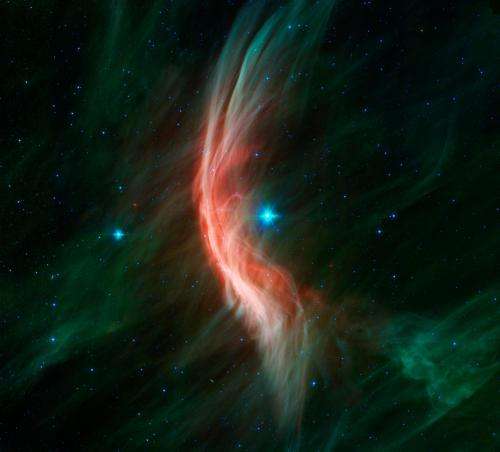
(Phys.org)—Like a ship plowing through still waters, the giant star Zeta Ophiuchi is speeding through space, making waves in the dust ahead. NASA's Spitzer Space Telescope has captured a dramatic, infrared portrait of these glowing waves, also known as a bow shock.

Astronomers theorize that this star was once sitting pretty next to a even heftier than itself. But when that star died in a fiery explosion, Zeta Ophiuchi was kicked away and sent flying. Zeta Ophiuchi, which is 20 times more massive and 80,000 times brighter than our sun, is racing along at about 54,000 mph (24 kilometers per second).

In this view, infrared light that we can't see with our eyes has been assigned visible colors. Zeta Ophiuchi appears as the bright blue star at center. As it charges through the dust, which appears green, fierce stellar winds push the material into waves. Where the waves are the most compressed, and the warmest, they appear red. This is analogous to the ripples that precede the bow of a ship as it moves through the water, or the pileup of air ahead of a supersonic airplane that results in a .

NASA's Wide-field Infrared Survey Explorer, or WISE, released a similar picture of the same object in 2011. WISE sees infrared light as does Spitzer, but WISE was an all-sky survey designed to take snapshots of the entire sky. Spitzer, by contrast, observes less of the sky, but in more detail. The WISE image can be seen at: phys.org/news/2011-01-runaway-star-plows-space.html .

Explore further: The 'flame' burns bright in new WISE image

More information: For more information about Spitzer, visit spitzer.caltech.edu and www.nasa.gov/spitzer.

Related Stories

Runaway star plows through space

Jan 25, 2011

(PhysOrg.com) -- A massive star flung away from its former companion is plowing through space dust. The result is a brilliant bow shock, seen here as a yellow arc in a new image from NASA's Wide-field Infrared ...

Speed demon creates a shock

Mar 11, 2011

(PhysOrg.com) -- Just as some drivers obey the speed limit while others treat every road as if it were the Autobahn, some stars move through space faster than others. NASA's Wide-field Infrared Survey Explorer, ...

The 'flame' burns bright in new WISE image

Jul 03, 2012

(Phys.org) -- A new image from NASA's Wide-field Infrared Survey Explorer, or WISE, shows the candle-like Flame nebula lighting up a cavern of dust. The Flame nebula is part of the Orion complex, a turbulent ...

Star explosion leaves behind a rose

Dec 12, 2011

(PhysOrg.com) -- About 3,700 years ago, people on Earth would have seen a brand-new bright star in the sky. It slowly dimmed out of sight and was eventually forgotten, until modern astronomers later found ...

The art of making stars

Apr 04, 2011

(PhysOrg.com) -- It might look like an abstract painting, but this splash of colors is in fact a busy star-forming complex called Rho Ophiuchi. NASA's Wide-field Infrared Explorer, or WISE, captured the picturesque ...

Wise catches aging star erupting with dust

Apr 26, 2012

(Phys.org) -- Images from NASA's Wide-field Infrared Survey Explorer (WISE) reveal an old star in the throes of a fiery outburst, spraying the cosmos with dust. The findings offer a rare, real-time look at ...

Recommended for you

Hubble reveals the ring nebula's true shape

5 hours ago

(Phys.org) —The Ring Nebula's distinctive shape makes it a popular illustration for astronomy books. But new observations by NASA's Hubble Space Telescope of the glowing gas shroud around an old, dying, ...

A hidden population of exotic neutron stars

10 hours ago

(Phys.org) —Magnetars – the dense remains of dead stars that erupt sporadically with bursts of high-energy radiation - are some of the most extreme objects known in the Universe. A major campaign using ...

Very Large Telescope celebrates 15 years of success

15 hours ago

(Phys.org) —With this new view of a spectacular stellar nursery ESO is celebrating 15 years of the Very Large Telescope—the world's most advanced optical instrument. This picture reveals thick clumps ...

Fragile mega-galaxy is missing link in history of cosmos

May 22, 2013

Two hungry young galaxies that collided 11 billion years ago are rapidly forming a massive galaxy about 10 times the size of the Milky Way, according to UC Irvine-led research published Wednesday in the journal ...

User comments : 2

Adjust slider to filter visible comments by rank

Display comments: newest first

rubberman
3 / 5 (2) Dec 19, 2012
This is what happens when a star actually moves through the ISM, hence a heliospheric/ISM bow shock. The description of the process in the article could use a little work. Love the picture.
Widdekind
1 / 5 (1) Dec 26, 2012
Inexpertly, the thick, dense bow shock shows, that dust resides everywhere, even if normally too diffuse and/or cold to be observable

More news stories

Hubble reveals the ring nebula's true shape

(Phys.org) —The Ring Nebula's distinctive shape makes it a popular illustration for astronomy books. But new observations by NASA's Hubble Space Telescope of the glowing gas shroud around an old, dying, ...

A hidden population of exotic neutron stars

(Phys.org) —Magnetars – the dense remains of dead stars that erupt sporadically with bursts of high-energy radiation - are some of the most extreme objects known in the Universe. A major campaign using ...

NASA head views progress on asteroid lasso mission

Surrounded by engineers, NASA chief Charles Bolden inspected a prototype spacecraft engine that could power an audacious mission to lasso an asteroid and tow it closer to Earth for astronauts to explore.

Controlling mood through the motions of mitochondria

(Medical Xpress)—Regulating the distribution of power in neurons is done by a system that makes the national electric grid look simple by comparison. Each neuron has several thousand mitochondria confined ...

A quantum simulator for magnetic materials

Physicists understand perfectly well why a fridge magnet sticks to certain metallic surfaces. But there are more exotic forms of magnetism whose properties remain unclear, despite decades of intense research. ...