Shadows on ice: Proba-1 images Concordia south polar base
Dec 13, 2012
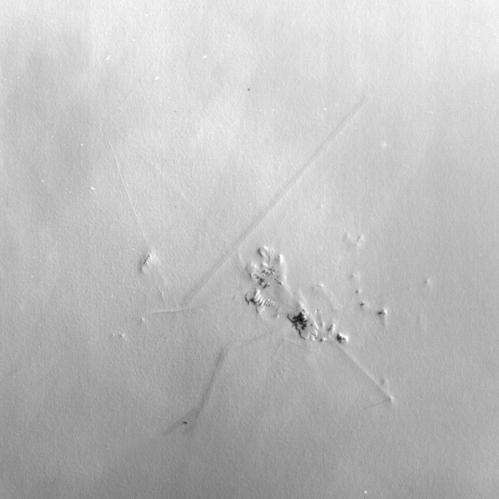
Proba-1 images Concordia base.

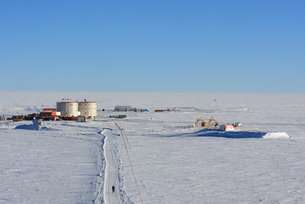
(Phys.org)—ESA's Earth-observing microsatellite Proba-1 has glimpsed one of the loneliest places on Earth – Concordia research base in the heart of Antarctica.

This image was acquired by the , the smallest imager on ESA's smallest satellite. This black and white digital camera incorporates a miniaturised telescope to fit in Proba-1, whose overall volume is less than a cubic metre.

Long shadows cast by the low Sun pick out details of the base's layout in this 5 m-resolution image.

The Concordia station, built and operated by France's IPEV polar institute and Italy's PNRA Antarctic programme, is one of the few permanently crewed habitats in Antarctica. Located 3233 m above sea level in the high interior, its nearest neighbour is Russia's base, some 560 km away.

Shadows on ice: Proba-1 images Concordia south polar base
Concordia station.

Its extreme location makes it interesting to ESA, which sponsors medical research on how isolation affects overwintering crews during months of cold darkness. 

Life in Concordia is similar to living on another planet. No help can arrive during the winter months and venturing outside is dangerous – temperatures can drop to –80ºC.

The base's distinctive double-cylinder habitats, home to skeleton crews during winter, are picked out by the area of greatest shadow. Directly northeast are the summer camp buildings, with the base runway visible to the north.

To the east of the main habitats are an astronomy platform – Concordia boasts some of the clearest skies in the world – and survey areas where subsurface drilling extracts ice cores.

A faint dot further east is the entrance to an underground seismology shelter measuring ground tremors.

A US-built radio tower and the smoothed-out path leading to it are visible towards the southeast corner of the image.

This image was acquired on 24 November.

Explore further: Proba-2's espresso-cup microcamera snaps Hurricane Isaac

add to favorites email to friend print save as pdf

Related Stories

Medical research on ice

Jun 12, 2008

New medical equipment recently delivered to the Antarctic station Concordia will help understand how our bodies physically adapt to this extreme environment - knowledge which could help prepare for a future ...

Voyage to the most isolated base on Earth

Jan 30, 2012

Alexander Kumar, the next ESA-sponsored crewmember to stay in Concordia, has arrived safely at the research base in Antarctica. The voyage to one of the remotest places on Earth takes even longer than the ...

Concordia calling

Jan 25, 2010

(PhysOrg.com) -- Altitude 3200 m, air pressure 645 hPa, minimum temperature -85°C, completely flat landscape, almost total isolation and virtually inaccessible from February to November. Welcome to the science ...

Mission to Mars via Antarctica

Dec 21, 2005

A few weeks before leaving for the Antarctic Concordia Station, the Italian-French crew that will spend over one year in one of the harshest, isolated environments on Earth, attended two days of preparatory ...

Season's greetings from the other extreme

Dec 23, 2011

It is summer in Antarctica and the new crew for the Concordia research station will soon arrive. And since the place is second only to space for harsh conditions, they have been trained courtesy of ESA.

Recommended for you

NASA head views progress on asteroid lasso mission

9 hours ago

Surrounded by engineers, NASA chief Charles Bolden inspected a prototype spacecraft engine that could power an audacious mission to lasso an asteroid and tow it closer to Earth for astronauts to explore.

Ecuador satellite collides with Russian space junk

9 hours ago

A small Ecuadoran satellite collided in orbit with the remains of a Russian rocket, but it is too soon to know how much damage it might have sustained, Quito's space agency said Thursday.

Forecast for Titan: Wild weather could be ahead

May 22, 2013

(Phys.org) —Saturn's moon Titan might be in for some wild weather as it heads into its spring and summer, if two new models are correct. Scientists think that as the seasons change in Titan's northern hemisphere, ...

SDO observes mid-level solar flare

May 22, 2013

UPDATE 16:30 p.m. EDT: The M7-class flare was also associated with a coronal mass ejection or CME, another solar phenomenon that can send billions of tons of particles into space. While this CME was not Ea ...

User comments : 0

More news stories

A hidden population of exotic neutron stars

(Phys.org) —Magnetars – the dense remains of dead stars that erupt sporadically with bursts of high-energy radiation - are some of the most extreme objects known in the Universe. A major campaign using ...

Hubble reveals the ring nebula's true shape

(Phys.org) —The Ring Nebula's distinctive shape makes it a popular illustration for astronomy books. But new observations by NASA's Hubble Space Telescope of the glowing gas shroud around an old, dying, ...

NASA head views progress on asteroid lasso mission

Surrounded by engineers, NASA chief Charles Bolden inspected a prototype spacecraft engine that could power an audacious mission to lasso an asteroid and tow it closer to Earth for astronauts to explore.

Controlling mood through the motions of mitochondria

(Medical Xpress)—Regulating the distribution of power in neurons is done by a system that makes the national electric grid look simple by comparison. Each neuron has several thousand mitochondria confined ...