Protein strongest just before death
Dec 12, 2012 by Layne Cameron
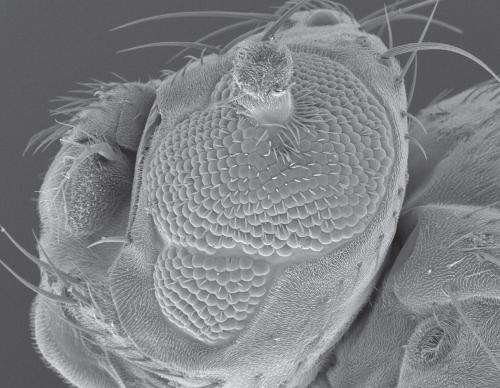
MSU researchers have discovered a protein that does its best work with one foot in the grave. Credit: Courtesy of MSU.

(Phys.org)—Researchers at Michigan State University have discovered a protein that does its best work with one foot in the grave.

The study, which appears in the current issue of the , focuses on the nontraditional lifestyle of suppressor proteins, which could lead to new ways to treat cancer.

"Retinoblastoma proteins are unique in that they use controlled destruction to do their jobs in a timely but restrained fashion," said Liang Zhang, a lead author and MSU graduate student. "This is an unusual way for proteins to act."
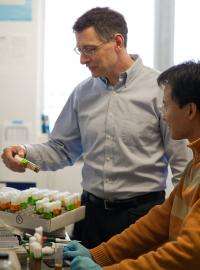
David Arnosti, professor of molecular biology, and director of MSU's Gene Expression in Disease Development. Credit: Michigan State University

As an organism grows, proteins essential for fueling its prosperity typically toe a tight line, performing their jobs at the right place and time. If these proteins go rogue, disasters such as cancer can result.

Retinoblastoma proteins, which could be labeled as rebellious ­as opposed to rogue, perform acts of valor rather than destruction. And just like fireworks, they save their best work for the finale.

Proteins' lifecycles end with degradation, and like most living things they become weaker and less efficient at their jobs near the end of their lives. For Retinoblastoma proteins, however, their destruction is linked to their ability to efficiently control excessive cell growth.

Using the fruit fly Drosophila, MSU researchers isolated the specific region that controls the protein's ability to degrade. Strikingly, this is the same region the protein uses to hit its stride and exert its full power to suppress genes related to unrestrained cell growth. Other categories of genes, such as those linked to cell death, may not be influenced by this specific region that controls degradation. This sheds light on a single mechanism that controls both living and dying at the .

Identifying this mechanism in could be beneficial to humans. David Arnosti, MSU and director of MSU's in Disease Development initiative, noted the genetic similarities between humans and Drosophila, describing fruit flies as "resembling little people with wings."

"By revealing the molecular details about the regulation of the fly Retinoblastoma protein, we can start to understand the possible roles of the human counterparts in cancer," he said.

Explore further: Revelation of protein complex function that controls cell proliferation in fruit fly wings provides insights into tumor

Related Stories

Fruit Flies, Death, and Immunity

Mar 28, 2007

University of Arkansas scientists have found an important mechanism that regulates the destruction of larval fruit fly salivary glands that could point the way to understanding programmed cell death in the human immune system.

Researchers discover key to cell specialization

Nov 10, 2011

Researchers at then Albert Einstein College of Medicine of Yeshiva University have uncovered a mechanism that governs how cells become specialized during development. Their findings could have implications for human health ...

Recommended for you

Attacking MRSA with metals from antibacterial clays

17 hours ago

In the race to protect society from infectious microbes, the bugs are outrunning us. The need for new therapeutic agents is acute, given the emergence of novel pathogens as well as old foes bearing heightened antibiotic resistance.

Keeping fruit, vegetables and cut flowers fresh longer

May 15, 2013

New technology offers the promise of reducing billions of dollars of losses that occur each year from the silent, invisible killer of fruits, vegetables and cut flowers—a gas whose effects are familiar to everyone who has ...

Why don't beetles freeze in the winter?

May 14, 2013

For 37 years, Queen's University Biochemistry professor Peter Davies has been unraveling the mystery of why some organisms including insects and fish don't freeze in the winter. His research into insect antifreeze protein ...

The molecular basis of strawberry aroma

May 13, 2013

You know that summer is here when juicy red strawberries start to appear on the shelves. In Germany, this seasonal fruit has never been more popular: on average 3.5 kilos per head were consumed in 2012—a ...

A new dimension for 3-D protein structures

May 13, 2013

(Phys.org) —3D structures of biological molecules like proteins directly affect the way they behave in our bodies. EPFL scientists have developed a new infrared-UV laser method to more accurately determine ...

User comments : 0

More news stories

Attacking MRSA with metals from antibacterial clays

In the race to protect society from infectious microbes, the bugs are outrunning us. The need for new therapeutic agents is acute, given the emergence of novel pathogens as well as old foes bearing heightened antibiotic resistance.

Beautiful 'flowers' self-assemble in a beaker

By simply manipulating chemical gradients in a beaker of fluid, materials scientists at Harvard have found that they can control the growth behavior of crystals to create precisely tailored structures—such ...

Making gold green: New non-toxic method for mining gold

Northwestern University scientists have struck gold in the laboratory. They have discovered an inexpensive and environmentally benign method that uses simple cornstarch—instead of cyanide—to isolate gold from raw materials ...

Yahoo Japan suspects 22 million IDs stolen

Yahoo Japan Corp. has said it suspects up to 22 million user IDs may have been stolen during an unauthorised attempt to access the administrative system of its Yahoo! Japan portal.

US seizes Bitcoin operator accounts

US authorities seized the accounts of a Bitcoin digital currency exchange operator, claiming it was functioning as an "unlicensed money service business," court documents showed Friday.

Alaska volcano shoots ash 15,000 feet into the air

(AP)—One of Alaska's most restless volcanoes has shot an ash cloud 15,000 feet into the air in an ongoing eruption that has drawn attention from a nearby community but isn't expected to threaten air traffic.