NASA puts Orion backup parachutes to the test
Dec 21, 2012 by Rachel Kraft & Brandi Dean
NASA puts Orion backup parachutes to the test
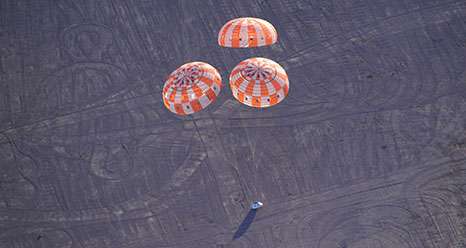
A mockup Orion capsule touches down in the desert of the U.S. Army Yuma Proving Ground in Arizona with the help of its three 300-pound main parachutes, after being dropped from an airplane 25,000 feet up. The test verified that the parachute design for the spacecraft – which will take humans farther than they’ve ever been before and return them to Earth at greater speeds than ever before – will work in the event of one of the capsule’s two drogue parachutes malfunctions. Credit: NASA

(Phys.org)—NASA completed the latest in a series of parachute tests for its Orion spacecraft Thursday at the U.S. Army Yuma Proving Ground in southwestern Arizona, marking another step toward a first flight test in 2014. The test verified Orion can land safely even if one of its two drogue parachutes does not open during descent.

Orion will take humans farther into space than ever before, but one of the most challenging things the multipurpose vehicle will do is bring its crew home safely. Because it will return from greater distances, Orion will reenter the Earth's at speeds of more than 20,000 mph. After re-entry, the parachutes are all that will lower the capsule carrying back to Earth.

"The mockup vehicle landed safely in the desert and everything went as planned," said Chris Johnson, a project manager for Orion's assembly system. "We designed the parachute system so nothing will go wrong, but plan and test as though something will so we can make sure Orion is the safest vehicle ever to take humans to space."

Orion uses five parachutes. Three are main parachutes measuring 116 feet wide and two are drogue parachutes measuring 23 feet wide. The 21,000-pound capsule needs only two main parachutes and one drogue. The extra two provide a backup in case one of the primary parachutes fails.

To verify Orion could land safely with only one drogue parachute, engineers dropped a spacecraft mockup from a plane 25,000 feet above the Arizona desert and simulated a failure of one of the drogues. About 30 seconds into the mockup's fall, the second drogue parachute opened and slowed the mockup down enough for the three main parachutes to take over the descent.

The next Orion parachute test is scheduled for February and will simulate a failure of one of the three main parachutes.

In 2014, an uncrewed will launch from Cape Canaveral Air Force Station in Florida on Exploration -1. The spacecraft will travel 3,600 miles above 's surface. This is 15 times farther than the International Space Station's orbit and farther than any spacecraft designed to carry humans has gone in more than 40 years. The main flight objective is to test Orion's heat shield performance at speeds generated during a return from deep space.

Explore further: NASA completes maximum parachute test for Orion spacecraft

More information: For information about Orion, visit: www.nasa.gov/orion

Related Stories

NASA completes Orion spacecraft parachute testing in Arizona

Sep 23, 2011

NASA this week completed the first in a series of flight-like parachute tests for the agency's Orion spacecraft. The drop tests at the U.S. Army's Yuma Proving Grounds in Arizona support the design and development of the ...

Nasa conducts new parachute test for Orion

Mar 02, 2012

(PhysOrg.com) -- On Feb. 29, NASA successfully conducted another drop test of the Orion crew vehicle's entry, descent and landing parachutes high above the Arizona desert in preparation for the vehicle's orbital ...

Drop test for Orion crew capsule's new parachutes

Apr 11, 2012

NASA successfully conducted a drop test of the Orion crew vehicle’s entry, descent and landing parachutes in preparation for the vehicle’s first orbital flight test, currently scheduled for 2014. Orion is the crew ...

Recommended for you

Dark, massive asteroid to fly by Earth on May 31

21 hours ago

It's 1.7 miles long. Its surface is covered in a sticky black substance similar to the gunk at the bottom of a barbecue. If it impacted Earth it would probably result in global extinction. Good thing it is ...

Research team explains 'Lazarus' comets

May 24, 2013

Astronomers from the University of Antioquia have discovered a graveyard of comets. These once-dormant comets, dubbed by astronomers as "The Lazarus comets," are now rejuvenated.

NASA ships sensors for seafaring satellite to France

May 24, 2013

(Phys.org) —Three NASA-built instruments that are integral components of the next in a series of U.S./European ocean altimetry satellites have arrived in France for integration with their spacecraft in ...

Trip into space with DiCaprio costs $1.55m

May 24, 2013

Leonardo DiCaprio is going to get closer to stars of a different kind as he heads into space aboard the Virgin Galactic, and a well-heeled bidder at the Cannes Film Festival has paid 1.2 million euros (1.5 million) to be ...

User comments : 0

More news stories

Galaxies fed by funnels of fuel

(Phys.org) —Computer simulations of galaxies growing over billions of years have revealed a likely scenario for how they feed: a cosmic version of swirly straws.

Source of life running out: water scientists

The majority of people on Earth people will face severe water shortages within a generation or two if pollution and waste continues unabated, scientists warned at a conference in Bonn Friday.

Dark, massive asteroid to fly by Earth on May 31

It's 1.7 miles long. Its surface is covered in a sticky black substance similar to the gunk at the bottom of a barbecue. If it impacted Earth it would probably result in global extinction. Good thing it is ...

Yahoo, pay-TV operators among Hulu bidders

Online video site Hulu is again up for sale, with Yahoo and pay TV operators DirecTV and Time Warner Cable among the seven bidders, according to a person with direct knowledge of the matter.