NASA sees the major Midwestern snowstorm in infrared light
Dec 21, 2012
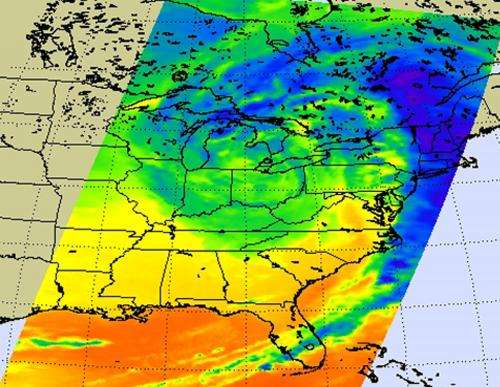
On Dec. 21 at 2:29 a.m. EST, the AIRS instrument aboard NASA's Aqua satellite captured this infrared image of the massive low pressure area that caused a major snowstorm in the Midwest and beyond. The darkest blue and purple (-63.6 Fahrenheit/-53.5 Celsius) areas indicate the highest clouds and coldest cloud top temperatures, where precipitation is heaviest. Credit: NASA JPL, Ed Olsen

NASA and NOAA satellites have been providing data on the powerful low pressure area that dropped more than a foot of snow in some Midwestern states and prompted many warnings and weather advisories. NASA's Aqua satellite captured an infrared image, while NOAA's GOES-13 satellite data was compiled into an animation that showed the movement of the storm system.

On Dec. 21 at 0729 UTC (2:29 a.m. EST), the Atmospheric Infrared Sounder (AIRS) instrument that flies aboard NASA's Aqua satellite captured an infrared image of the massive low pressure area that caused a major snowstorm in the Midwest and beyond.

The AIRS infrared image was false-color enhanced to show temperatures. In the false color image, the darkest blue and purple areas indicate the highest clouds and coldest cloud top temperatures, where precipitation is heaviest. Those coldest cloud top temperatures were near 220 kelvin (-63.6 Fahrenheit/-53.5 Celsius) and were over the New England states and southeastern Canada. Those were also areas where the heaviest precipitation was falling. The also showed that the low pressure center of circulation was located over northern Ohio. The southern extent of the storm brought wind damage to Alabama and spawned tornadoes in Arkansas. AIRS imagery is created at NASA's Jet Propulsion Laboratory in Pasadena, Calif.

This video is not supported by your browser at this time.
This NOAA's GOES-13 satellite animation shows movement of the storm from Dec.19 through the morning of Dec. 21. The long line of clouds is a cold front associated with a low pressure center that moves in from the west as the animation begins and reaches northern Ohio by the time the animation ends on Dec. 21 at 9:45 a.m. EST. Credit: NASA GOES Project

According to USA Today, the storm had taken at least eight lives, caused about 1,000 flight cancelations and power outages, caused closures of schools and government offices, multiple and road closures and dropped more than a foot of snow in parts of Wisconsin and Iowa. The National Weather Service noted that the storm system caused Blizzard Warnings in Minnesota, Wisconsin, Illinois and Iowa. The storm also triggered Winter Weather Advisories from Washington state to Maine and covered parts of 17 states.

NOAA's GOES-13 satellite monitors weather over the eastern half of the U.S. from a fixed orbit in space. Imagery from GOES-13 was compiled into an animation by NASA's GOES Project at the NASA Goddard Space Flight Center in Greenbelt, Md. that showed the movement of the storm from Dec.19 through the morning of Dec. 21. Over that time, the animation shows a long line of clouds from a cold front that stretched from Canada to the U.S. Gulf Coast move west to east. The cold front is associated with a low pressure center that moves in from the west as the animation begins and reaches northern Ohio by the time the animation ends on Dec. 21 at 1445 UTC (9:45 a.m. EST).

On Dec. 21, the noted "Blizzard and Winter Warnings remain in effect through Friday night (Dec. 21) or Saturday (Dec. 22) for the Great Lakes and central Appalachians, where heavy snow will combine with strong winds to produce dangerous travel conditions."

Explore further: NASA sees newborn Tropical Storm Evan causing trouble for American Samoa

add to favorites email to friend print save as pdf

Related Stories

Minnesota blizzard caught by Terra satellite

Dec 14, 2010

The upper Midwest was hit by a powerful winter storm this past weekend as more than 17 inches of snow brought down the roof to the Metrodome football complex in Minneapolis. NASA's Terra satellite flew over ...

Recommended for you

NASA's Landsat satellite looks for a cloud-free view

2 hours ago

For decades, Landsat satellites have documented the desiccation of the Aral Sea in Central Asia. Once one of the largest seas in the world, it shrunk to a tenth of its original volume after Russia diverted ...

Volcanoes cause climate gas concentrations to vary

10 hours ago

Trace gases and aerosols are major factors influencing the climate. With the help of highly complex installations, such as MIPAS on board of the ENVISAT satellite, researchers try to better understand the ...

Explainer: Why are tornadoes so destructive?

10 hours ago

Tornadoes are a part of life for people living in the Great Plains of the United States. In Oklahoma, a state that averages 62 tornadoes a year, people are prepared as best as they can be and are well warned.

User comments : 0

More news stories

Forecast for Titan: Wild weather could be ahead

(Phys.org) —Saturn's moon Titan might be in for some wild weather as it heads into its spring and summer, if two new models are correct. Scientists think that as the seasons change in Titan's northern hemisphere, ...

NASA's Landsat satellite looks for a cloud-free view

For decades, Landsat satellites have documented the desiccation of the Aral Sea in Central Asia. Once one of the largest seas in the world, it shrunk to a tenth of its original volume after Russia diverted ...

SDO observes mid-level solar flare

UPDATE 16:30 p.m. EDT: The M7-class flare was also associated with a coronal mass ejection or CME, another solar phenomenon that can send billions of tons of particles into space. While this CME was not Ea ...

FDA panel backs experimental Merck insomnia drug

(AP)—A federal panel of medical experts says that an experimental insomnia drug from Merck & Co Inc. appears safe and effective, despite evidence from company trials that the pill can cause daytime sleepiness and difficulty ...