Low-energy GPS sensing looms large
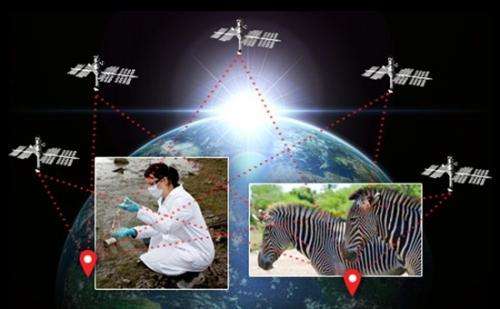
Location sensing has become ubiquitous—it's present every time you turn on your smartphone or engage your car's navigation system. It's also become critical to a variety of outdoors and remote research applications, such as wildlife tracking, participatory environmental sensing, and personal health and wellness monitoring.
The Global Positioning System (GPS) is commonly used for tagging the location of data samples. But traditional GPS location fixing is a power hog; in fact, the typical smartphone battery will drain in about six hours if the phone's GPS is constantly running, which is particularly problematic in remote locations. Moreover, a smartphone is fairly bulky—not exactly the kind of sensor you can, for example, attach to fruit bats to monitor their nocturnal flights.
In a paper titled, "Energy Efficient GPS Sensing with Cloud Offloading", Microsoft researchers propose a potential solution to this battery power and size dilemma. This paper describes cloud-offloaded GPS (CO-GPS), an innovative way to perform location sensing by using tiny embedded devices and the cloud to share the work of GPS signal acquisition and processing. By logging only a few milliseconds of raw GPS signals, the device can store enough information for resolving GPS-based location, and it consumes two to three orders of magnitude less energy than stand-alone or mobile phone GPS sensors. The signals are then sent to the cloud with sensor data to reconstruct the location and time that the samples are taken. In delay-tolerant, data acquisition applications—such as animal tracking, float sensor networks, participatory environmental sensing, and long-range time synchronization—CO-GPS is ideal for extending the battery life of mobile devices.
The paper received the Best Paper Award at ACM SenSys 2012—the premier conference on networked embedded sensing systems and a top forum for the sensor network research community. Many attendees consider the work to be a breakthrough in pushing continuous location sensing to extremely low power devices that can be carried by humans, animals, or recreational equipment.
Microsoft anticipates that CO-GPS will be a boon to citizen-science efforts, particularly those that rely on participatory sensing from embedded devices. For example, the CO-GPS approach is a key enabling technology in Microsoft Research Project CLEO, a participatory environmental sensing system that will be showcased at the 2012 AGU Fall Meeting this week.
More information: research.microsoft.com/pubs/17 … SenSys147-co-gps.pdf
Provided by Microsoft


