S. Korea postpones rocket launch to 2013
Dec 03, 2012
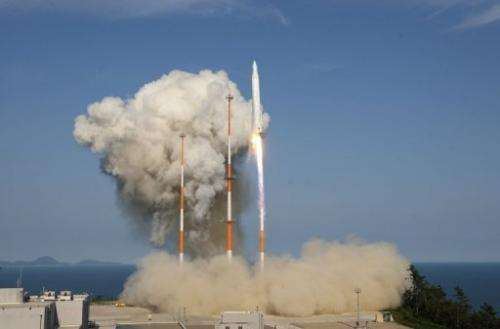
Image provided by Korea Aerospace Research Institute shows the 2009 launch of the KSLV-1. The KSLV-1 was removed from the launch pad at the Naro Space Center on Thursday after engineers detected a propulsion system problem with just minutes left on the launch countdown clock.

South Korea has postponed its third bid to put a satellite in orbit until next year, after a technical problem forced the cancellation of last week's scheduled launch, an official said Monday.

"We have decided not to launch the this month," a science ministry official said.

Engineers are now conducting a "comprehensive" check of the rocket's second stage that will take more than one month, the official said, declining to speculate on when a new attempt could be made.

The 140-tonne Korea Launch Vehicle (KSLV-1) was removed from the launch pad at the Naro Space Center on the south coast on Thursday after engineers detected a propulsion system problem with just minutes left on the launch countdown clock.

It was to have been South Korea's third attempt to put a satellite in orbit and gain entry to an elite global space club that includes Asian powers China, India and Japan.

After successive failures with the same KSLV-1 in 2009 and 2010, the current mission is seen as crucial to the future of South Korea's space programme.

The third attempt has now been suspended two times.

Originally scheduled for October 26, it was first delayed by more than a month after engineers detected a broken rubber seal in a connector between the launch pad and the first stage.

The KSLV-1 has a first stage manufactured by Russia and a solid-fuel second stage built by South Korea.

North Korea announced Saturday that it would launch a long-range rocket—ostensibly aimed at placing a satellite in orbit—between December 10 and 22.

The United States and its key Asian military allies, South Korea and Japan, insist the is a disguised ballistic missile test that violates UN resolutions triggered by Pyongyang's two nuclear tests in 2006 and 2009.

Explore further: S. Korea sets new window for rocket launch

add to favorites email to friend print save as pdf

Related Stories

S. Korea sets new window for rocket launch

Oct 29, 2012

South Korea said Monday it would make another attempt to send a satellite into space next month after a scheduled rocket launch last week was cancelled because of a technical glitch.

South Korean rocket launch suspended

Nov 29, 2012

South Korean space officials suspended a crucial rocket launch Thursday, after a technical problem halted the countdown just 17 minutes before the scheduled blast-off.

S. Korea rocket launch set for Nov 29

Nov 22, 2012

South Korea plans to go ahead with a delayed rocket launch on Thursday next week in its third bid in four years to put a satellite into orbit, officials said.

S. Korea to make third rocket launch bid in October

Sep 11, 2012

South Korea will make its third attempt next month to put a satellite in space, the science ministry said Tuesday, as it bids to join an exclusive club of Asian nations with space-launch capability.

S. Korea readies for delayed rocket launch

Nov 20, 2012

South Korea is set to go ahead next week with a delayed rocket launch as it aims to join the elite club of nations capable of putting a satellite into orbit, an official said Tuesday.

Recommended for you

NASA head views progress on asteroid lasso mission

12 hours ago

Surrounded by engineers, NASA chief Charles Bolden inspected a prototype spacecraft engine that could power an audacious mission to lasso an asteroid and tow it closer to Earth for astronauts to explore.

Ecuador satellite collides with Russian space junk

12 hours ago

A small Ecuadoran satellite collided in orbit with the remains of a Russian rocket, but it is too soon to know how much damage it might have sustained, Quito's space agency said Thursday.

Forecast for Titan: Wild weather could be ahead

May 22, 2013

(Phys.org) —Saturn's moon Titan might be in for some wild weather as it heads into its spring and summer, if two new models are correct. Scientists think that as the seasons change in Titan's northern hemisphere, ...

SDO observes mid-level solar flare

May 22, 2013

UPDATE 16:30 p.m. EDT: The M7-class flare was also associated with a coronal mass ejection or CME, another solar phenomenon that can send billions of tons of particles into space. While this CME was not Ea ...

User comments : 0

More news stories

A hidden population of exotic neutron stars

(Phys.org) —Magnetars – the dense remains of dead stars that erupt sporadically with bursts of high-energy radiation - are some of the most extreme objects known in the Universe. A major campaign using ...

Hubble reveals the ring nebula's true shape

(Phys.org) —The Ring Nebula's distinctive shape makes it a popular illustration for astronomy books. But new observations by NASA's Hubble Space Telescope of the glowing gas shroud around an old, dying, ...

Century-old science helps confirm global warming

(Phys.org) —Ocean measurements taken more than 135 years ago during the scientific expedition of HMS Challenger have provided further confirmation of human-produced global warming over the past century.

Controlling mood through the motions of mitochondria

(Medical Xpress)—Regulating the distribution of power in neurons is done by a system that makes the national electric grid look simple by comparison. Each neuron has several thousand mitochondria confined ...

A quantum simulator for magnetic materials

Physicists understand perfectly well why a fridge magnet sticks to certain metallic surfaces. But there are more exotic forms of magnetism whose properties remain unclear, despite decades of intense research. ...