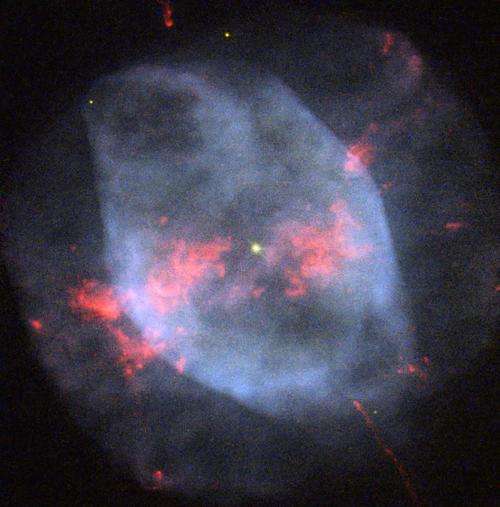
Image: Hubble's 'smoky' shells
Dec 17, 2012
Credit: ESA/Hubble & NASA

(Phys.org)—Located in a relatively vacant region of space about 4,200 light-years away and difficult to see using an amateur telescope, the lonesome planetary nebula NGC 7354 is often overlooked. However, thanks to this image captured by the NASA/ESA Hubble Space Telescope we are able to see this brilliant ball of "smoky" light in spectacular detail.

Just as shooting stars are not actually stars and lava lamps do not actually contain lava, planetary nebulae have nothing to do with planets. The name was coined by Sir William Herschel because when he first viewed a through a telescope, he could only identify a hazy, smoky sphere, similar to gaseous planets such as Uranus. The name has stuck even though modern telescopes make it obvious that these objects are not planets at all, but the glowing gassy outer layers thrown off by a hot dying star.

It is believed that winds from the central star play an important role in determining the shape and morphology of planetary nebulae. The structure of NGC 7354 is relatively easy to distinguish. It consists of a circular , an elliptical inner shell, a collection of bright knots roughly concentrated in the middle and two symmetrical jets shooting out from either side. Research suggests that these features could be due to a companion central star; however the presence of a second star in NGC 7354 is yet to be confirmed.

NGC 7354 resides in Cepheus, a constellation named after the mythical King Cepheus of Ethiopia and is about half a light-year in diameter.

Explore further: Hubble sees a planetary nebula in the making

Related Stories

The Colorful Demise of a Sun-Like Star

Feb 13, 2007

This image, taken by NASA's Hubble Space Telescope, shows the colorful "last hurrah" of a star like our Sun. The star is ending its life by casting off its outer layers of gas, which formed a cocoon around ...

Hubble Captures Stars Going Out in Style

Sep 11, 2007

The colorful, intricate shapes in these NASA Hubble Space Telescope images reveal how the glowing gas ejected by dying Sun-like stars evolves dramatically over time.

The Last Confessions of a Dying Star

Mar 04, 2008

Probing a glowing bubble of gas and dust encircling a dying star, NASA's Hubble Space Telescope reveals a wealth of previously unseen structures.

Hubble sees a celestial swan and butterfly

Jun 05, 2012

(Phys.org) -- This image from the Hubble Space Telescope shows planetary nebula NGC 7026. Located just beyond the tip of the tail of the constellation of Cygnus (The Swan), this butterfly-shaped cloud of glowing ...

Hubble finds stellar life and death in a globular cluster

Nov 22, 2011

(PhysOrg.com) -- A new NASA Hubble Space Telescope image shows globular cluster NGC 1846, a spherical collection of hundreds of thousands of stars in the outer halo of the Large Magellanic Cloud, a neighboring ...

Hubble sees a planetary nebula in the making

Oct 12, 2012

(Phys.org)—The Universe is filled with mysterious objects. Many of them are as strange as they are beautiful. Among these, planetary nebulae are probably one of the most fascinating objects to behold in ...

Recommended for you

Dusty surprise around giant black hole

9 minutes ago

(Phys.org) —ESO's Very Large Telescope Interferometer has gathered the most detailed observations ever of the dust around the huge black hole at the centre of an active galaxy. Rather than finding all of ...

Three centaurs follow Uranus through the solar system

Jun 18, 2013

Astrophysicists from the Complutense University of Madrid have confirmed that Crantor, a large asteroid with a diameter of 70 km has an orbit similar to that of Uranus and takes the same amount of time to ...

Final curtain for Europe's deep-space telescope

Jun 17, 2013

The deep-space telescope Herschel took its final bow on Monday, climaxing a successful four-year mission to observe the birth of stars and galaxies, the European Space Agency (ESA) said.

Hubble spots a very bright contortionist

Jun 17, 2013

(Phys.org) —The contorted object captured by Hubble in this picture is IRAS 22491-1808, also known as the South America Galaxy. It is an ultra-luminous infrared galaxy (ULIRG) that emits a huge amount of ...

User comments : 0

More news stories

Dusty surprise around giant black hole

(Phys.org) —ESO's Very Large Telescope Interferometer has gathered the most detailed observations ever of the dust around the huge black hole at the centre of an active galaxy. Rather than finding all of ...

Singapore haze at worst yet, Malaysia schools shut

Singapore urged people to remain indoors amid unprecedented levels of air pollution Thursday as a smoky haze wrought by forest fires in neighboring Indonesia worsened dramatically. Nearby Malaysia closed ...

China astronauts float water blob in kids' lecture

Astronauts struck floating martial arts poses, twirled gyroscopes and manipulated wobbling globes of water during a lecture Thursday from China's orbiting space station that's part of efforts to popularize ...

Philippines financial capital bans plastic bags

The Philippines financial capital banned disposable plastic shopping bags and styrofoam food containers on Thursday, as part of escalating efforts across the nation's capital to curb rubbish that exacerbates ...

Taiwan's Hon Hai to hire 3,000 after Mozilla tie-up

Taiwan's Hon Hai Precision said Thursday it aims to hire up to 3,000 new employees to develop devices and software for Mozilla's Firefox operating system as it seeks to diversify from its core manufacturing services.

S.Korean airlines ban shark fin as cargo

South Korea's two largest airlines, Korean Air and Asiana, said Thursday they had both decided to ban shark fin from their cargo flights as part of a growing global campaign against the Asian delicacy.