The health and growth of calves in Tanzanian smallholder dairy farms
Dec 13, 2012

Milk production is a major source of income for many farmers in Tanzania and therefore an important factor in combating poverty in the region. But the health and growth of the calves and the milk production rate is often poor.

Jelly Senyagwa Chang'a's doctoral research project appraised the health and performance of belonging to dairy breeds in the eastern part of the southern highlands in Tanzania. She discovered that the dairy farmers had scant knowledge about feeding and looking after calves, but also that there was a relatively low rate of clinical diseases, blood parasites and endoparasites in calves in the region. The low growth rate from birth to was first and foremost due to feeding and less to do with health issues.
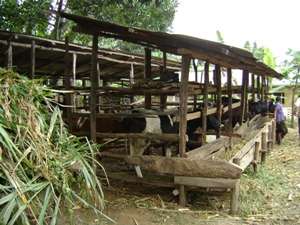
A cow shed in one of the smallholder dairy farms in Tanzania. Credit: Jelly S. Chang'a

Chang'a studied the calves' living conditions and found that a low growth rate was linked to what time of year the calf was born, the amount of milk feed, the source of drinking water and the age of weaning. She also examined individual parameters having a significant bearing on the growth of the calves and found low blood levels of total protein, phosphorus and and that blood urea was high in the calves that grew slowly.

It was assumed that cryptosporidia (gastrointestinal parasites) were partly the cause of poor growth and health in calves in the study area, but the results of Chang'a's work show that these parasites only have a small impact on the health of the calves.
The health and growth of calves in Tanzanian smallholder dairy farms
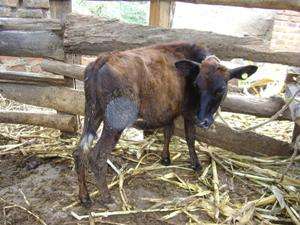
A six-month-old calf indicating poor growth. Credit: Jelly s. Chang'a

This PhD project was carried out at the Norwegian School of Veterinary Science, while the field data were collected in Tanzania.

Jelly Senyagwa Chang'a defended her doctoral research on 6th December 2012 with a thesis entitled "Calf health and performance in Tanzanian smallholder ."

Explore further: Study: Colostrum health benefits for dairy calves not affected by cold storage

add to favorites email to friend print save as pdf

Related Stories

Model developed for manipulating vitamin D levels in calves

May 25, 2010

A new model for manipulating vitamin D levels in young calves has been developed by Agricultural Research Service (ARS) scientists who say it could help establish just how much of this important nutrient the young animals ...

Supplement aids milk production

Sep 12, 2011

(PhysOrg.com) -- Massey University research has led to the development of a calf supplement that can increase milk yield in dairy cows by up to 12 per cent.

Recommended for you

Honeybees trained in Croatia to find land mines

10 hours ago

(AP)—Mirjana Filipovic is still haunted by the land mine blast that killed her boyfriend and blew off her left leg while on a fishing trip nearly a decade ago. It happened in a field that was supposedly ...

Front-row seats to climate change

May 17, 2013

By day, insects provide the white noise of the South, but the night belongs to the amphibians. In a typical year, the Southern air hangs heavy from the humidity and the sounds of wildlife.

Climate change may have little impact on tropical lizards

May 17, 2013

A new Dartmouth College study finds human-caused climate change may have little impact on many species of tropical lizards, contradicting a host of recent studies that predict their widespread extinction in a rapidly warming ...

Wetlands: value to locals matters most

May 17, 2013

A new way of valuing ecosystem services, incorporating the local perspective, is the driving force behind a project assessing aquatic ecosystems in highland areas of Asia

User comments : 0

More news stories

Honeybees trained in Croatia to find land mines

(AP)—Mirjana Filipovic is still haunted by the land mine blast that killed her boyfriend and blew off her left leg while on a fishing trip nearly a decade ago. It happened in a field that was supposedly ...

Heat-related deaths in Manhattan projected to rise

Residents of Manhattan will not just sweat harder from rising temperatures in the future, says a new study; many may die. Researchers say deaths linked to warming climate may rise some 20 percent by the 2020s, ...

Kinks and curves at the nanoscale

One of the basic principles of nanotechnology is that when you make things extremely small—one nanometer is about five atoms wide, 100,000 times smaller than the diameter of a human hair—they are going ...