Hawaiian Islands are dissolving, study says
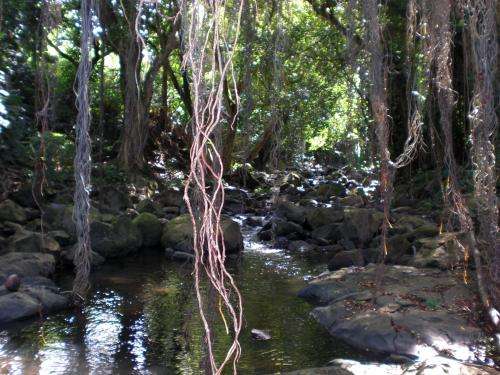
(Phys.org)—Someday, Oahu's Koolau and Waianae mountains will be reduced to nothing more than a flat, low-lying island like Midway.
But erosion isn't the biggest culprit. Instead, scientists say, the mountains of Oahu are actually dissolving from within.
"We tried to figure out how fast the island is going away and what the influence of climate is on that rate," said Brigham Young University geologist Steve Nelson. "More material is dissolving from those islands than what is being carried off through erosion."
The research pitted groundwater against stream water to see which removed more mineral material. Nelson and his BYU colleagues spent two months sampling both types of sources. In addition, ground and surface water estimates from the U.S. Geological Survey helped them calculate the total quantity of mass that disappeared from the island each year.
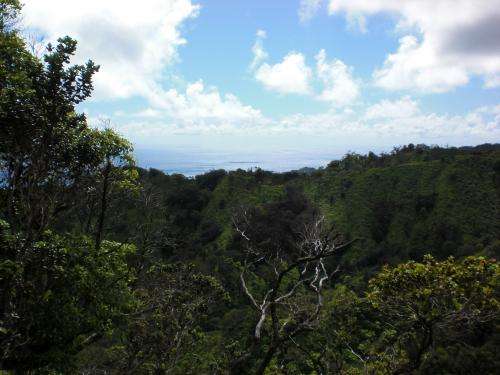
"All of the Hawaiian Islands are made of just one kind of rock," Nelson said. "The weathering rates are variable, too, because rainfall is so variable, so it's a great natural laboratory."
Forecasting the island's future also needs to account for plate tectonics. As Oahu is pushed northwest, the island actually rises in elevation at a slow but steady rate. You've heard of mountain climbing; this is a mountain that climbs.
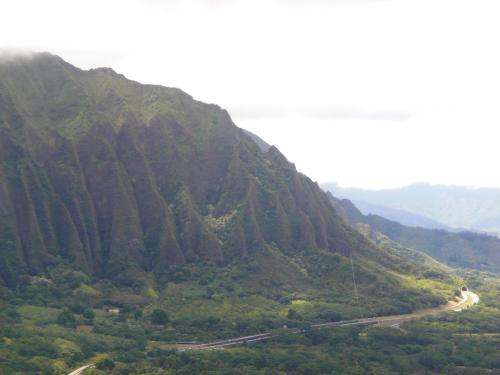
According to the researchers' estimates, the net effect is that Oahu will continue to grow for as long as 1.5 million years. Beyond that, the force of groundwater will eventually triumph and the island will begin its descent to a low-lying topography.
Undergraduate student Brian Selck co-authored the study, which appears in the journal Geochimica et Cosmochimica Acta. Unfortunately for him, he joined the project only after the field work in Hawaii took place.
Instead, Selck performed the mineralogical analysis of soil samples in the lab back in Provo. The island's volcanic soil contained at least one surprise in weathered rock called saprolites.
"The main thing that surprised me on the way was the appearance of a large amount of quartz in a saprolite taken from a 1-meter depth," Selck said.
More information: www.sciencedirect.com/science/ … ii/S0016703712005583
Journal information: Geochimica et Cosmochimica Acta
Provided by Brigham Young University


