Disputed fish quota cuts lead to tough EU talks
Dec 18, 2012
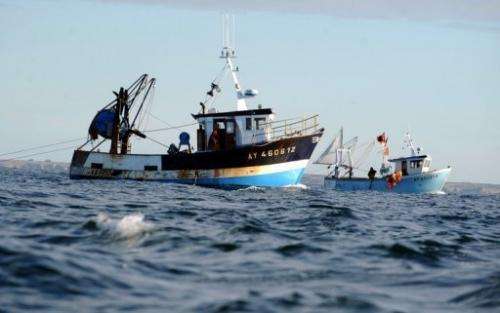
French fishermen fish for scallops off Quiberon, western France, on October 30, 2012 after a three-year ban. EU fishery ministers began difficult talks Tuesday on the vexed question of 2013 quotas as they sought to balance conflicting demands from environmentalists and fishermen alike.

EU fishery ministers began difficult talks Tuesday on the vexed question of 2013 quotas as they sought to balance conflicting demands from environmentalists and fishermen alike.

The European Commission is proposing to cut quotas for some 47 in the Atlantic and because many stocks are over-exploited.

In October, they agreed to maintain controversial fishing subsidies for the industry, opposed by environmental groups who say they only encourage overfishing of already stressed stocks.

The subsidies pay for modernising existing vessels or taking older boats out of the fleet and are jealously guarded by the main fishing powers—France, Portugal and especially Spain.

"The negotiations are going to go on all day, into the night, to tomorrow and no doubt, tomorrow night as well," said Cyprus Agriculture, Natural Resources and Environment Minister Sofocilis Aletraris as he went in to chair the talks.

Cyprus Agriculture, Natural Resources and Environment Minister Sofoclis Aletraris (R) speaks to his Spanish counterpart Miguel Arias Canete before the Agriculture and Fisheries Council at EU headquarters in Brussels on December 18, 2012. EU fishery ministers began talks Tuesday on the vexed question of 2013 quotas as they sought to balance conflicting demands from environmentalists and fishermen.

are pressing for reforms to allow stocks to recover above so-called Maximum Sustainable Yields (MSY), the EU benchmark, while major fishing groups claim ministers were caving in to Green demands.

Europeche, which represents EU national fishery organisations, said the planned quota cuts go beyond the scientific recommendations and put environmental over social and economic considerations.

To accept them would undercut the viability of companies and lead to job losses across the industry, Europeche said in a statement.

Spanish Agriculture Minister Miguel Arias Canete said the proposed quota cuts, some of more than 30 percent, were not justified by scientific research and would harm his country's .

The Fisheries Committee of the European Parliament meanwhile approved measures to rebuild stocks above MSY levels, to ban the practice of fish discards and control subsidies.

The WWF said the vote would prove to be the cornerstone of a new EU Common Fisheries Policy (CFP) Basic Regulation, meeting all its five goals of reform.

The committee has shown "through this milestone vote that the is listening to scientific advice and wants to recover."

Small artisanal fishermen meanwhile said any quota cuts should not hurt those who practice traditional methods which harm the environment least.

Explore further: EU keeps controversial fishing subsidies

add to favorites email to friend print save as pdf

Related Stories

EU keeps controversial fishing subsidies

Oct 24, 2012

The EU agreed on Wednesday to maintain controversial fishing subsidies, sparking a sharp response from environmental groups who say the payments contribute to overfishing of already stressed stocks.

EU fish discard ban agreed -- for 2019

Jun 13, 2012

After 20 hours of talks into the early hours Wednesday, Europe's fisheries ministers finally struck a compromise deal to save the oceans from overfishing -- but failed to satisfy environmentalists.

No sea change for European fishing

Jun 08, 2012

An ambitious reform of Europe's fishing sector to help replenish shrinking fish stocks appears likely to be watered down substantially by European Union nations, diplomats said Friday.

European fish stocks to be counted

Nov 12, 2012

Counting every single fish in the European seas may sound as likely as finding a mermaid, but it seems the world of technology has no boundaries.

Recommended for you

Climate change may have little impact on tropical lizards

May 17, 2013

A new Dartmouth College study finds human-caused climate change may have little impact on many species of tropical lizards, contradicting a host of recent studies that predict their widespread extinction in a rapidly warming ...

Wetlands: value to locals matters most

May 17, 2013

A new way of valuing ecosystem services, incorporating the local perspective, is the driving force behind a project assessing aquatic ecosystems in highland areas of Asia

Symbolic saviour of an endangered species

May 16, 2013

In 2006 Berlin Zoo saw the birth of their first polar bear cub in 33 years. A retired circus polar bear gave birth to two cubs at the zoo. One of them died soon after, but Knut survived. At only a month old he became the ...

User comments : 0

More news stories

Morocco to harness the wind in energy hunt

Morocco is ploughing ahead with a programme to boost wind energy production, particularly in the southern Tarfaya region, where Africa's largest wind farm is set to open in 2014.

Galaxy's Ring of Fire

Johnny Cash may have preferred this galaxy's burning ring of fire to the one he sang about falling into in his popular song. The "starburst ring" seen at center in red and yellow hues is not the product of ...