America's top young scientist crafts system to purify water (w/ video)
Dec 20, 2012 by Nancy Owano report

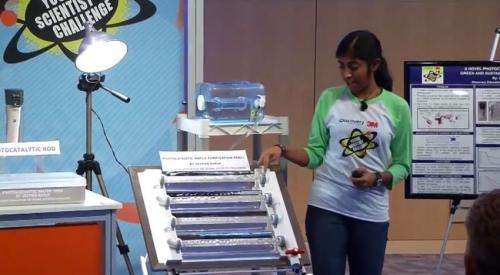
(Phys.org)—Deepika Kurup, a 14-year-old high school student from Nashua, New Hampshire, has won this year's Discovery Education 3M Young Scientist Challenge for her solar-powered device designed to kill bacteria in water. She now has the title of "America's Top Young Scientist," and a reward of $25,000 for her work. for students in fifth to eighth grade. Kurup entered the prestigious-science competition before she was in high school. This was her second time entering; in an another year's competition she had taken first place in her state.

The advantages of her award-winning system are several. Its low-cost is just one benefit. In contrast to water purification methods using UV lamps that call for electricity or chemicals, Kurup's method runs "off-grid," yielding fresh-tasting water. Another advantage tied to her process is time; it can kill many types of bacteria in less time than other methods. Her judges saw her presentation as part of the competition at the 3M in St. Paul, Minnesota.

This video is not supported by your browser at this time.

The student's system involves exposing and to sunlight. The chemical reaction that this initiates forms to go after and destroy types of bacteria. She counted the levels of coliform bacteria before and after she applied her system, with 3M Petrifilms, a microbiological testing process. The Petrifilm E.coli/Coliform Count Plate identifies both E. coli and other coliforms.

Her system reduced the amount of coliforms from 8,000 down to 50 and E. coli from more than 1,000 down to none in less than eight hours. In one hour, she degraded methane blue. She used her back yard as her testbed, trying out her system with contaminated water from the Nashua wastewater treatment facility. Kurup's composite involved 3M Glass Bubbles, which the company describes as engineered hollow glass microspheres, intended as alternatives to conventional fillers and additives. The low-density particles are used to reduce part weight and to cut costs.

The idea for her winning project came to her when on vacation in India, she said. Witnessing children drinking dirty water from a stagnant pool triggered her resolve "to find a solution to the global water crisis."

Kurup worked on the project for three months, drawing on documentation including PhD papers about water purification methods. She also had contact with a 3M mentor, as scientists from 3M guide finalists through the translation from their concepts to prototypes.

Kurup said she would like to further develop the water filtration project and, in the tradition of many adult scientists, she said her next step was "applying for a patent." Her ultimate career goal is to be a neurologist.

The competition's second, third and fourth-place winners also showed innovative solutions. Second-place winner, Carolyn Jons, presented a packaging method to inhibit mold growth and keep food fresh. Third-place winner, Anin Sayana, had a project designed to selectively target chemotherapy-resistant cancer stem cells. Anishaa Sivakumar, in fourth place, had a project for helping to treat macular degeneration.

Explore further: Industrial design students create solar bag that purifies water while person walks

Related Stories

3M shows photovoltaic film for windows

Oct 07, 2011

(PhysOrg.com) -- 3M drew press and viewer interest earlier this week at CEATEC with its show of special film that the company has developed to coat ordinary, existing windows and convert them into solar panels. ...

Sunlight plus lime juice makes drinking water safer

Apr 17, 2012

Looking for an inexpensive and effective way to quickly improve the quality of your drinking water? According to a team of researchers from the Johns Hopkins Bloomberg School of Public Health and the Johns Hopkins School ...

Recommended for you

Bacteria use hydrogen, carbon dioxide to produce electricity

10 minutes ago

Researchers have engineered a strain of electricity-producing bacteria that can grow using hydrogen gas as its sole electron donor and carbon dioxide as its sole source of carbon. Researchers at the University of Massachusetts, ...

German energy shift faces headwinds

17 hours ago

Tense engineers have their eyes peeled on complex colour-coded diagrams on a wall-sized screen that makes their control room look like the inside of a spaceship.

Morocco to harness the wind in energy hunt

May 18, 2013

Morocco is ploughing ahead with a programme to boost wind energy production, particularly in the southern Tarfaya region, where Africa's largest wind farm is set to open in 2014.

Energy-positive with natural ventilation

May 17, 2013

Buildings can be air-conditioned using entirely natural means, without mechanical ventilation systems. This is the claim made by 78-year-old Benjamin Bronsema, who will be awarded his PhD for his thesis on the subject at ...

User comments : 9

Adjust slider to filter visible comments by rank

Display comments: newest first

extinct
1.3 / 5 (6) Dec 20, 2012
I hope this comes to market, but if the past is any indication, cheap & effective innovations usually vanish into quiet obscurity, because no financial backer wants to back them, because they are too embroiled in their own greed. Maybe this time will be different. Sure hope so.
Lurker2358
1.1 / 5 (7) Dec 20, 2012
If you're going to use solar anyway, then there is no need to use nanotechnology or chemicals. You can just boil the water and collect the steam. Or you can concentrate the UV directly and kill the bacteria even if you can't bring the water to a boil...
Newbeak
not rated yet Dec 20, 2012
This brings to mind Dean Kamen's Slingshot water purifier: http://en.wikiped...ystem%29
More expensive,but it also produces power.
Whydening Gyre
1 / 5 (4) Dec 20, 2012
Whatever happened to using iodine to purify water? It was part of the Boy Scouts survival training, if I remember correctly... (50 years IS a long time, tho...)
ScooterG
2.8 / 5 (9) Dec 20, 2012
I hope this comes to market, but if the past is any indication, cheap & effective innovations usually vanish into quiet obscurity, because no financial backer wants to back them, because they are too embroiled in their own greed. Maybe this time will be different. Sure hope so.


Then why don't you provide the financial backing? Take out a second mortgage on your house and give the proceeds to this bright young woman. Don't worry about the financial risk to you and your family - just do the right thing!

That way, you could help mankind and at the same time have a good feeling about yourself knowing you put a lot of what you've worked hard for at risk for something that (you know) will not produce a (monetary) return.

You will be remembered by history as a "non-greedy" person
StillWind
1.8 / 5 (5) Dec 21, 2012
I hope this comes to market, but if the past is any indication, cheap & effective innovations usually vanish into quiet obscurity, because no financial backer wants to back them, because they are too embroiled in their own greed. Maybe this time will be different. Sure hope so.


Then why don't you provide the financial backing? Take out a second mortgage on your house and give the proceeds to this bright young woman. Don't worry about the financial risk to you and your family - just do the right thing!

That way, you could help mankind and at the same time have a good feeling about yourself knowing you put a lot of what you've worked hard for at risk for something that (you know) will not produce a (monetary) return.

You will be remembered by history as a "non-greedy" person


Hear! Hear!
Wolf358
2.3 / 5 (6) Dec 21, 2012
If you're going to use solar anyway, then there is no need to use nanotechnology or chemicals. You can just boil the water and collect the steam. Or you can concentrate the UV directly and kill the bacteria even if you can't bring the water to a boil...


Agreed, but doing it the simple way doesn't involve a lot of free advertising for 3M and it's products.
ragaraine
not rated yet Dec 24, 2012
Boiling water requires too much energy and you don't really want distilled water either. However, personally, when traveling I am using plastic bottles and sunlight (UV) for several hours. Of course this only works against biological harm, not chems.

According to WHO: "UV units to treat small batches (1 to several liters) or low flows (1 to several liters per minute) of water at the community level are estimated to have costs of 0.02 US$ per 1000 liters of water, including the cost of electricity and consumables and the annualized capital cost of the unit."
barakn
not rated yet Dec 31, 2012
Whatever happened to using iodine to purify water? It was part of the Boy Scouts survival training, if I remember correctly... (50 years IS a long time, tho...)

It tastes like crap and long-term over-consumption of iodine has health implications.

More news stories

German energy shift faces headwinds

Tense engineers have their eyes peeled on complex colour-coded diagrams on a wall-sized screen that makes their control room look like the inside of a spaceship.

Internet in 'coma' as Iran election looms

Iran is tightening control of the Internet ahead of next month's presidential election, mindful of violent street protests that social networkers inspired last time around over claims of fraud, users and ...

Lovelorn frogs bag closest crooner

What lures a lady frog to her lover? Good looks, the sound of his voice, the size of his pad or none of the above? After weighing up their options, female strawberry poison frogs (Oophaga pumilio) bag th ...

Engineered microbes grow in the dark

Scientists at the University of California, Davis have engineered a strain of photosynthetic cyanobacteria to grow without the need for light. They report their findings today at the 113th General Meeting of the American ...

Blame your parents for bunion woes

A novel study reports that white men and women of European descent inherit common foot disorders, such as bunions (hallux valgus) and lesser toe deformities, including hammer or claw toe. Findings from the Framingham Foot ...