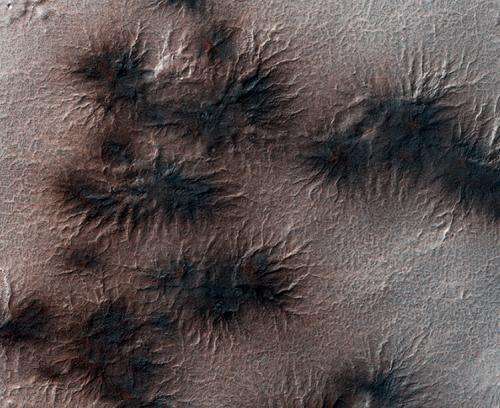
'Spiders' on Mars

Nov 19, 2012 by Jason Major, Universe Today
Credit: NASA/JPL/University of Arizona

Eek, spiders! All right, so it's not actually little green arachnids we're talking about here, but they are definitely spidery features. Called araneiform terrain, these clusters of radially-branching cracks in Mars' south polar surface are the result of the progressing spring season, when warmer temperatures thaw subsurface CO2 ice.

As below the surface warms it can sublimate rapidly and burst through the frozen ground above, creating long cracks. If the material below is dark it can be carried upwards by the escaping gas, staining the surface.

Each dark splotch is around 100 meters wide.

This image was acquired by the HiRISE camera aboard NASA's Mars Reconnaissance Orbiter on September 26, from a distance of 262 km (163.8 miles). See the full-size scan here, and check out more recent HiRISE images in the November PDS release here.

Explore further: Latest from Mars: Massive polar ice cliffs, northern dunes, gullied craters

add to favorites email to friend print save as pdf

Related Stories

Clouds get in the way on Mars

Mar 23, 2012

The science team from the HiRISE camera on the Mars Reconnaissance Orbiter wanted to take another look at a region of icy sand dunes on Mars to look for seasonal changes as spring is now arriving on the Red ...

Dark Pit on Mars' Arsia Mons, with Sunlit Wall

Aug 31, 2007

The High Resolution Imaging Experiment (HiRISE) camera on NASA's Mars Reconnaissance Orbiter has confirmed that a dark pit seen on Mars in an earlier HiRISE image really is a vertical shaft that cuts through ...

Pits, flows, other scenes in new set of Mars images

Dec 02, 2010

Newly released images from 340 recent observations of Mars by the High Resolution Imaging Science Experiment (HiRISE) camera aboard NASA's Mars Reconnaissance Orbiter show details of a wide assortment of Martian ...

Recommended for you

Dark, massive asteroid to fly by Earth on May 31

May 24, 2013

It's 1.7 miles long. Its surface is covered in a sticky black substance similar to the gunk at the bottom of a barbecue. If it impacted Earth it would probably result in global extinction. Good thing it is ...

Research team explains 'Lazarus' comets

May 24, 2013

Astronomers from the University of Antioquia have discovered a graveyard of comets. These once-dormant comets, dubbed by astronomers as "The Lazarus comets," are now rejuvenated.

NASA ships sensors for seafaring satellite to France

May 24, 2013

(Phys.org) —Three NASA-built instruments that are integral components of the next in a series of U.S./European ocean altimetry satellites have arrived in France for integration with their spacecraft in ...

Trip into space with DiCaprio costs $1.55m

May 24, 2013

Leonardo DiCaprio is going to get closer to stars of a different kind as he heads into space aboard the Virgin Galactic, and a well-heeled bidder at the Cannes Film Festival has paid 1.2 million euros (1.5 million) to be ...

User comments : 1

Adjust slider to filter visible comments by rank

Display comments: newest first

cantdrive85
1.4 / 5 (9) Nov 19, 2012
Once again, the answers may have an electrical origin.

http://www.thunde...ders.htm

More news stories

Galaxies fed by funnels of fuel

(Phys.org) —Computer simulations of galaxies growing over billions of years have revealed a likely scenario for how they feed: a cosmic version of swirly straws.
