Physicists create tractor beam for microscopic particles
Nov 15, 2012 by James Devitt
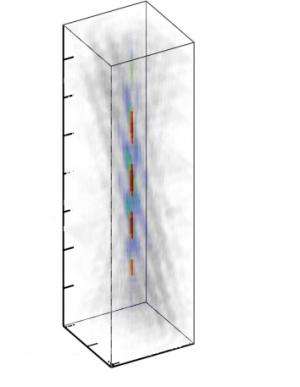
NYU physicists have created a tractor beam capable of pulling particles micrometers in size. This so-called optical conveyor tractor beam has a range of potential applications (rendering above)--from microfluidics in the near term to far-out applications like collecting dust samples from comet tails.

(Phys.org)—New York University physicists have created a tractor beam capable of pulling particles micrometers in size. This so-called optical conveyor tractor beam, reported in the journal Physical Review Letters, has a range of potential applications, from microfluidics in the near term to far-out applications like collecting dust samples from comet tails.

"This is science fiction made real," said NYU Physics Professor David Grier, one of the paper's co-authors. "This tractor beam moves objects back to its source, just like those in so many sci-fi movies, but with very small pieces."

The creation builds upon an earlier Grier creation: optical solenoid, or spiraled, beams, which can be used to confine and pull small objects—a couple micrometers in size—over a range of eight micrometers. By contrast, the conveyor has demonstrated moving particles distances of 30 to 40 micrometers. Together, they are the only working tractor beams in the world.

"The field of tractor beams is really in its infancy," added David Ruffner, an NYU doctoral student and the paper's other co-author. "There is great potential for advances."

The work applies Newton's third law of motion: for every action, there is an equal and opposite reaction. In this case, the action is the scattering of the beam off the particle and the reaction is the motion of the particle. In principle, this is akin to shooting a watermelon seed using your thumb and forefinger—if you grasp the seed in the right location, you can shoot the seed toward you rather than away. In this case, the beam of light functions as fingers. However, Grier and Ruffner's creation uses only a single , whose internal properties allow it to surround and squeeze particles in hauling them back to the light's source.

While the researchers are now working on ways to increase the weight the beam can hold as well as the distances it can move objects, it may have immediate applications. For instance it could transport biological cells in three dimensions toward arrays of chemical sensors in a microfluidic device, which controls fluids under a millimeter in scale.

A more ambitious long term application would be sending these beams into comets to pull out in space probe missions. This would be an improvement over current methods such as those used by NASA's rover Curiosity, which recently landed on Mars. Curiosity relies on a mechanical arm, which has several moving parts and, therefore, is susceptible to breaking. A beam of light, by contrast, has no mechanical properties, eliminating the possibility of structural damage. Moreover, the beam would pull in, rather than scoop up, particles, thereby preserving their make-up in ways current methods cannot achieve.

Explore further: Physics duo create tractor beam using dual Bessel beams

Related Stories

Physics duo create tractor beam using dual Bessel beams

Oct 22, 2012

(Phys.org)—David Ruffner and David Grier of New York University have developed a technique for using Bessel beams to draw a particle toward a source. In their paper published in Physical Review Letters they d ...

Photonics: Beam me up

May 24, 2012

'Tractor beams' of light that pull objects towards them are no longer science fiction. Haifeng Wang at the A*STAR Data Storage Institute and co-workers have now demonstrated how a tractor beam can in fact be realized on a ...

Tractor beams come to life

Sep 08, 2010

Tractor beams, energy rays that can move objects, are a science fiction mainstay. But now they are becoming a reality -- at least for moving very tiny objects.

NASA studying ways to make 'tractor beams' a reality

Oct 31, 2011

Tractor beams -- the ability to trap and move objects using laser light -- are the stuff of science fiction, but a team of NASA scientists has won funding to study the concept for remotely capturing planetary ...

Recommended for you

Breakthrough calls time on bootleg booze

May 20, 2013

(Phys.org) —Using a laser, the St Andrews scientists can now carry out detailed analysis of a spirit sample no bigger than a teardrop and can even confirm whether it is toxic or not. It's hoped the testing ...

Bringing life into focus

May 17, 2013

Spinning-disk confocal microscopy is an optical imaging technique that can be used to generate detailed three-dimensional fluorescence images of living cells and their contents. Although a powerful tool for ...

User comments : 0

More news stories

Making quantum encryption practical

One of the many promising applications of quantum mechanics in the information sciences is quantum key distribution (QKD), in which the counterintuitive behavior of quantum particles guarantees that no one can eavesdrop on ...

Lab sets a new record for creating heralded photons

(Phys.org) —Entanglement, by general consensus of physicists, is the weirdest part of quantum science. To say that two particles, A and B, are entangled means that they are actually two parts of an inseparable ...

Study shows where scene context happens in our brain

In a remote fishing community in Venezuela, a lone fisherman sits on a cliff overlooking the southern Caribbean Sea. This man –– the lookout –– is responsible for directing his comrades on the water, ...

Green conversion of heat to electricity

Soon, it will be possible to produce electricity from heat over 30 degrees emitted from a waste incinerator, refinery, or data processor. The start-up Osmoblue has just confirmed the feasibility of this new ...