NASA radar images asteroid 2007 PA8
Nov 06, 2012
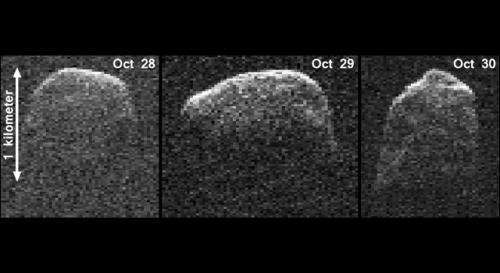
This composite image of asteroid 2007 PA8 was obtained using data taken by NASA's 230-foot-wide (70-meter) Deep Space Network antenna at Goldstone, Calif. The composite incorporates images generated from data collected at Goldstone on Oct. 28, 29, and 30, 2012. Credit: NASA/JPL-Caltech/Gemini

(Phys.org)—Scientists working with NASA's 230-foot-wide (70-meter) Deep Space Network antenna at Goldstone, Calif., have obtained several radar images depicting near-Earth asteroid 2007 PA8. The images were generated from data collected at Goldstone on Oct. 28, 29 and 30, 2012. The asteroid's distance from Earth on Oct. 28 was 6.5 million miles (10 million kilometers). The asteroid's distance to Earth was 5.6 million miles (9 million kilometers) on Oct. 30. The perspective in the images is analogous to seeing the asteroid from above its north pole. Each of the three images is shown at the same scale.

The of asteroid 2007 PA8 indicate that it is an elongated, irregularly shaped object approximately one mile (1.6 kilometers) wide, with ridges and perhaps craters. The data also indicate that 2007 PA8 rotates very slowly, roughly once every three to four days.

JPL scientists chose to image asteroid 2007 PA8 due to its size and relative proximity to Earth at the point of closest approach. On Nov. 5 at 8:42 a.m. PST (11:42 a.m. EST /16:42 UTC), the was about four million miles (6.5 million kilometers) from Earth, or 17 times the distance between Earth and the moon. The trajectory of asteroid 2007 PA8 is well understood. This flyby was the closest Earth approach by this asteroid for at least the next 200 years. NASA detects, tracks and characterizes asteroids and comets passing close to Earth using both ground- and space-based telescopes. The Near-Earth Object Observations Program, commonly called "Spaceguard," discovers these objects, characterizes a subset of them, and plots their orbits to determine if any could be potentially hazardous to our planet.

JPL manages the Near-Earth Object Program Office for NASA's Science Mission Directorate in Washington. JPL is a division of the California Institute of Technology in Pasadena.

Explore further: Research team explains 'Lazarus' comets

Related Stories

NASA releases radar movie of asteroid 2005 YU55

Nov 09, 2011

(PhysOrg.com) -- Scientists working with the 230-foot-wide (70-meter) Deep Space Network antenna at Goldstone, Calif., have generated a short movie clip of asteroid 2005 YU55. The images were generated from ...

NASA in final preparations for Nov. 8 asteroid flyby

Oct 27, 2011

(PhysOrg.com) -- NASA scientists will be tracking asteroid 2005 YU55 with antennas of the agency's Deep Space Network at Goldstone, Calif., as the space rock safely flies past Earth slightly closer than the ...

NASA Scientists Get First Images of Earth Flyby Asteroid

Jan 28, 2008

Scientists at NASA's Jet Propulsion Laboratory in Pasadena, Calif., have obtained the first images of asteroid 2007 TU24 using high-resolution radar data. The data indicate the asteroid is somewhat asymmetrical ...

Asteroid to Make Rare Close Flyby of Earth

Jan 24, 2008

Scientists are monitoring the orbit of asteroid 2007 TU24. The asteroid, believed to be between 150 meters (500 feet) and 610 meters (2,000 feet) in size, is expected to fly past Earth on Jan. 29, with its ...

Small asteroid to pass within Earth-Moon system Tuesday

Oct 11, 2010

(PhysOrg.com) -- A small asteroid will fly past Earth early Tuesday within the Earth-moon system. The asteroid, 2010 TD54, will have its closest approach to Earth's surface at an altitude of about 45,000 kilometers ...

Recommended for you

Dark, massive asteroid to fly by Earth on May 31

16 hours ago

It's 1.7 miles long. Its surface is covered in a sticky black substance similar to the gunk at the bottom of a barbecue. If it impacted Earth it would probably result in global extinction. Good thing it is ...

Research team explains 'Lazarus' comets

19 hours ago

Astronomers from the University of Antioquia have discovered a graveyard of comets. These once-dormant comets, dubbed by astronomers as "The Lazarus comets," are now rejuvenated.

NASA ships sensors for seafaring satellite to France

20 hours ago

(Phys.org) —Three NASA-built instruments that are integral components of the next in a series of U.S./European ocean altimetry satellites have arrived in France for integration with their spacecraft in ...

Trip into space with DiCaprio costs $1.55m

20 hours ago

Leonardo DiCaprio is going to get closer to stars of a different kind as he heads into space aboard the Virgin Galactic, and a well-heeled bidder at the Cannes Film Festival has paid 1.2 million euros (1.5 million) to be ...

User comments : 5

Adjust slider to filter visible comments by rank

Display comments: newest first

VendicarD
3.4 / 5 (5) Nov 06, 2012
With Republicans plotting to cut U.S. federal spending by 2/3 rds or more, one wonders how NASA will be funded during the resulting Grand Economic Depression.
GSwift7
1 / 5 (1) Nov 07, 2012
With Republicans plotting to cut U.S. federal spending by 2/3 rds or more, one wonders how NASA will be funded during the resulting Grand Economic Depression


Wow, what a troll.

approximately one mile (1.6 kilometers) wide, with ridges and perhaps craters. The data also indicate that 2007 PA8 rotates very slowly, roughly once every three to four days


This demonstrates the difficulty in doing anything usefull with an asteroid, such as mining one. I think we will eventually, but technical challenges are abundant.

1st, they move fast and even 17 times the distance to the moon is a vast distance to cover, though relatively close by space standards.

2nd, this thing is too big to attempt to re-direct it with any current technology, so not a chance to park it in a 'nice' orbit.

3rd, it's too small to have significant gravity. That makes working on it difficult.

4th, they are irregularly shaped and rotate, so dangerous to approach.
GSwift7
2 / 5 (1) Nov 07, 2012
Continued:

5th, very few of these objects are in orbits that we can intercept. Most people do not realize that our current technology is not capable of matching the orbit of just anything we want, within a reasonable budget at least. Just about anything that does not orbit parallel to the ecliptic is out of reach, as well as most things with highly elongated orbits.

The main belt asteroids are easier to meet up with, but they are really far away. That's why current plans are focused on near earth asteroids, but only a very short list of potential candidates that happen to have accessible orbits. Even with those few object, the timing is tricky. Some only have a once in a lifetime window of opportunity.
antialias_physorg
3 / 5 (1) Nov 07, 2012
Most people do not realize that our current technology is not capable of matching the orbit of just anything we want

At least with the massive amount of gear that a mining operation would require. Small probes? They could probably match most anything in the solar system given enough time.

But for mining operations we're not talking about a probe with masses of a few (hundred) kg.
We'd be talking (kilo)-tons worth of equipment.
GSwift7
4 / 5 (1) Nov 07, 2012
At least with the massive amount of gear that a mining operation would require. Small probes? They could probably match most anything in the solar system given enough time


Well, if you have a big enough budget to assemble multi-stage boosters in earth orbit using multiple launch vehicles, then you can rendevous with just about anything, but you would need to design something like that from scratch. For the majority of NEO's the off-the-shelf boster systems just don't have the fuel capacity to get into a matching orbit. You can send something on a ballistic crash course or fly-by course easily enough, but matching the vector of one of these things isn't that easy, especially if it's a highly oblique orbit. Without having a planet in just the right spot at just the right time to slingshot around, changing your vector at 40,000 mph isn't easy. Even with a small probe, the mass of the engines and fuel/fuel tank would be problematic. Return trip? Even worse.

More news stories

Galaxies fed by funnels of fuel

(Phys.org) —Computer simulations of galaxies growing over billions of years have revealed a likely scenario for how they feed: a cosmic version of swirly straws.

Source of life running out: water scientists

The majority of people on Earth people will face severe water shortages within a generation or two if pollution and waste continues unabated, scientists warned at a conference in Bonn Friday.

Dark, massive asteroid to fly by Earth on May 31

It's 1.7 miles long. Its surface is covered in a sticky black substance similar to the gunk at the bottom of a barbecue. If it impacted Earth it would probably result in global extinction. Good thing it is ...