Myna 'guity of evicting Aussie birds'
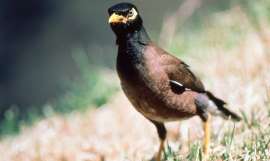
The common myna – popularly known as 'the cane-toad of the air' – has been convicted on new evidence it is pushing Australian native birds out of their home range.
Debate has raged for more than a decade about the damage caused by swelling myna populations, both in Australia and other countries around the world, leading the pesky bird to be rated No. 3 on the IUCN's list of the worst invasive species.
Now a team of Australian researchers has come up with what is thought to be the world's first clear proof that mynas do indeed have a negative impact on native bird numbers.
In a long running study, Kate Grarock and her colleagues of the ARC Centre of Excellence for Environmental Decisions (CEED) and Australian National University investigated 20 birds species round the national capital, Canberra, analysing ornithological records of bird abundance collected by the Canberra Ornithologists Group (COG).
COG established the Canberra Garden Bird Survey (GBS) in 1981 in which volunteers surveyed birds in and around the city. Observers survey an area of 3.1 hectares every fortnight for a 120-minute period. A total of 74 492 surveys was undertaken in Canberra over 29 years
"We found a negative relationship between the establishment of the Common Myna and the long-term abundance of three Australian cavity-nesting species and eight small bird species," Ms Grarock says.
The birds most affected by mynas were cavity nesters like the Sulphur-crested Cockatoo, Crimson Rosella, Laughing Kookaburra, and small birds such as the Superb Fairy-Wren, Striated Pardalote, Rufous Whistler, Willie Wagtail, Grey Fantail, Magpie-lark, House Sparrow, Silvereye and Common Blackbird. Larger birds like magpies, wattlebirds, galahs, ravens and currawongs appeared unaffected.
"To the best of our knowledge, this finding has never previously been demonstrated at the population level," she adds. "It is particularly difficult to track the impact of an invasive species on native wildlife when it isn't an actual predator, as this can take place subtly and over a long time and can vary season by season," she says. "Also you need to know whether it is the invader that is causing the damage – or whether it is simply due to habitat change, such as cities expanding."
The results confirmed that the impact of the myna was significant on native as well as on other introduced birds – and was not benign, Ms Grarock says.
Mynas were introduced into Australia in 1862, originally to control insect pests at the Melbourne markets. A pair was brought to Canberra in 1968, and the species' numbers began to increase dramatically throughout the ACT from the early 1990s, to become one of the city's commonest birds, prompting public calls for their control.
Similar calls have been voiced in cities around Australia as well as round the world.
"The common myna is considered by the public to be a pariah. In Australia in 2005, the species was voted as the 'most significant pest', 'the pest problem seen to be increasing most' and the top 'pest problem that needs more control'. Community concern about the common myna was greater than for devastating species such as the cane toad, red fox, feral cat and European rabbit," she notes.
However, until now there has been little clear scientific basis for its public reputation.
"Understanding the impact of an introduced species is essential for its effective management," Grarock also says. "If you are going to put a lot of money and effort into a control program, you need to be sure it is worthwhile – and that it is going to work. Controlling mynas may have little benefit if the main cause of native bird decline is urban development."
The research into the impact of the common myna demonstrates the sort of long-term investigation that is necessary to prove an invader is having a negative effect on native or local wildlife, to develop an effective control strategy and to prioritise it among other possible threats to Australian native wildlife, she says.
More information: Grarock K, Tidemann CR, Wood J, Lindenmayer DB (2012) Is It Benign or Is It a Pariah? Empirical Evidence for the Impact of the Common Myna (Acridotheres tristis) on Australian Birds. PLoS ONE 7(7): e40622. doi:10.1371/journal.pone.0040622
Journal information: PLoS ONE
Provided by ARC CoE for Environmental Decisions


