Gateway enzyme for chemicals from catnip to cancer drug
Nov 21, 2012
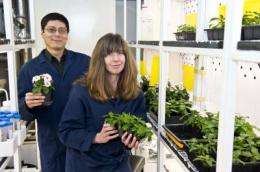
Dr Fernando Geu-Flores and Dr Sarah O'Connor in a controlled environment room with periwinkle plants. Credit: John Innes Centre

Scientists have discovered an enzyme used in nature to make powerful chemicals from catnip to a cancer drug, vinblastine. The discovery opens up the prospect of producing these chemicals cheaply and efficiently.

They are produced naturally by some plants such as the medicinal Madagascar periwinkle, but faster-growing plants could be used to produce them. With synthetic biology, improvements could also be made to them.

The study, to be published in Nature on Thursday, was led by scientists from the John Innes Centre, an institute on Norwich Research Park strategically funded by BBSRC.

"Thousands of chemicals are derived from the enzyme we have called iridoid synthase," says senior author Dr Sarah O'Connor from the JIC and the University of .

"We can start to use it to come up with new-to-nature structures with of benefit to both medicine and agriculture."

Many , often important , produce chemicals that are identical to or that closely resemble the iridoid synthase product. Strategic use of these iridoid chemicals could be used to disrupt the aphids' breeding cycle or to repel them from crops.

The anticancer ingredient sulphate is currently derived from the Madagascar periwinkle plant. The iridoid synthase is an essential step in the production of this compound. But vinblastine is produced in just very low levels and the drug has many side effects. The hope is to find a way to produce it more cheaply, easily and with a that lessens side effects.

"We need to identify more enzymes to see the entire pathway used in nature to make this potent compound," said Dr O'Connor.

"But the enzyme we have discovered is also the basic for many other iridoid chemicals and we can start to experiment with building new chemical structures with biological activity."

The backbone of all iridoids consists of two fused rings and scientists have been trying to track down what makes this ring system. Experiments showed that iridoid synthase is the enzyme responsible.

Scientists already knew the enzyme preceeding iridoid synthase and how the gene encoding it is expressed. The lead author, Dr Fernando Geu-Flores from JIC, therefore looked for enzymes that are encoded by genes expressed in a similar way and narrowed down their search to 20 enzymes.

Research published in the 1980s indicated that the missing enzyme is dependent on a particular compound called NADPH, which narrowed the search down to two enzymes.

O'Connor and her co-workers will also investigate whether the enzyme is important in a simple chemical reaction used by chemists for nearly 100 years. Scientists are trying to identify which enzymes catalyse a reaction called the Diels-Alder reaction, named after the Nobel prize-winning scientists who discovered it. A better understanding of how the iridoid synthase works could open up new ways to make pharmaceutical compounds using synthetic biology.

Explore further: Remarkable enzyme points the way to reducing nitric acid use in industry

More information: An alternative route to cyclic terpenes by reductive cyclization in iridoid biosynthesis. Nature, dx.doi.org/10.1038/nature11692

Related Stories

Chemists engineer plants to produce new compounds

Jan 19, 2009

(PhysOrg.com) -- In work that could expand the frontiers of genetic engineering, MIT chemists have, for the first time, genetically altered a plant to produce entirely new compounds, some of which could be ...

Periwinkle can serve as tiny chemical plant

Nov 16, 2006

MIT researchers have discovered a way to manipulate the chemistry taking place in the tiny periwinkle plant to produce novel compounds that could have pharmacological benefits.

Vitamin B1 biosynthesis: Think Rubik's cube

Nov 20, 2008

(PhysOrg.com) -- A key enzyme in the biosynthesis of vitamin B1 has somehow evolved the ability to perform a complex series of some 15 to 20 steps, report two Cornell chemists.

Recommended for you

Attacking MRSA with metals from antibacterial clays

May 17, 2013

In the race to protect society from infectious microbes, the bugs are outrunning us. The need for new therapeutic agents is acute, given the emergence of novel pathogens as well as old foes bearing heightened antibiotic resistance.

Keeping fruit, vegetables and cut flowers fresh longer

May 15, 2013

New technology offers the promise of reducing billions of dollars of losses that occur each year from the silent, invisible killer of fruits, vegetables and cut flowers—a gas whose effects are familiar to everyone who has ...

Why don't beetles freeze in the winter?

May 14, 2013

For 37 years, Queen's University Biochemistry professor Peter Davies has been unraveling the mystery of why some organisms including insects and fish don't freeze in the winter. His research into insect antifreeze protein ...

The molecular basis of strawberry aroma

May 13, 2013

You know that summer is here when juicy red strawberries start to appear on the shelves. In Germany, this seasonal fruit has never been more popular: on average 3.5 kilos per head were consumed in 2012—a ...

A new dimension for 3-D protein structures

May 13, 2013

(Phys.org) —3D structures of biological molecules like proteins directly affect the way they behave in our bodies. EPFL scientists have developed a new infrared-UV laser method to more accurately determine ...

User comments : 0

More news stories

Attacking MRSA with metals from antibacterial clays

In the race to protect society from infectious microbes, the bugs are outrunning us. The need for new therapeutic agents is acute, given the emergence of novel pathogens as well as old foes bearing heightened antibiotic resistance.

Beautiful 'flowers' self-assemble in a beaker

By simply manipulating chemical gradients in a beaker of fluid, materials scientists at Harvard have found that they can control the growth behavior of crystals to create precisely tailored structures—such ...

Heat-related deaths in Manhattan projected to rise

Residents of Manhattan will not just sweat harder from rising temperatures in the future, says a new study; many may die. Researchers say deaths linked to warming climate may rise some 20 percent by the 2020s, ...

Kinks and curves at the nanoscale

One of the basic principles of nanotechnology is that when you make things extremely small—one nanometer is about five atoms wide, 100,000 times smaller than the diameter of a human hair—they are going ...