Researchers gain new insights into the behaviour of the coconut crab Birgus latro
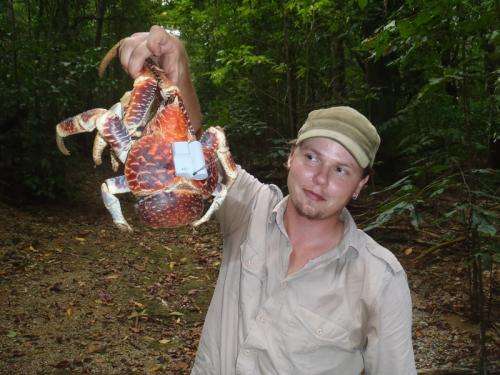
(Phys.org)—Researchers from Jena and Greifswald used GPS satellites for a long-term behavioural monitoring of land crab migration on Christmas Island. In cooperation with colleagues from the Zoological Institute at the University of Greifswald, scientists from the Max Planck Institute for Chemical Ecology in Jena, Germany, used a GPS-based telemetric system to analyze movements of freely roaming robber crabs, which is the first large-scale study of any arthropod using GPS technology to monitor behaviour.
This analysis focused on the coconut crab Birgus latro, a terrestrial crustacean living on tropical islands in the Indo-Pacific. Weighing up to 4 kg, Birgus latro, also called the giant robber crab, is the world's largest land-living arthropod. Its lifespan can reach 60 years. The study was carried out on Christmas Island in the Indian Ocean which has a largely undisturbed population of about several hundreds of thousands coconut crabs.
Between 2008 and 2011, 55 male robber crabs were equipped with GPS tags which successfully recorded more than 1,500 crab days of activity and followed some individual animals for as long as three months. Besides site fidelity with short-distance excursions, the data revealed long-distance movements between the coast and the inland rainforest. These movements are likely related to mating, saltwater drinking and foraging.
The tracking patterns indicate path following as a main navigation strategy. Furthermore, translocation experiments showed that robber crabs are capable of homing over large distances. The search behaviour induced in these experiments suggests path integration to be another important navigation strategy.
The GPS tags were custom-made by e-obs GmbH (digital telemetry) in Munich in a limited-lot production. The devices can be programmed in such a way that they record GPS positions at intervals of one hour over a period of several months. The tag also contains an accelerometer to record movements in different (x, y, or z) directions and thus the activity of the crabs. Recorded data were downloaded by the scientists once a week via a radio link within a range of about 200 meters, so that the crabs were not disturbed. The devices send out radio impulses (pingers) in order to enable localization of the crabs via wireless connection using a high-sensitivity directional antenna. Similar devices were recently used in a study to monitor bird migration. The development of further miniaturized electronic devices and batteries should help to establish this method successfully for the study of even smaller animal species in the future.
More information: Grandy, K. et al., Giant robber crabs monitored from space: GPS-based telemetric studies on Christmas Island (Indian Ocean). PLoS ONE 7(11): e49809. doi:10.1371/journal.pone.0049809
Journal information: PLoS ONE
Provided by Max Planck Society


