Europe juggles ambitions, constraints in talks on space
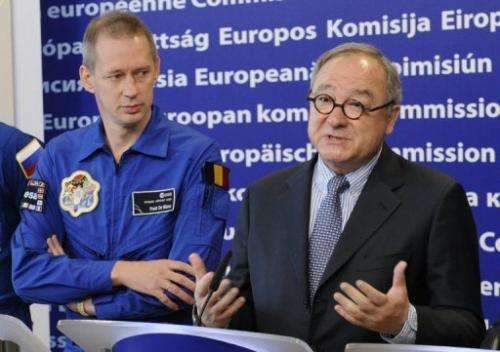
Europe faces key decisions this week about its role in space, pondering plans for a new rocket and its involvement in the International Space Station at a time of money crunch.
Meeting in Naples on Tuesday and Wednesday, science ministers from the European Space Agency's 20 member states will be asked to set a multi-year programme with billions of euros at stake for the highly successful space industry.
It will be the first top-level meeting by ESA in four years, a period whose achievements included the launch of the first satellites in Europe's rival to the US Global Positioning System (GPS).
But 2008 also marked the start of the financial crisis which now drags on many European economies, forcing governments almost everywhere to count the pennies.
In an interview with AFP, ESA Director General Jean-Jacques Dordain said he was hoping members would back a three-year budget of 12 billion euros ($15 billion) but would be happy with "something around 10 billion euros."
If so, it would mean a roughly stable budget compared with current levels, "but given the current situation, this is not small beer", he said.
Topping the bill is a successor to ESA's Ariane 5 heavy lifter, providing a rocket with nimbler launch options for the fast-changing satellite market.
Rival schemes are being pushed by France and Germany, which with Italy are the big hitters in ESA.
France is lobbying for an Ariane 6, which would require some four billion euros and lead—if all goes well—to a maiden flight in 2021.
"We have to aim for an ultra-reliable, ultra-cheap launcher which does not need 120 million euros in subsidies each year," said Bruno Sido, a senator who heads a science and technology panel in France's upper house of parliament.
Germany wants a less ambitious option, an Ariane 5 ME (for "Midlife Evolution"), that would be readier sooner at a putative cost of two billion euros.
"There's a lot of things on the table," David Williams, head of the UK Space Agency, told AFP in a phone interview.
"There will be a lot of backroom discussions and dealings. The bottom line is that everyone wants to go there and find success, but it's only when you are in the room together that the issues have to be addressed."
Weighing on many minds is not just belt-tightening but also the rise of the US private sector from sub-contractor to lead player.
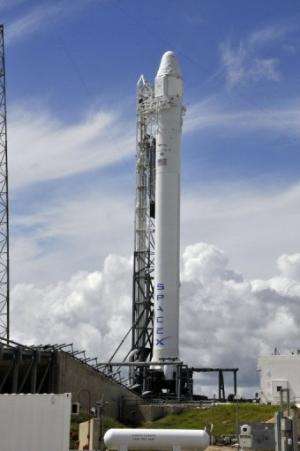
Last month, the US firm SpaceX sent an unmanned freighter, Dragon, to the ISS, vindicating NASA's initiative to delegate resupply missions to private corporations.
After delivering 450 kilograms (1,000 pounds) of cargo, the Dragon splashed down in the Pacific, bringing back 758 kilos (1,670 pounds) of experiments and hardware.
NASA also has a $1.9-billion resupply contract for the station with Orbital Sciences Corporation, which will run its first test flight in the next few months at a base in Virginia.
These developments are eyed with some concern in Europe, which must decide whether—and how—to extend its involvement in the ISS beyond 2015.
Right now, its major contribution to the ISS is a robot freighter called the Automated Transfer Vehicle (ATV).
It is a Rolls-Royce of a beast, offering fly-by-starlight navigation and self-docking and a far bigger (20-tonne) payload than Falcon.
But it is also many times more expensive and does only a one-way trip, because it is sent on a suicide plunge, burning up in the atmosphere after use.
Dordain said Europe had no doubts about continuing in the US-led project despite its many cost overruns and delays.
"There is a value in the space station and a value in our partnership," said Dordain. "ESA must remain a partner."
One idea being mooted is to use the ATV's impressive avionics and propulsion for Orion, a capsule that NASA plans as the successor to the space shuttle.
This would be Europe's major contribution to the ISS from 2015 to 2020 under a barter agreement.
(c) 2012 AFP


