EDRS space network ready to go ahead
Nov 26, 2012
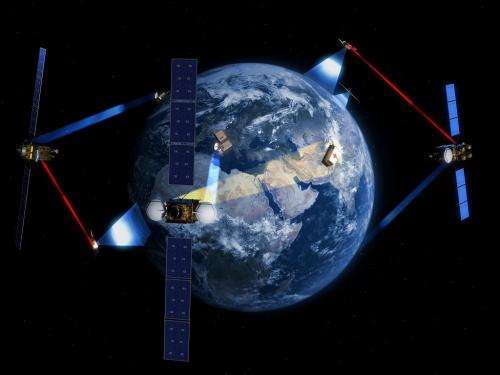
Artist impression of European Data Relay Satellite (EDRS) system. Credit: ESA

(Phys.org)—The design of Europe's data relay satellite system – EDRS - has been completed and approved. This marks the moment when it moves ahead with a green light from its first customer, the Global Monitoring for Environment and Security initiative from the European Union (GMES).
 
EDRS will provide a telecommunications network that is fast, reliable and seamless, making real-time information from satellites available on demand.
EDRS will be the first commercially operated data relay system to deliver services to the Earth observation community.

It is being built through a Public–Private Partnership (PPP) between ESA and Astrium Services, using carried by two satellites in geostationary , hovering 36 000 km above the Equator, where their speed matches Earth's rotation.

Data transmitted from satellites in lower orbits to either of these EDRS payloads can then be relayed to the ground.

The payload includes a laser terminal developed by TESAT of Germany to transmit up to 1.8 per second over distances in excess of 40 000 km, between the lower satellites and EDRS in geostationary orbit.

A design review board of senior members from ESA, Astrium and the DLR German Aerospace Center approved the entire system design: from the satellites to the support that will be required from the ground.

The industrial organisation is fully in place with all subcontracts negotiated and ESA's partner Astrium Services ready to begin production.

"EDRS is a fantastic breakthrough for Europe, from the innovative laser communication terminal technology, which is the heart of EDRS, to the provision of operational services by 2014 through a PPP that combines the best from European space companies with the national and European space institutions," says Magali Vaissiere, director of ESA's Telecommunications and Integrated Applications Directorate.

The first of the two EDRS payloads will be carried on the Eutelsat-EB9B satellite, starting operation in 2014, built by and positioned at 9°E over the Equator.

The second satellite, planned for launch in 2016, will carry the second EDRS payload as well as the Hylas-3 payload from the UK's Avanti Communications. This will be built by Germany's OHB using the SmallGEO platform, currently under development by OHB under ESA contract.  

Explore further: Preparing for Galileo's next launch

add to favorites email to friend print save as pdf

Related Stories

Hylas gets green light for spaceport trip

Sep 29, 2010

(PhysOrg.com) -- Following extensive testing in India, the Hylas-1 telecommunication satellite has been given the go-ahead for shipping to Europe?s Spaceport in French Guiana for its November flight.

Preparing for Galileo's next launch

Sep 11, 2012

(Phys.org)—After arriving at the launch site last month, the second pair of Galileo navigation satellites is being prepared for launch from Europe's Spaceport in October. 

Hylas-1 in orbit brings Europe broadband from space

Nov 29, 2010

A flawless launch has delivered Hylas-1, ESA’s first public–private partnership in a full satellite system, into space. The satellite was released today into its transfer orbit after a textbook launch ...

Hylas payload shipped to India

Nov 06, 2009

(PhysOrg.com) -- Hylas, a flexible, broadband Ka-band satellite, is steadily moving towards completion. The communications payload has been shipped from England to India for integration with the platform, ...

Hylas-1 ready for service

Mar 25, 2011

It’s all systems go for Hylas-1, the first satellite created specifically to deliver broadband access to European consumers. Since its launch in November, Hylas has performed well throughout its testing ...

Recommended for you

Mars rover Opportunity examines clay clues in rock

May 18, 2013

(Phys.org) —NASA's senior Mars rover, Opportunity, is driving to a new study area after a dramatic finish to 20 months on "Cape York" with examination of a rock intensely altered by water.

NASA's STEREO detects a CME from the sun

May 17, 2013

On 5:24 a.m. EDT on May 17, 2013, the sun erupted with an Earth-directed coronal mass ejection or CME, a solar phenomenon that can send billions of tons of solar particles into space that can reach Earth ...

Nine-year-old Mars rover passes 40-year-old record

May 17, 2013

While Apollo 17 astronauts Eugene Cernan and Harrison Schmitt visited Earth's moon for three days in December 1972, they drove their mission's Lunar Roving Vehicle 19.3 nautical miles (22.210 statute miles ...

Bright explosion on the Moon

May 17, 2013

For the past 8 years, NASA astronomers have been monitoring the Moon for signs of explosions caused by meteoroids hitting the lunar surface. "Lunar meteor showers" have turned out to be more common than anyone ...

User comments : 0

More news stories

Galaxy's Ring of Fire

Johnny Cash may have preferred this galaxy's burning ring of fire to the one he sang about falling into in his popular song. The "starburst ring" seen at center in red and yellow hues is not the product of ...