Calif debuts landmark program to cap emissions
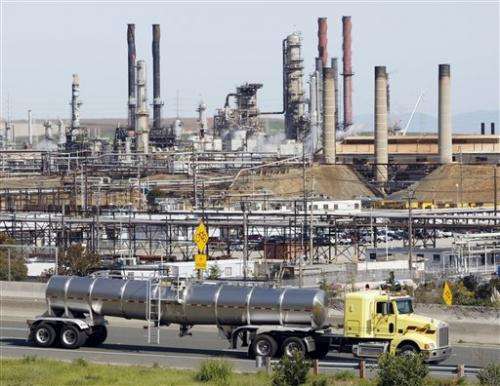
(AP)—California began auctioning permits Wednesday for greenhouse gas emissions, launching one of the world's most ambitious efforts to cut heat-trapping gases from industrial sources.
The California Air Resources Board said it began selling the pollution "allowances" in a closed, online auction expected to create the world's second-largest marketplace for carbon emissions.
Under the program, the state sets a limit, or cap, on emissions from individual polluters. Businesses are required to either cut emissions to cap levels or buy allowances through the auction from other companies for each extra ton of pollution discharged annually.
The board said the results of the auction—what price is paid for a ton of carbon, and how many companies participated—would be released Nov. 19.
The cap-and-trade plan is a central piece of AB32, the state's landmark 2006 global warming regulations.
The auction was being closely watched nationally, as the world's ninth-largest economy institutes a program that has eluded lawmakers in Washington.
Only the European Union has implemented a similar plan in terms of scope, and it currently operates the world's largest carbon marketplace. A much less inclusive cap-and-trade scheme covers only electricity producers in the northeastern United States.
Failure of the California program would be a devastating blow to carbon control efforts nationally, said Severin Borenstein, a professor at the University of California, Berkeley, an expert on energy economics.
"Cap and trade is still probably the most likely way we eventually could get to a national carbon mitigation program," Borenstein said.
For the first two years of the program, large industrial emitters will receive 90 percent of their allowances for free in a soft start meant to give companies time to reduce emissions through new technologies or other means.
The cap, or number of allowances, will decline over time in an effort to reduce greenhouse gas emissions year-by-year.
If a business cuts emissions below its cap, it could profit by selling its extra allowances at a later auction.
Firms can also generate credits by investing in forestry and other projects that remove carbon from the atmosphere. Those credits can satisfy up to 8 percent of a company's mandated emissions reductions
Some businesses targeted by the program have argued the increased costs will drive jobs out of California. Executives also argue it could result in increased emissions by businesses in neighboring states that boost production to grab business.
"Raising costs in California will allow out-of-state firms to lower prices and take market share," said Shelly Sullivan of the AB32 Implementation Group, a business coalition that supports greenhouse gas reductions but opposes the auctioning of allowances.
"As it stands now the auction equates to a tax for these businesses to continue to operate in the state," Sullivan said. "Those costs will be passed through to consumers."
The California Chamber of Commerce has filed a lawsuit challenging the air board's authority to sell the allowances to generate revenue for the state. It claims the sale of allowances is an illegal tax because taxes need a two-thirds vote by the Legislature.
Stanley Young, a board spokesman, said cap-and-trade will withstand legal scrutiny.
"This market-based approach to cutting greenhouse emissions gives businesses the flexibility to best decide how to reduce their emissions," Young said.
The board estimates that about $1 billion could be raised from the sale of allowances in fiscal year 2012-13. About 23 million allowances will be sold for 2013 emissions, and 39.5 million allowances were being pre-sold Wednesday for 2015 emissions.
There is some uncertainty about how the money will be used. California law dictates only that it go into a special greenhouse gas reduction account, and any programs that use the funds be consistent with the goals of AB32.
California officials hope a successful rollout of the cap-and-trade system will embolden other states to follow suit and spur economic growth by strengthening the clean technology business sector.
Not all businesses are opposed to the plan. Mike Mielke of the Silicon Valley Leadership Group—which has 375 members, including tech titans IBM, Apple, and Cisco—said lots of technology firms see opportunity in the new carbon market.
"Cap-and-trade sends a clear market signal with a price on carbon," Mielke said. "A growing portion of our membership is clean technology, and that's a growing sector because of AB32."
Copyright 2012 The Associated Press. All rights reserved. This material may not be published, broadcast, rewritten or redistributed.


